Nola
BeautifulNola is the therapist available to students at TAPs and an important support in Ava Spirini’s effort to live with the death of Kelly Waititi. Her approach is patient rather than prescriptive: she gives Ava control over what to disclose, uses drawing to open a route into difficult subjects, and explains grief as an irregular process rather than a sequence with a deadline. The continuing work does not erase Ava’s loss; it helps her understand that grief and change can coexist.
Role at TAPs
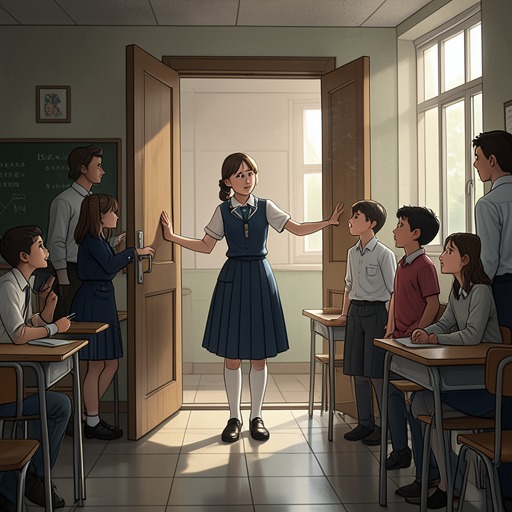
Nola works with students at TAPs, where they can see her if they choose. Minda recommends that Ava make an appointment, presenting therapy as an available source of help rather than something imposed on her. The recommendation matters because Ava is wary of explanations offered by other people and has found that familiar assurances about grief do not fit what she feels. Nola’s first task is therefore not to claim that she already understands Ava, but to make space for Ava to decide what the meeting will contain.
When they meet, Nola explains that Ava is not required to speak or act in any particular way. She does not know Ava or the people in Ava’s life; anything she learns will come from Ava herself. Nola describes her role as helping Ava work out strategies for dealing with feelings she finds difficult. This makes the terms of the relationship explicit: Nola offers professional support, but Ava retains authority over her own account and can disclose as much or as little as she wants.
Conversation Through Drawing
When Ava is unsure about talking, Nola offers drawing as an alternative and suggests putting on music. Ava doubts her own ability, but Nola makes artistic skill irrelevant to the exercise. The drawing gives them a shared subject that is not initially Ava’s personal history. They discuss its colors and lines, including a small feature that is nearly hidden beneath the rest of the image, and the conversation gradually becomes a way for Ava to speak about herself and some of the things that have happened to her.
The method changes the pace of disclosure. Rather than demanding a complete account or treating silence as refusal, Nola follows what Ava is able to discuss in the moment. The drawing acts as a point of attention between them, allowing the conversation to approach painful material indirectly before Ava begins to describe it in her own terms. Nola’s flexibility is consistent with the control she has already promised Ava: the session can proceed through an activity, not only through direct questioning.
Explaining Grief Without a Timetable
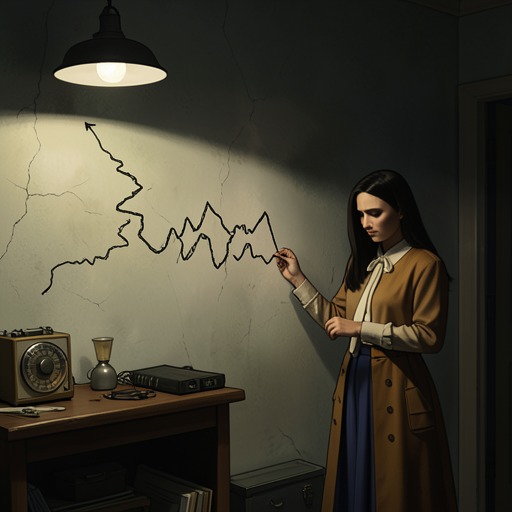
Nola gives Ava a visual model of grief. On a graph, she marks the death as the beginning, identifies one line with time and another with the experience of grief, then fills the page with irregular, squiggling lines. The image rejects a neat upward or downward course. Nola explains that there is no typical path and no way to say exactly when the intensity will ease. The experience may remain difficult, but at some point it may become a little less so; Ava cannot be given a date for that change.
Ava responds with relief. The model does not tell her that she should already feel better, or that her grief is progressing incorrectly. Instead, its disorder gives a shape to the uncertainty she has been living with. Nola’s account acknowledges that the present can continue to hurt while leaving open the possibility of change. Its reassurance lies not in predicting a quick recovery, but in refusing to measure Ava against a universal schedule.
Nola also challenges the idea that Ava must return to the person she was before Kelly died. She explains that people change continually and that part of Ava’s grief concerns the self she was before the loss. Ava is still here, but is not unchanged; the next task is to consider what this changed Ava wants and how she wants to feel. Nola makes that task manageable by directing attention to the coming week rather than requiring Ava to settle every question about her future at once.
Continuing Support and Significance
Nola’s work with Ava continues beyond the first conversations. By the time of the later account, Ava still sees her every fortnight. Nola returns to the box analogy for grief and reminds Ava that there is no right or wrong way to feel. The distinction she emphasizes is between having feelings and making choices in response to them: emotions need not be judged as failures, even though some actions taken under their pressure may cause further trouble.
That continuing perspective lets Ava hold several feelings together rather than treating calm as proof that grief has disappeared. Sadness, hurt, anger, confusion, grief, and love remain present; at times, they are contained in the box or simply do not overwhelm the rest of her. Nola’s significance is thus not that she supplies a cure or a final interpretation of Kelly’s death. She offers Ava a confidential, adaptable setting, practical ways to approach difficult feelings, and permission to change without pretending that loss has been left behind.