Delaware
BelovedDelaware is the northern state where Paul D, after his harrowing escape from the chain gang in Alfred, Georgia, found the longest period of settled life he had known since leaving Sweet Home. It was there, in Wilmington, that he lived with a weaver woman for almost two years, a stretch of domestic stability that contrasted sharply with the years of flight and hiding that preceded and followed it. Yet Delaware also became the place where Paul D first experienced the restless, claustrophobic feeling he later called "house-fits"—a glassy anger that made him want to yell and break something or run off—a pattern that would repeat itself at 124 Bluestone Road and ultimately drive him into the cold house and then out of Sethe's home entirely.
Paul D's Arrival and Life in Delaware
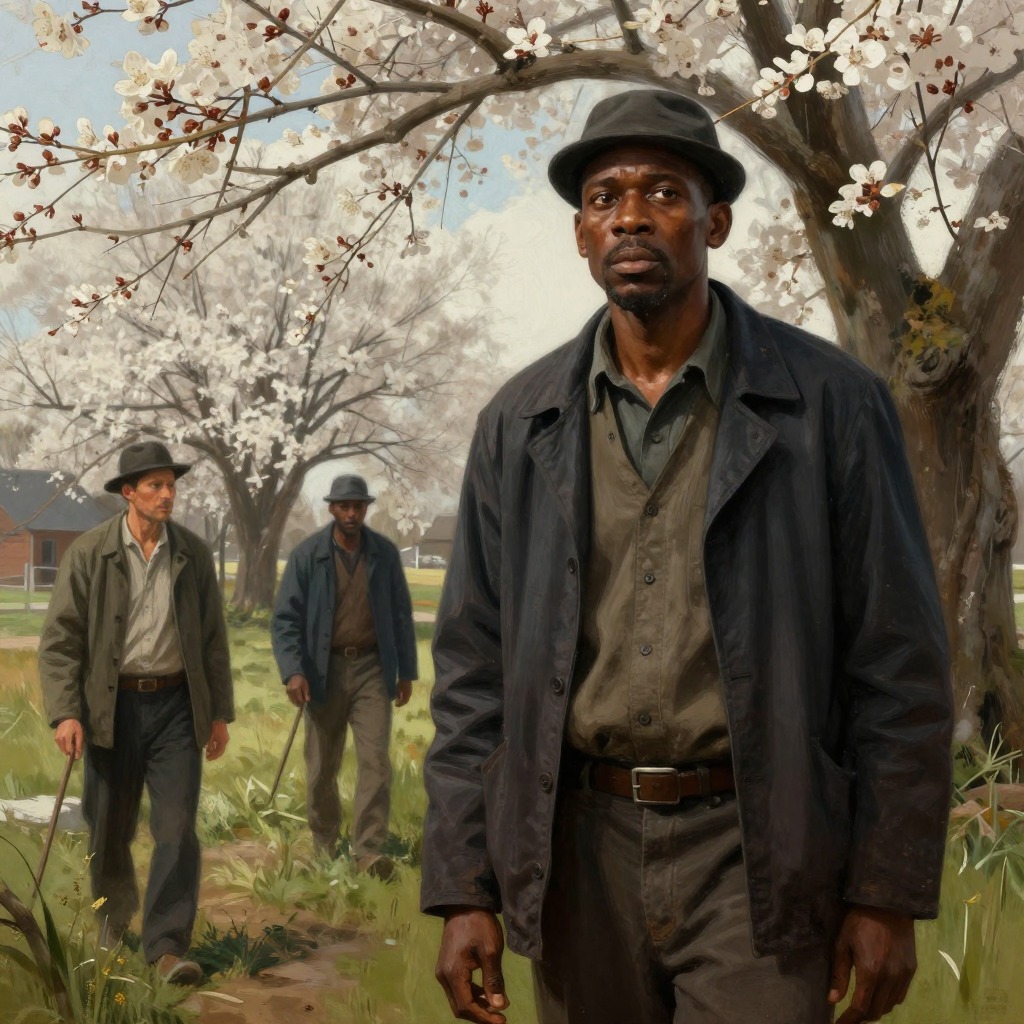
Paul D arrived in Delaware after following the tree flowers north from Georgia, a journey that took him from February to July, racing from dogwood to blossoming peach, then cherry, magnolia, chinaberry, pecan, walnut, and prickly pear, until he reached a field of apple trees whose flowers were just becoming tiny knots of fruit. The apple field turned out to be in Delaware, where the weaver woman lived. She snapped him up as soon as he finished the sausage she fed him, and he crawled into her bed crying. She passed him off as her nephew from Syracuse simply by calling him that nephew's name. For eighteen months he stayed with her, the longest period of settled life he had experienced since his escape from Alfred, Georgia, and the only time he had been able to remain in one spot with a woman or a family for longer than a few months since leaving Sweet Home.
The House-Fits and Restlessness
Despite the stability Delaware offered, Paul D began to experience what he called "house-fits"—the glassy anger men sometimes feel when a woman's house begins to bind them, when they want to yell and break something or at least run off. He associated this nervousness with the woman in the house, and it was in the weaver woman's house in Delaware that he first felt it. This pattern of restlessness would later recur at 124 Bluestone Road, where he found himself unable to sleep in the bed with Sethe, then unable to stay in the rocking chair, then unable to remain in Baby Suggs' bed, and finally driven to the cold house and then out of the house entirely. The house-fits in Delaware were the precursor to the involuntary moving that Beloved later forced upon him at 124.
Delaware as the Meanest Place for Negroes
Paul D considered Delaware "the meanest place for Negroes he had ever seen outside Pulaski County, Kentucky, and of course the prison camp in Georgia." This assessment underscores the paradox of his time there: it was the longest period of settled life he had known, yet it was also a place of profound racial hostility. The weaver woman's willingness to hide him and pass him off as her nephew did not erase the broader danger of the state for a black man. His eventual departure from Delaware was not a voluntary choice but a forced one: he was purchased by the Northpoint Bank and Railroad Company, which took him back into a form of slave labor, first in Delaware itself and then in Alabama, where he worked for the Confederacy sorting the dead and smelting iron. The eighteen months in Delaware thus represent both the closest Paul D came to a settled domestic life and the clearest illustration of how precarious that life was, subject to the whims of white economic power that could reclaim him at any moment.
Narrative Significance
Delaware functions in the novel as a transitional space between the trauma of Alfred, Georgia, and the possibility of a new life with Sethe at 124. It is where Paul D first experienced the domestic stability he would later seek with Sethe, but also where he first encountered the restlessness that would ultimately drive him away from her. The weaver woman's kindness—feeding him, giving him a bed with white cotton sheets, passing him off as her nephew—represents the kind of care that Paul D had rarely received and would later find again in Sethe. Yet the house-fits he experienced there foreshadow his inability to fully settle into any domestic arrangement, a pattern that Beloved would later exploit to drive him out of 124. Delaware thus marks both the beginning of Paul D's post-slavery life and the first sign of the psychological wounds that would prevent him from fully inhabiting that life until his final reconciliation with Sethe.