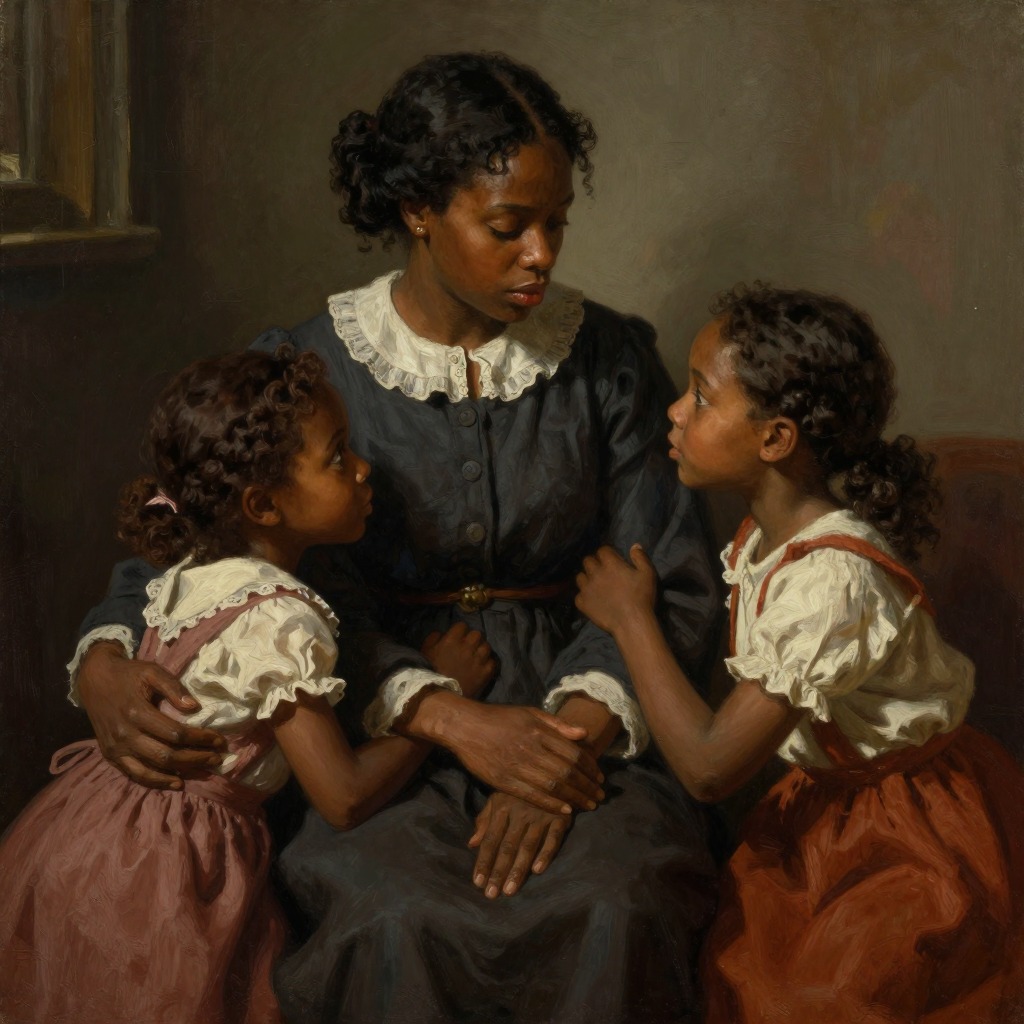
The keeping room
BelovedThe keeping room at 124 Bluestone Road is the most private and emotionally charged space in the novel—a room that serves as sickbed, sanctuary, confessional, and stage for the central dramas of Sethe's haunted life. It is here that Baby Suggs, the family's spiritual matriarch, spends her final years in bed, pondering color; here that Sethe kneels in prayer and later confronts the return of her dead daughter; and here that Beloved, the mysterious young woman who embodies that daughter, is nursed through her illness. More than any other room in the house, the keeping room concentrates the novel's themes of memory, mourning, and the possibility of healing, making it a microcosm of 124's larger history of loss and love.
The Room as Sickbed and Sanctuary
The keeping room is first introduced as Baby Suggs' sickroom. After her grandsons Howard and Buglar flee the house, Baby Suggs lies there, suspended between the nastiness of life and the meanness of the dead, using her remaining energy to ponder color—asking for lavender or pink. Sethe and Denver bring her fabric and other small comforts, and it is in this room that Baby Suggs dies, shortly after the brothers leave. The room later becomes a place of convalescence for Beloved, who collapses on Baby Suggs' bed upon arriving at 124, exhausted and feverish. Denver tends her there, hiding her incontinence and rearranging the quilt with its two orange patches so that Beloved can see the color. The room thus serves as a threshold between life and death, where both the dying and the newly arrived seek rest.
A Place of Prayer and Confrontation
Sethe uses the keeping room as a private space for prayer and reflection. Denver observes her mother kneeling there, and it is in this room that Sethe, after Paul D's arrival, kneels and thinks about the meaning of the word "plans"—the plans Beloved might have, and the temptation to trust and remember. The room's austerity—slate-colored walls, earth-brown floor, a quilt of dark scraps with only two orange squares—mirrors Sethe's own emotional barrenness, and it is here that she confronts the loss of color in her life, remembering the pink chips of her baby's headstone as the last color she truly saw. The keeping room becomes a site of internal struggle, where Sethe wrestles with her past and her desire for a future.
The Stage for Beloved's Return
When Beloved arrives, the keeping room becomes the stage for her gradual reclamation of Sethe's attention. It is here that Beloved, recovering from her mysterious illness, first begins to ask Sethe about her past—about her earrings, her mother, her diamonds—and Sethe, for the first time, finds pleasure in telling her story. The room witnesses the growing bond between them, as Beloved's presence transforms the space from a place of mourning into one of obsessive devotion. Later, as their relationship deteriorates, the keeping room becomes the site of Beloved's demands and Sethe's desperate attempts to explain herself, culminating in the scene where Sethe, broken and diminished, sits in a corner chair while Beloved grows ever larger.
The Room's Narrative Significance
The keeping room is also the room where Baby Suggs, holy, once held her great heart open to the community, before the Misery—Sethe's infanticide—drove her to retreat into it and eventually to die. The room thus encapsulates the novel's central tragedy: the collapse of a once-vibrant home into a space of isolation and grief. Yet it is also the room where Sethe, after Paul D's return, lies in bed, singing a lullaby, and where Paul D finally tells her, "You your best thing," offering a glimmer of redemption. The keeping room, with its layered history of birth, death, and rebirth, stands as the novel's most resonant symbol of the possibility—and the difficulty—of laying down the sword and shield and finding peace.