Gulf Squadron
BlackwaterGulf Squadron is the Tharcian naval force defending the Gulf of Promise during a Union operation designed to mislead and disrupt the defenders. Its actions unfold amid spoofed fleet signatures, interrupted communications, severe equipment and supply constraints, and the evacuation of civilians. The squadron’s experience makes clear that its survival depends not only on firepower, but on how commanders interpret uncertain signals and allocate scarce resources.
Mission and Operational Context
The Union task force redirected toward Promise rather than the Amazon Sea, where the remainder of the 2nd Fleet was to engage the Olympians. Its plan was to disrupt Tharcian intentions toward Phobos and exploit the strategic importance of Promise: the region contained a pilot-training settlement, while food and trade moved through it. The Lusatia, Pommern, and Wojtek clusters were described as part of the Tharcian core in space, giving the operation stakes beyond a single engagement.
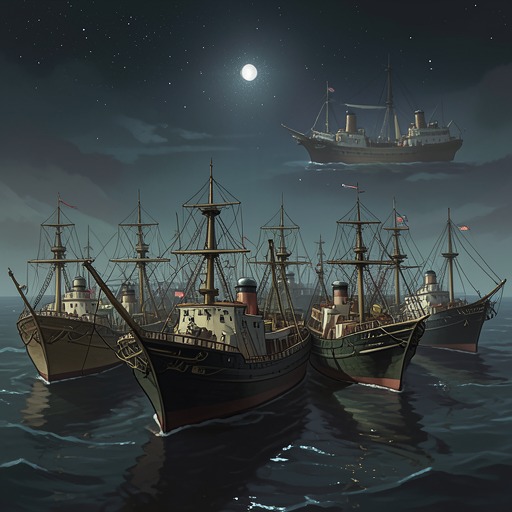
The Union’s five reconnaissance and electronic-warfare cruisers were to make the force appear to be civilian ships fleeing the Amazon Sea. The deception relied on timing: reports from the Lagrange point would reach Deimos after the false impression had been relayed, potentially leading the Tharcians to believe an attack had begun hours earlier and prompting them to protect Deimos prematurely. The Union also concealed larger ships behind lighter vessels’ radar shadows. Its three battlecruisers and two heavy cruisers were hidden in the formation while electronic-warfare systems suggested a much larger screen of smaller ships.
Warning and Readiness
Commander Henri Marcell recognized the danger when a flotilla entered the system presenting itself as civilians fleeing a Union attack. The ships’ formation looked too uniform, and they were not accelerating as fleeing vessels might be expected to. Marcell connected the apparent disguise to the Union’s earlier use of radar shadows at Vespa, where smaller ships had been concealed behind capital ships, and judged the new formation a reversal of that tactic.
He ordered the crew to action stations and sent a warning to Gulf Squadron that the approaching flotilla was likely a Union trick. The warning mattered because the spoofing masked drive signatures and the squadron had no dedicated electronic-warfare assets to counter it. Marcell’s answer was to rely on the Orbit Patrol: if the squadron illuminated the formation with targeting sensors, a single Union ship might fire, exposing the deception. On the tactical display, Gulf Squadron was scattered across the Gulf of Promise but began forming hurried battle formations alongside the Orbit Patrol.
The Blackwater, Marcell’s ship, was powerful for an escort and could field thirty-six Panzerters, making it closer in practice to a fast squadron than a conventional escort carrier. Yet its aircraft and pilots had to be physically collected, and the ship had not received the Panzerters it was meant to take aboard. Although it had obtained spare parts, fuel, and food, the missing aircraft were a serious reduction in available firepower. The distinction between nominal capacity and combat readiness shaped the squadron’s choices from the outset.
Combat Losses and Civilian Evacuation
As the fighting developed, the Blackwater’s point defenses proved capable against incoming missiles, and railgun fire silenced landers and Marine Panzerters left drifting by Ensign Roland Horn. The squadron’s wider position was far worse. The Impervious was destroyed when its missile magazines detonated, and wreckage damaged several smaller ships; the Advantage was soon lost to railgun fire from Union battlecarriers and their Panzerters. Marcell, somewhat removed from the immediate chaos, noticed that communications with larger ships had ceased and that he was not hearing from the smaller ones either. A damaged Orbit Patrol cutter managed only a brief, frantic transmission.
The squadron’s response joined combat action to evacuation. Marcell proposed rallying the survivors and civilians after a scout cruiser was disabled, then hiding them in the shoal zone and sending a tight-beam report to Deimos. The cruiser was identified as the source of interference affecting the forces below, and it had a small flotilla escort. Anna Strauss explained that Marcell intended to assemble whatever forces he could and escort the civilians into the shoal zone once the jamming stopped. Roland understood the refuge as a dangerous option, but also as the available means of protecting the civilians from the Union.
The evacuation placed immediate demands on ships not equipped for a prolonged journey. Civilian vessels had to remain close to a cutter or warship or risk becoming isolated, unable to communicate or see beyond a short range. Many had been boarded hurriedly and packed with civilians and their pets. Marcell ordered an accounting of food and water aboard every civilian and military ship, along with ammunition counts for the warships, wary of allowing point-defense cannons to run out during combat. He faced a direct allocation dilemma: ration his crew to give more to civilians, or maintain their normal food supply so they could continue performing at full capacity. Sustained combat would raise the crew’s caloric needs, especially those of the pilots, whose numbers had recently doubled; reducing supplies to civilians, meanwhile, risked lasting effects on children’s health.
Deception, Constraints, and Continued Resistance
The Union’s disguises and Marcell’s countermeasures form a contest over what each side can make the other believe. Later, Marcell recognized that the enemy was concealing its intentions through a reverse Gray stack maneuver. He ordered the Blackwater to follow the Union formation, told Opera to notify the rest of the squadron, and took several cutters for navigation. He also called for an open-channel broadcast claiming that a large task force from the belt would arrive in the upper shoal zone in five hours after refueling at Deimos. Marcell admitted that he did not know whether a squadron or any ships were actually there: jamming and interference prevented certainty. The Union could nevertheless hear the claim, and he hoped the possibility of reinforcements would make it react to Tharcian moves rather than dictate them.
The squadron’s tactics remained bounded by equipment and ammunition. Rocco Swift reported that an entire salvo had failed because the rounds were duds, raising the possibility of faulty magazines. Elsewhere, while escorting a convoy, he identified its vessels as military transports and judged that they carried something valuable. These moments show that the fight was not decided by plans alone: a malfunctioning salvo could undermine a tactical opportunity, while the nature of a convoy could draw Tharcian aircraft into pursuit.
Marcell also used deployable magnetic mines to broaden the Blackwater’s operational options. Their sensors prevented them from attaching to friendly ships; once attached to an enemy hull, their adjustable explosives formed shaped charges. Clearing them required ships to move slowly and use point defenses manually, leaving those defenses less available against fast missiles. Marcell combined the mines with a missile attack: the Union’s point defenses concentrated on incoming missiles, then slackened as one began releasing mines. The enemy apparently mistook a third missile for another minelayer and conserved fire. That missile then released megathermal warheads into a destroyer, whose drive failed as the ship split apart. The outcome illustrates Marcell’s effort to stack the conditions of an engagement in his favor, using misdirection to make the Union’s own defensive choices open a path for attack.
Gulf Squadron’s story is therefore one of a force trying to remain operational while its information, communications, aircraft, ammunition, and civilian supplies are all under pressure. Its defense depends on improvisation—warning the Orbit Patrol, gathering survivors, protecting evacuees, and making the enemy respond to uncertain signals—rather than on an uncontested advantage in numbers or readiness.