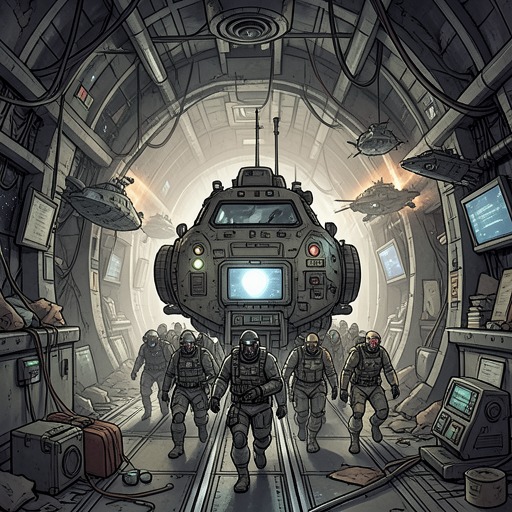
Grain & Steel Combat Air Wing 4th Squadron
BlackwaterGrain & Steel Combat Air Wing 第 4 中隊 is assigned to attack the Tharcian heavy cruisers in the Gulf of Promise, the largest dedicated warships in the sector and the chief threat to the Union battlecarriers. Its assault on the I-Class cruiser Impervious turns that assignment into a test of timing and coordination: the squadron must get close enough to suppress the ship’s defenses while another flight plants harpoons capable of destroying it from within.
Mission and targets
The squadron’s objective is set during a taskforce briefing. Four Tharcian heavy cruisers are identified as the most dangerous dedicated warships in the area, with Impervious singled out as the priority target. Its missile bays could prove fatal to lighter Union ships if the cruiser passed behind the screening vessels. The deputy CAG warns that losing three cruisers, or allowing the screens to fall below half strength, would count as mission failure and force a retreat.
The other heavy cruisers are designated secondary targets in order of precedence. The plan depends on striking before the enemy is ready, while the Union taskforce uses electronic warfare to disguise its size and intentions. Five reconnaissance and electronic-warfare cruisers are to spoof the taskforce as a civilian flotilla fleeing the Amazon Sea; delayed and manipulated reports are intended to make the Tharcian command believe an attack began hours earlier than it did. A separate deception hides the larger warships behind the radar profile of light cruisers and smaller vessels, making the formation appear to contain more small ships than it actually does. The squadron’s attack therefore forms part of a larger attempt to make the enemy misread both the force’s composition and the timing of the threat.
Organization and coordination
During the briefing, the deputy CAG assigns Rocco to escort the squadron, while the broader launch plan sends Panzerters out once the taskforce reaches action stations. Rocco later proposes splitting into flights to attack Impervious and two A-Class cruisers, then reforming as squadrons to attack a Pulaski-class ship. The plan emphasizes flexible groupings: aircraft can concentrate on separate targets, then regroup for the next stage rather than remain committed to a single formation throughout.
In combat, Rocco leads his squadron in a corkscrew search around the bow of the G&S. The Panzerters form into triangles of three, with a flight leader or assistant flight leader at each point. After one rotation around the ship, they emerge above 4th Squadron. The formation and the search pattern give the pilots a way to find and join the other group amid a battle already in motion, where identifying the right flight is a practical prerequisite for coordinated action.
Assault on Impervious
The torpedo flight must approach at a right angle to the cruiser’s hull. The vacuum-bomb warhead needs that perpendicular impact to achieve its intended explosive force, but the straight approach also gives point defenses a relatively stable target because the attacking craft’s silhouette changes little. The tactics place the pilots in a narrow bind: the attack geometry necessary for the weapon also makes the run easier to track and intercept.
The operation’s logic treats Tuber pilots as unusually suited to that danger. Engineered for superior reflexes and instincts, and trained throughout their lives, they are expected to evade defensive fire while still holding the course and speed needed to deliver torpedoes. The grim premise is that replaceable pilots can be grown again if they die, while an experienced pilot such as Rocco cannot be replaced as easily. The narrative makes the human cost of the attack plan explicit even as it explains its tactical rationale.
When Wheeler’s flight changes to harpoons, Rocco recognizes the danger and moves to draw fire away from the attacking pilots. He brings his flight close along Impervious’s hull, shooting at its point-defense cannons as the Panzerters corkscrew around the ship. The cruiser’s defenses prove unexpectedly dense; one aircraft from Rocco and Irons’s wingman crashes in flames against the hull. That loss does not stop the diversion. Rocco spots Wheeler’s flight beginning its attack while his own pilots continue to engage the defenses.
The harpoons are rods that extend into spears tipped with superheated plasma. Their points pierce the armor, after which the hull’s composite layers seal around the breach. The weapon exploits that sealing process: each rod releases grapefruit-sized cluster bomblets inside the vessel, where they scatter before detonating. Once the harpoons strike, the explosions spread through Impervious’s forward section, its drive flickers out, and micro-explosions ravage engineering. The decisive damage comes when the bomblets reach the missile bay; the cruiser splits in two as superheated gas and atmosphere escape into space.
Significance
The attack joins distinct roles in one coordinated strike: Wheeler’s flight delivers the harpoons, while Rocco’s flight exposes itself to point-defense fire to create an opening. The mission’s success depends not on a straightforward exchange of fire but on deception, formation discipline, and accepting risk at close range. The contrast between the precise plan and the violent result is central to the squadron’s depiction: a carefully engineered method still costs an aircraft, and the weapon that defeats the cruiser works by turning its own sealed armor into a trap for the munitions released inside it.