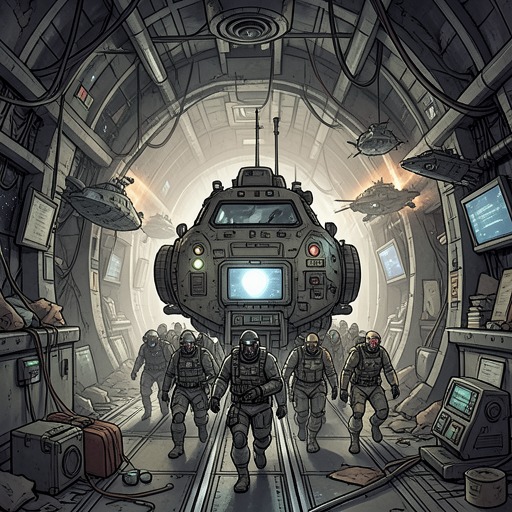
Grain & Steel Combat Air Wing 2nd Squadron
BlackwaterThe 2nd Squadron of the Grain & Steel Combat Air Wing, also known as Graveyard Squadron, is a fighter unit aboard the PFSS Grain & Steel, commanded by Rocco Swift. Its appearances connect frontline operations to the conditions that make those operations possible: launch coordination, machine maintenance, reliable ammunition, and the squadron’s capacity to work alongside other forces. Rocco’s claim that the unit leads in assists also gives its reputation a pointed edge: he attributes the gap between him and ace status to a colleague taking his kills.
Identity and Command
The squadron is one of five commanded units represented at a briefing aboard the PFSS Grain & Steel. Rocco sits with the other commanders while the combat air wing commander and deputy prepare to brief them; the ship’s political officer is also present. The setting places the unit within a larger air-wing structure rather than as an independent force, with its commander participating in shipboard planning and coordinating with other squadrons.
Rocco’s own account of the unit’s performance blends boast and complaint. He says it leads the Graveyard Squadron in assists and argues that, without another pilot taking his kills, he would also be an ace. The remark presents the squadron as operating through shared combat outcomes, while showing how individual recognition can be contested even among pilots who depend on one another.
Launch and Combat Operations
During a deployment, Altman calls for the 2nd Squadron to check in over the net. Rocco answers as Green Leader, using the minute required for the squadron to launch to assess the situation through his panoramic cockpit. A Tharcian destroyer lies ahead, already bearing railgun damage from the battlecarrier, with smaller wrecked ships nearby. The squadron’s launch is therefore not a ceremonial departure: it moves its pilots into an active battlespace already marked by recent fighting.
Rocco also describes a plan that divides the attacking force into coordinated flights. He proposes splitting against the Impervious and two A-Class ships, then reforming into their squadrons to attack the Pulaski-class vessel. The commanders take an express elevator to brief their squadrons together, and Rocco messages Irons to bring his squadron up while Wheeler summons his team. The sequence shows planning translating directly into personnel coordination, with the attack organized first by target and then by unit.
The squadron’s work can extend well beyond a conventional engagement. At 2200 Colony Time on 2 November 2135, Rocco and Irons lead the 2nd Squadron through a debris field near Island Fredrick in the Lusatia cluster, following astrogation data supplied by Altman. They pass wrecked landing ships and fragments of marine-type Panzerters while searching the area. The wreckage suggests a disastrous operation, but Rocco’s immediate task is to establish what remains and why he has been given an encrypted comm-key.
A wingwoman then identifies a shipping drone among the wreckage. Rocco sees its importance not just as captured matériel but as a source of food and water for people in need; the sight recalls his own childhood as a hungry boy on a distant settlement between Mars and Jupiter. He orders the squadron to investigate a heat source and then take the drone, while admitting that he has not yet worked out how. The unit’s objective thus shifts from searching wreckage to securing a potentially vital supply asset.
Maintenance and Readiness
The squadron’s combat readiness depends on technical work that continues after its pilots return. After a sortie, Rocco guides his Panzerter into a cradle aboard the Grain & Steel. Technicians and maintainers attach fuel lines to its backpack and legs and connect a data cable at the neck. Although the machine has taken hits, redundant systems can keep it operational after damage to an avionics bay or sensor suite; damage to a joint, by contrast, can ground it for about an hour. The scene makes readiness a practical, shared product of resilient equipment and the labor of the crew maintaining it.
That dependence is not abstract. When a technician tells Rocco that the knee joints have had to be replaced again because he is stressing them beyond standard tolerances, he rolls his eyes and points to the Tharcian fire he faces in combat. His response underscores a recurring pressure: a pilot’s actions can exceed a machine’s limits, while the resulting repair burden falls on the maintenance staff responsible for returning it to service.
Ammunition can also fail at the moment it is needed. During combat, Rocco asks Whaler what happened after a salvo fails to make contact; Whaler reports that the entire salvo consisted of dud rounds and suggests the magazines may be bad. Rocco continues fighting, but the report exposes a failure that cannot be solved by piloting skill alone. The squadron’s effective strength depends on the condition of its ammunition as well as its aircraft and pilots.
Coordination, Constraints, and Significance
The squadron operates in a wider force whose resources are unevenly available. Captain Marcell notes that the Blackwater was expected to receive Panzerters but instead took on spare parts, fuel, and food without the machines. Their absence is a serious loss of available firepower, and Marcell hopes a pilot in the colony will prevail. The Blackwater can field thirty-six Panzerters, giving it the scale of a squadron more than a conventional escort carrier, but the machines and their pilots still have to be retrieved. This contrast places fighter strength within a logistical chain: capacity on paper does not become combat power until personnel and equipment can be brought together.
The same material limits shape the forces around the squadron. Marcell orders a fleet-wide accounting of food, water, and military ammunition, warning that point-defense cannons cannot be allowed to run dry in a fight. Civilian ships have been crowded with evacuees and pets and are poorly prepared for a long journey; military crews, meanwhile, face the increased demands of near-constant combat and a recently doubled number of pilots. These details do not establish that Rocco’s squadron alone carries out the fleet’s relief work, but they frame the conditions in which its missions take place: combat readiness and civilian survival compete for supplies.
Across these episodes, the 2nd Squadron is defined less by a single victory than by repeated acts of coordination under constraint. It launches into a battle already in progress, plans attacks with neighboring units, searches wreckage for survivors or useful assets, and returns its machines to maintainers who must diagnose wear and damage. Its designation as a combat unit therefore encompasses a broader system of dependence: pilots can press the attack, but their capacity to do so rests on communication, usable weapons, functioning Panzerters, and the recovery of resources that may matter to an entire population.