Rabo Karabekian's capture in Europe
BluebeardRabo Karabekian’s capture in Europe began with a wound he barely remembers and ended in a landscape crowded with the displaced. Near the end of World War II, while serving as an officer in a camouflage unit, he was wounded and taken prisoner in Luxembourg without firing a shot. His quick recovery, release from the German camp, and return to civilian life did not erase the experience: it resurfaced in his sense of isolation and, decades later, in a mural that made May 8, 1945, a small but legible date among thousands of human stories.
Service and Capture
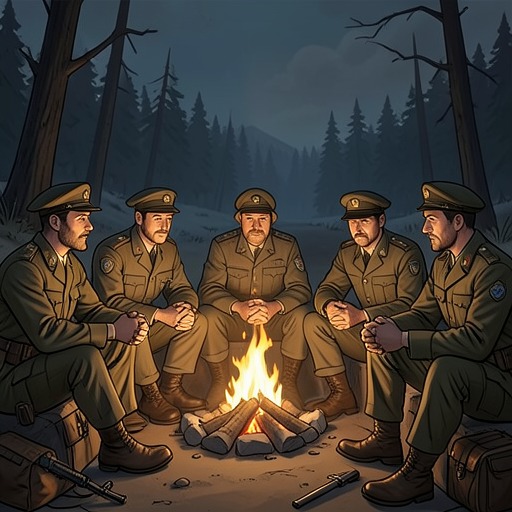
Karabekian’s wartime role grew from the Army’s decision to group artists into a camouflage unit. He commanded a platoon of Army Engineers whose members were artists in civilian life, on the theory that they would be especially capable of creating convincing illusions. The unit’s work was to mislead German forces about what lay behind Allied lines. It was assigned temporarily to different generals rather than attached to a conventional division or corps, and its orders came directly from Supreme Headquarters of the Allied Expeditionary Force.
By the time the war reached its final phase, the camouflage specialists were fighting as ordinary infantry. Karabekian recalled seeing a white German tank and soldiers dressed in white crossing a snow-covered meadow in Luxembourg. He did not remember being struck; his next recollection was the approaching German force. He was unconscious when captured, and morphine kept him unconscious until he awoke in a German military hospital in a church across the border, in Germany. His account emphasizes the gap between the abrupt loss of freedom and the limited pain he remembered: the wound healed quickly, and he was soon sent to a prisoner camp as an unremarkable captive.
Release into a Devastated Landscape
The war in Europe ended on May 8, 1945, but Karabekian’s camp had not yet been captured by the Russians. He and hundreds of other captured officers were marched out into the countryside. Their guards disappeared during the night; the next morning, the prisoners found themselves at the edge of a great green valley near the present-day border between East Germany and Czechoslovakia.
The people below them represented many kinds of captivity and displacement. Karabekian described concentration-camp survivors, former slave laborers, prisoners of war and enlisted men from armies that had fought Germany, as well as people released from prisons and asylums. Civilians who had fled advancing fronts were there too. The remnants of the German forces were also present, still armed but, in his later account, waiting to surrender. The valley was not simply the scene of his release: it was a convergence of people whom the war had driven out of camps, institutions, armies, and homes.
Return and Personal Aftermath
After the war, the United States paid for cosmetic surgery where Karabekian’s left eye had been. He underwent the operation at Fort Benjamin Harrison, outside Indianapolis. He recalled feeling not bitterness but blankness, and compared that emotional state to what he had understood in his former associate Fred Jones. His remark that neither had anything to come home to gives the return a personal cost beyond the injury itself.
Karabekian married the nurse who cared for him at the hospital and had two sons. In his later account, the marriage and family did not become a lasting refuge: he says that his first wife and sons left him in 1956, and that he gave up on himself as a painter. Afterward he sought solitude and lived as a hermit for eight years. Much later, he names his failure as a husband of Dorothy and the estrangement of Henri and Terry as a source of shame. The war capture is not presented as the sole cause of these later losses, but it belongs to the history of a veteran who returned without a secure sense of home.
Memory Made into Art
The episode returns in Karabekian’s conversations with Circe Berman, who questions whether his experience warrants the same name for trauma that he claims for his father’s ordeal. Karabekian insists that he had an ordeal of his own, pointing to the loss of his eye; Circe counters that he had described little pain and a quick recovery. Their exchange distinguishes the bodily injury from the broader meaning of survival without settling the question by the severity of the wound alone.
That distinction becomes visible in Karabekian’s mural, Now It’s the Women’s Turn. He says that, on average, ten clearly drawn World War II survivors occupy each square foot. A magnifying glass reveals not a generalized crowd but prisoners of war, concentration-camp victims, slave laborers, soldiers, local families, and people released from asylums. He made a story for each figure and initially stayed in the barn to tell visitors about them, but the task exhausted him; he eventually invited viewers to make up their own war stories.
In one detail, a figure studies a page from an anti-Semitic weekly published in occupied Riga, while the date May 8, 1945, is written in tiny characters on an ammunition box nearby. Karabekian points out that Circe was only one year old on that date. The mural thus places the end of his captivity inside a much larger, densely populated history: his own memory remains present, but it is neither the only story nor the whole picture.