Hanno Buddenbrook’s typhoid illness and death
BuddenbrooksHanno Buddenbrook’s typhoid illness and death bring the family’s decline to its final personal loss, while the narration turns his illness into a measured, unsettling passage from bodily collapse to an unknowable threshold. The disease is described week by week, medical treatment is shown to be uncertain, and the family’s later silence leaves Hanno’s last hours largely unspoken. Among the few details they can voice is Kai Mölln’s repeated kissing of his hands, a gesture of devotion that survives where explanation fails.
The Course of the Illness
The account first sets out typhoid as a sequence of worsening symptoms. In the incubation period, despondency deepens alongside lassitude, loss of appetite, restless and unrefreshing sleep, headaches, dizziness, aching limbs, and occasional nosebleeds. These signs are difficult to distinguish from an ordinary state of ill health, a difficulty made especially acute when a family’s hopes rest on the patient. In Hanno’s case, the narration stresses how easily an ominous change may appear to be only a worsening of familiar symptoms.
The onset of fever brings a more visible crisis: a shaking chill, a rapid rise in temperature, red spots on the chest and stomach that briefly fade under pressure before returning, and a pulse that may reach one hundred beats a minute. The fever remains around 104 degrees for a week. During the second week, some pains recede as the neurological and physical deterioration intensifies. Dizziness grows; buzzing in the ears may become so severe that the patient cannot hear. The mouth hangs open, the eyes grow dim, and consciousness gives way to stupor interrupted by babbling and excited fantasies. Incontinence, a distended abdomen, a dark coating on the mouth, shallow and laboured breathing, and a fluttering pulse accompany the body’s increasing helplessness. The spots multiply and the temperature reaches 105 degrees.
The third week is described as the moment of crisis. Delirium falls silent, but this quiet gives no reassurance: the patient lies in total apathy, and no outward sign can settle whether the mind has disappeared into darkness or withdrawn into distant dreams. By presenting the stages in this stark progression, the narrative makes the illness both exact in its physical detail and radically uncertain in its outcome.
Medical Care and Uncertainty
The hypothetical account of a competent physician identifies Dr. Langhals as someone able to recognize the disease despite its ambiguous early signs. The characteristic spots provide decisive evidence. He can prescribe practical measures: a spacious, ventilated room kept below sixty-three degrees, cleanliness and frequent changes of position to limit bedsores, cleansing the mouth with damp linen, and a light but nourishing diet. The prescribed medicines include iodine, potassium iodide, quinine, and an antipyretic. To combat the fever, the patient is placed in a bath every three hours, day and night, with cold water gradually added; afterwards he receives a restorative such as cognac or champagne.
Yet procedural confidence is sharply distinguished from knowledge of the outcome. These therapies are presented as attempts made without certainty that they will help. Until the third-week crisis, the physician cannot know whether the disease is a recoverable infection that medical skill can combat or the form taken by an irreversible dissolution. The passage does not claim that treatment causes Hanno’s death or that a particular intervention fails; instead, it emphasizes the limits of what the doctor can know while the illness is still unfolding.
The Threshold Between Life and Death
The narrative renders the crisis as a choice that cannot be observed from outside. In feverish dreams, the patient may hear a clear, cheering voice calling him back toward familiar life. If that call awakens a sense of neglected duties, shame, renewed energy, courage, joy, and love, he may turn back and live. If he recoils from it and reaches instead toward escape, the account says he will die. This formulation gives the illness an inward, almost allegorical dimension without making recovery or death legible to the physician in advance.
That imagined summons makes the boundary between life and death both intimate and opaque. The patient’s return is associated not with abstract strength alone but with renewed attachment to the busy, varied world he has left behind. Conversely, the prospect of death is figured as a withdrawal along a path of escape. The passage offers no report of Hanno’s private perceptions during his fever; its account of the voice describes the possible structure of the crisis, not a confirmed experience of his. Its uncertainty preserves the distance between a general description of typhoid and the inaccessible consciousness of one dying boy.
Family Silence and Kai’s Farewell
The aftermath is shown months later, at an autumn gathering held to say goodbye to Gerda Buddenbrook before she leaves the town for Amsterdam. Hanno has been at rest for six months beneath the family crest and a sandstone cross at the edge of the little woods. Rain moves against the nearly bare trees and windows, and the women gathered in black turn, after a pause, to the subject of his last illness. The change of subject is halting and tactful; as soon as Hanno’s name is spoken, the room falls silent.
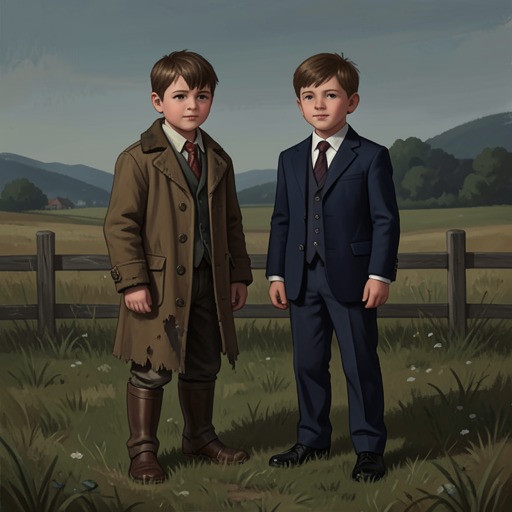
The family does not narrate his final illness directly. They speak in hushed, guarded phrases and avoid looking at one another, as though the memory carries more than they can state openly. The narration calls that silence a sombre secret and describes the illness as horrible beyond description. This reticence is not filled with a detailed deathbed scene. Instead, one last episode emerges from it: the patched and tattered little count, Kai Mölln, came to visit and almost forced his way into the room where Hanno lay ill.
Hanno smiled at Kai’s voice even though he no longer recognized anyone. Kai kissed both of Hanno’s hands again and again. When the women ask whether he really kissed Hanno’s hands, the answer confirms the action through its repetition. The scene is strikingly small beside the extended clinical account, but it gives the family’s recollection a concrete human point: recognition has failed, yet a response to a familiar voice remains, and Kai’s farewell is expressed through touch rather than explanation.
Narrative Function and Ending
The illness’s three-week structure and the six-month interval before the family gathering place bodily crisis and retrospective mourning in different registers. The first is laid out with clinical detail, including temperatures, pulse rates, symptoms, and treatment; the second is marked by rain, mourning clothes, pauses, and evasive speech. This contrast makes the family’s inability to recount Hanno’s last illness part of its meaning. Medical description can enumerate what happens to a body, but it cannot disclose the patient’s inward passage through the crisis or restore him to those who remember him.
Hanno’s death also becomes an absence within the living family. Gerda is preparing to leave, and the others acknowledge that Thomas and Hanno are gone; the gathering is therefore both a farewell to Gerda and a meeting shaped by losses that cannot be repaired. The account ends not with a medical verdict or a final statement from Hanno, but with the remembered repetition of Kai’s kisses. That gesture does not undo death or explain it. It gives the family’s silence a surviving detail of affection, and closes Hanno’s story on the contrast between the body’s helplessness and the care still offered to it.