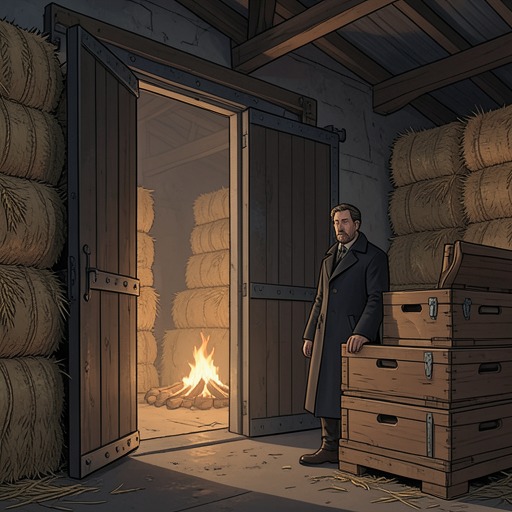
Hail damage to the Pöppenrade harvest
BuddenbrooksThe hail damage to the Pöppenrade harvest turns a risky purchase into a failed investment at the moment Thomas Buddenbrook hopes it will revive his confidence and his firm. A telegram announcing the damage interrupts the centenary celebration, but Thomas’s first response is not the despair the loss might suggest: after absorbing the news in private, he concludes that it is better this way. The reversal exposes how much he had invested in the deal as a test of his own capacity to act, as well as a potential commercial rescue.
The proposed purchase
Thomas has been brooding over his exhaustion and his inability to summon the response he expects of himself. The Pöppenrade opportunity appears to offer a decisive beginning: the entire harvest could be acquired for an investment of about 40,000 marks courant, with the prospect, as he imagines it, of doubling the money. He treats the risk not simply as a matter of profit but as a challenge to his moral scruples and a way to recover his sense of power and good fortune.
The arrangement is unusual because it depends on personal connections. Tony has acted as intermediary, and her friendship with Armgard von Maiboom links Thomas to a hard-pressed landed aristocrat who is selling the harvest. Thomas believes that this personal element makes the transaction a private matter requiring tact, rather than an ordinary deal to be handled by routine business methods. He intends to write on his own stationery, identifying himself as Senator Buddenbrook, and discreetly ask whether a visit would be welcome. He also anticipates that the purchase might give his firm an advantage over Strunck & Hagenström, and imagines that his business judgment could later guide a profitable resale.
His preparations reveal the emotional stakes beneath the calculations. Thomas repeatedly revisits the matter, thinks about Herr Marcus, Hermann Hagenström, Christian, and Tony, and pictures the ripe harvest as he considers how the deal might restore the firm’s fortunes. He pushes aside his scruples and insists that he will proceed. The resolve is a bid to recover initiative as much as a commercial decision.
The telegram at the celebration
The news arrives at a quarter after twelve while the municipal-theatre orchestra’s program is nearing its end at the Buddenbrook firm’s centenary celebration. A young office apprentice brings Thomas a folded telegram through the crowd. Custom requires that telegrams received during business hours be delivered immediately, even during festivities; the business routine therefore enters the celebration without ceremony.
Thomas steps away from Kistenmaker, Gieseke, and Voigt and reads the message in a corridor beside the grand hall. The narration specifies the setting—the stairs, the dumbwaiter shaft, and a table used for polishing silver—before registering his response. His eyes widen; he gasps so sharply that his throat dries and he coughs. He tells the apprentice that will do, but his words are almost inaudible over the guests’ conversation. The apprentice leaves, while Thomas remains alone with the unfolded telegram.
He stands beside the table with his hands hanging slack, struggling to breathe evenly and rocking his head. He repeats that it was only a little hail. The brief phrase reduces the event to a small natural cause, even as his physical response registers the magnitude of the financial and personal blow. When his breathing steadies, he turns away and enters the grand hall, moving slowly to a sofa by the window.
Relief and reversal
Away from the guests, Thomas closes his eyes and tells himself that it is better this way. He repeats the thought, then settles on the conclusion that it really is better. After five minutes, his body relaxes and his expression becomes peaceful. He folds the telegram, puts it in his breast pocket, and rises to return to the celebration.
The apparent recovery does not restore his willingness to take part in the festivities. As the music starts again, he sinks back onto the sofa, recoiling from the performance. The telegram has ended the imagined business coup, but it has also released him from the strain of believing that the deal must prove his courage and revive his fortunes. His relief does not amount to a practical recovery for the firm; it is a private response to the collapse of an enterprise he had loaded with hopes of self-renewal.
Business risk and the family firm
The episode belongs to a longer history of financial pressure. Thomas had previously explained to his wife that the family’s resources were far from unlimited: after inherited wealth, dowries, business arrangements, property purchases, compensation payments, and estate distributions, he estimated the remaining funds at roughly 420,000 marks courant, in addition to her dowry. He also stressed that business had recently declined while the firm’s expenses could not readily be reduced. The proposed harvest purchase thus takes place against a background of constrained capital, not secure abundance.
The firm’s exposure to credit and reputation is also made explicit in an earlier confrontation over Grünlich’s financial weakness. Kesselmeyer argues that the firm’s losses in a Bremen bankruptcy and its uncertain condition have contributed to a wider loss of confidence, which in turn affects Grünlich’s credit. That episode establishes the interdependence of firms’ reputations and borrowing prospects in the town. Against this background, Thomas’s hope that a successful transaction could restore the firm’s fortunes is not merely a wish for a windfall; it is an attempt to counter a broader atmosphere of commercial vulnerability.
After Thomas’s death, his will requires the firm to be liquidated and dissolved within a year. Kistenmaker and Marcus oversee the process, but contracts are sold too quickly and on disadvantageous terms, warehouses and stored grain are disposed of at a loss, and further losses accumulate through haste and delay. Thomas’s estate, valued on paper at 650,000 marks, proves to be worth far less in the course of liquidation. The later losses do not establish that the hail-damaged harvest alone determined the firm’s fate; rather, the episode foreshadows the vulnerability of a business whose capital, reputation, and future have become difficult to secure. The interrupted celebration makes that vulnerability visible at the very moment the family is publicly honoring the firm’s past.