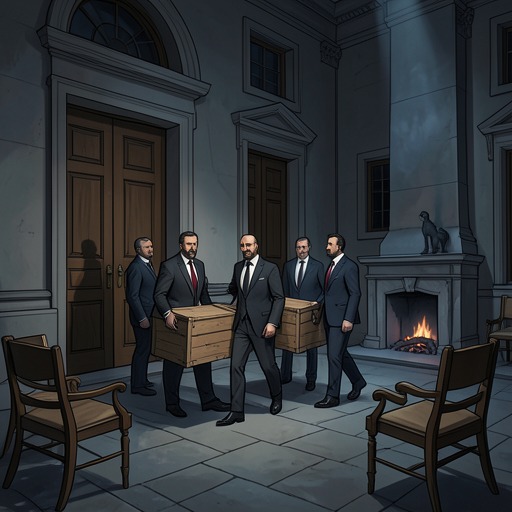
Clara Tiburtius’s bequest to her husband
BuddenbrooksClara Tiburtius’s bequest to her husband transfers the inheritance she would otherwise have received from her mother, Elisabeth Buddenbrook, to Sievert Tiburtius after Elisabeth’s death. Clara’s request, made in a final letter and honored in secret, sets a daughter’s dying wish against Thomas Buddenbrook’s stewardship of family capital. His anger is therefore about more than the sum at stake: the bequest becomes another sign that decisions are moving beyond his control as the family and its business weaken.
Background and the Bequest
Clara died without children. After her death, Elisabeth disclosed the arrangement to Thomas, who had recently returned from Clara’s funeral in Riga with Sievert. The disclosure came amid the family’s mourning, just days after Thomas had prepared his mother for the news of Clara’s death. The sequence gives the inheritance decision the weight of a final act: Clara’s death and her request reach Thomas together, but only after her mother has already agreed to honor it.
In a letter written in pencil with a trembling hand, Clara told Elisabeth that she did not expect them to meet again in this life. Since God had given her no children, she asked that what would have been hers if she had outlived her mother should pass to her husband when Elisabeth died. She described this as her last request and asked her mother not to refuse it. Elisabeth sent Sievert a telegram accepting the request, and Clara died at peace with the arrangement. Her appeal rests on personal loyalty and the urgency of a final wish; it is not presented as an instruction from Thomas or a decision made with his consent.
Thomas’s Objection
Thomas reacted with fury when he learned that his mother had promised Sievert the inheritance without consulting him. He calculated the sum at 127,500 marks courant and argued that Clara’s dowry should be distinguished from the inheritance: he could accept Sievert keeping the dowry, but objected to the further transfer. His repeated grievance was that Elisabeth had gone over his head and kept the decision secret because she knew he would oppose it.
Elisabeth defended her choice as compliance with her dying daughter’s request, not as an attempt to undermine her son. She acknowledged that she had deliberately kept the arrangement from Thomas because she believed he would stop her. In her view, she had been bound by Clara’s plea; in his, the secrecy excluded the head of the family business from a consequential decision about family wealth. The conflict thus turns on competing claims of authority and obligation: a mother’s promise to a dying daughter against a son’s expectation that he should control decisions affecting the inheritance.
A Family Dispute Becomes a Larger Crisis
The narration makes clear that the inheritance amount alone does not account for Thomas’s outburst. He is already irritable after a succession of business and civic disappointments, and the bequest feels like one more defeat: even in the house of his forefathers, others have acted without him. He imagines that he could have prevented the arrangement, but his authority was never tested. The event unsettles his confidence in his influence and good fortune as much as it threatens the family’s capital.
Tony, who is present during the quarrel, tries to calm her brother and argues that the money may eventually return to the family after Sievert’s death. Thomas nevertheless refuses to sue his own mother. He dismisses the idea of taking the private disagreement into court and lets the arrangement stand, choosing not to turn a family conflict into a public scandal. His decision closes the immediate dispute without undoing the bequest or resolving the anxieties that produced his anger.
Financial and Generational Consequences
Thomas places Clara’s inheritance within a wider account of losses. He recalls that Tony has lost 80,000 marks courant, while Christian has spent the 50,000 advanced from his inheritance and another 30,000, with further expenses expected for treatment at Oeynhausen. Clara’s dowry is already gone, and her share of the estate will leave the family for an indefinite period. Thomas adds that business has been dreadful since he spent 100,000 on his new house. In this reckoning, the bequest is one element in a cumulative pressure on family resources, not an isolated injury.
The episode also anticipates the contrast between the family’s sense of continuity and its changing material prospects. The Buddenbrook family records preserve births, illnesses, marriages, and other modest events with reverence, making private lives part of an inherited chronicle. But the inheritance dispute shows how succession can carry wealth away from the family even while its members remain bound to its history. Later, Thomas’s testamentary direction that the firm be liquidated within a year leaves Tony grieving that its inherited history will end despite the presence of an heir. The bequest is not itself the cause of that dissolution, but it belongs to the same widening tension between family continuity as an ideal and the dispersal of the assets meant to sustain it.