Hanno’s double line in the Buddenbrook genealogy
BuddenbrooksHanno’s double line in the Buddenbrook genealogy is a brief act of marking that unsettles the family’s central record of descent. Drawn beneath his own name in the formal family register, the two strokes suggest an ending where his father expects a successor: when questioned, Hanno says he thought there would be nothing more. The gesture gives visible form to the uncertainty of the Buddenbrook line and the conflict between inherited duty and Hanno’s own disposition.
The genealogy and its purpose
The family genealogy belongs to a larger archive that preserves births, childhood illnesses, schooling, marriages, business milestones, and other events across generations. The chronicle’s ordered entries make even ordinary incidents part of a continuous family history, and the family treats its records with a reverence that approaches religious piety. Each generation is expected to take up the record where its predecessor left off, making the book both a repository of memory and a statement of confidence in succession.
That confidence is reinforced by the family’s economic history. The Buddenbrooks’ estate and firm have been repeatedly shaped by inheritances, dowries, distributions to relatives, and business losses; the family’s account of its past therefore joins lineage to the preservation of capital and commercial standing. By the time the genealogy reaches Hanno, the expectation of continuity is not merely a matter of names: he is the son and sole heir on whom his father’s hopes for the family’s future rest.
Hanno’s mark
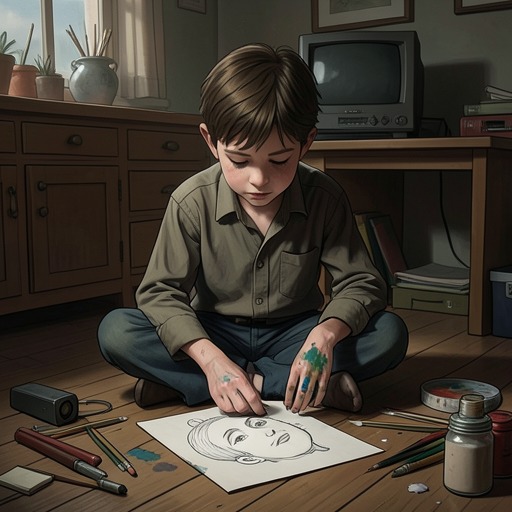
One afternoon, Hanno finds the family papers open on his mother’s desk. The large, gilt-edged notebook lies among loose pages in its leather writing case, and he approaches the genealogy while alone in the living room. He examines the succession of names, written in the different hands of his forebears and his father, with an expression described as critical, serious, and indifferent. The old manuscript’s elaborate writing and the later entries’ more recent strokes present family continuity as something made and maintained through successive acts of inscription.
At the end of the genealogy, Hanno reads his own entry beneath those of his parents: Justus, Johann, Kaspar, born 15 April 1861. He finds the formal name amusing. Using the metal ruler and his mother’s gold-and-ebony penholder, he draws two neat horizontal lines directly under his name, one slightly thinner than the other. The careful, mechanical character of the mark contrasts with the emotional weight the family assigns to the book: Hanno does not add a new event or future descendant, but draws a boundary beneath the last recorded name.
Confrontation with Thomas
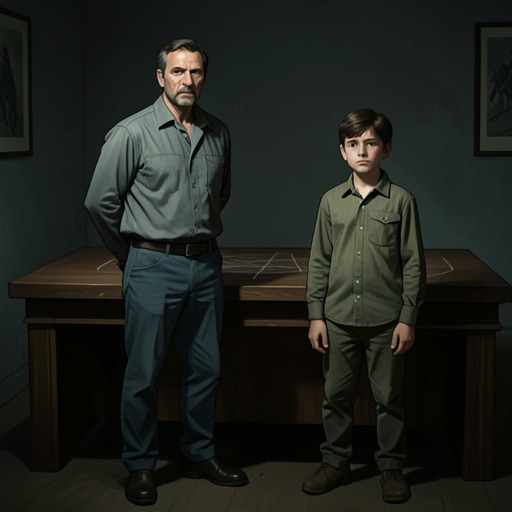
After dinner, Thomas calls Hanno to account for the lines. He asks whether Hanno made them and, when his son confirms it, demands to know why. Thomas interprets the act as malicious and strikes Hanno’s cheek with the lightly rolled-up notebook. Hanno pulls away, holds a hand to his cheek, and answers shyly and nervously that he thought there would be nothing more.
The exchange makes explicit the difference between the two readings of the genealogy. For Thomas, its open-ended sequence carries an obligation: Hanno is expected to continue a family history whose names, business, and inheritance have been bound together. Hanno’s explanation instead treats his own place in the sequence as its endpoint. The father’s anger cannot convert that private, apparently matter-of-fact mark into a promise of continuation; it only makes the family’s expectation and the child’s response collide in a single scene.
Meaning within the family’s decline
The double line resonates against the way the family itself understands its records. Tony, on reading the chronicle, sees each life as a link in a chain and imagines that future family members will continue to record its history with the same reverence. Hanno’s intervention reverses that hopeful image: instead of imagining himself as one link among others, he marks the space after his name as closed. The contrast is especially sharp because the genealogy is designed to make continuity visible and authoritative, while Hanno’s two strokes use that same page to suggest discontinuity.
The gesture also anticipates the practical crisis that follows Thomas’s death. Thomas’s will directs that the firm be liquidated and dissolved within a year, despite Hanno’s position as his son and sole heir. Tony is distressed that the family business will not be maintained for Hanno, but continues to hope that her nephew will establish a new enterprise and restore the family name. The liquidation proceeds at a loss, and the estate’s paper valuation proves far greater than what can be realized. Against that later outcome, Hanno’s mark reads as an image of the break in succession, not as a literal cause of the firm’s dissolution. It condenses into a small alteration of the family record the gap between the future the Buddenbrooks imagine and the future their last male heir seems able to inhabit.