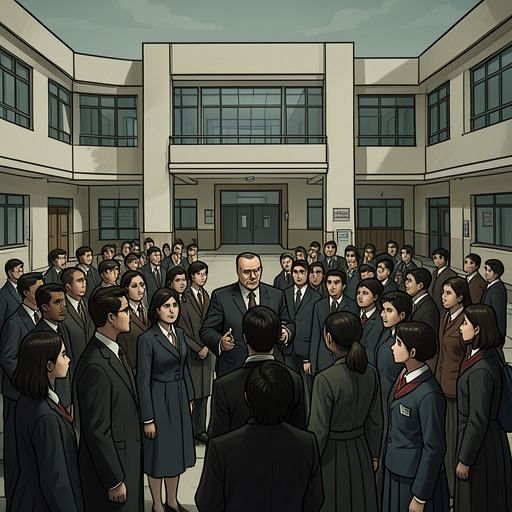
Wulicke’s surprise inspection of Modersohn’s lesson
BuddenbrooksDirector Wulicke’s surprise inspection of Herr Modersohn’s English lesson transforms a classroom already teetering on disorder into a public test of authority and competence. The teacher’s prospects and the students’ standing are judged in the same sudden ordeal: the pupils falter, Hanno Buddenbrook receives a demerit, and Modersohn is left pale and ruined. The scene’s decisive reversal is that a class that had seemed to be evading scrutiny becomes the occasion for the harshest scrutiny of all.
The interruption
Before Wulicke arrives, the lesson has dissolved into noisy misrule. Feet scrape the dusty floor; a cock crows, a pig grunts, and peas fly. Twenty-five boys have given themselves over to anarchy, while obscene drawings pass from hand to hand amid lewd laughter. The music box briefly stills them with a delicate melody, but the quiet makes the next disturbance more violent: the door is flung open without a knock, and the director enters with the force of a monstrous presence.
The boys spring up and arrange themselves in anxious submission, arms pressed to their sides, heads bowed. Modersohn, turned ash-grey, drags his professorial chair down from the platform and dusts it with his handkerchief. Wulicke inspects the ranks, spreads his arms as if poised to strike a piano keyboard, and orders them to sit. His calm command is more threatening than a shout; when he tells the class to continue, the words sound like a warning that failure will have consequences.
A lesson becomes an examination
Wulicke’s visit is not merely a check on classroom discipline. Modersohn is expected to demonstrate his teaching and show what the sophomores have learned in six or seven hours of instruction; the result will determine his future. The inspection therefore places teacher and pupils under simultaneous examination, although only the pupils have so far been accustomed to being tested. Modersohn is caught unprepared, and the lesson he must present as evidence of his ability becomes evidence against him.
The recitation of “The Monkey” is a fiasco. With the director present, the students cannot simply read from their books, and Modersohn cannot rely on Adolf Todtenhaupt, who knows everything, to carry the class for an hour. Moving on to Ivanhoe brings little improvement: only young Count Mölln can translate even a little, because he has an interest in the novel. The others cough, stammer, and stumble over the words. Hanno cannot get beyond the first line. Wulicke answers the failures with a roar likened to a violent scrape on the lowest note of a contrabass, while Modersohn wrings his ink-stained hands and repeats that the lesson had always gone well before.
Judgment and immediate consequences
The bell does not end the inspection. Wulicke remains erect before his chair, crosses his arms, nods disdainfully, and demands the attendance book. He enters demerits beside the names of those whose performance has been unsatisfactory or worse—six or seven pupils in all. Hanno is among them. Wulicke cannot issue Modersohn a pupil’s demerit, but the distinction offers no protection: the teacher stands pale, broken, and in worse condition than any student. Wulicke adds that he will destroy all their careers, then vanishes.
For Hanno, the humiliation settles into a concrete expectation of failure. He believes he will be held back at Easter and leaves the room wearily, rubbing his tongue against a bad molar. The reversal feels cruel precisely because the class had seemed, until the inspection, to be getting away with its disorder. Hanno reflects that when fear is greatest things may go well, or nearly so, whereas disaster arrives when no one expects it; the inspection makes that pessimistic pattern seem confirmed.
Hanno, Kai, and the scene’s double verdict
In the courtyard, Kai Mölln comes to Hanno, puts an arm around him, and walks beside him through classmates excitedly discussing the dramatic episode. Kai looks at Hanno anxiously and affectionately and apologizes for translating instead of keeping quiet and taking a demerit alongside him. His response makes the school’s judgment a personal matter between friends: Kai’s competent performance has spared him the punishment that Hanno received, and he feels the disparity as an injury rather than a triumph.
Hanno answers by recalling that he did answer what patula Jovis arbore, glandes means, but he refuses to treat the demerit as something worth dwelling on. Kai, by contrast, turns the director’s threat into a grim reflection on careers. He imagines Modersohn’s professional future as finished too, and questions a system that distinguishes teaching assistants from professors without recognizing teachers as a category in their own right. The inspection thus ends on two levels: an institutional verdict that marks Hanno and devastates Modersohn, and the boys’ shared, rueful recognition of how arbitrary and crushing that authority feels.
Narrative significance
The scene’s central irony lies in the mismatch between the modest formal task and its consequences. A model English lesson, meant to display what pupils have learned, becomes a test of whether the teacher can survive an unannounced evaluation; the students’ inability to perform also exposes the fragility of the lesson’s apparent success. Modersohn’s repeated insistence that things had gone well before cannot change what the inspection has made visible. The classroom’s disorder is abruptly replaced by an exacting ritual of ranks, attendance, and recorded demerits.
The episode also makes authority tangible through sound and gesture: the music box’s brief melody, Wulicke’s contrabass voice, the students’ strained silence, and the slow inscription of names in the attendance book. Against this machinery, Hanno’s demerit becomes more than a mark for one failed recitation: it feeds his expectation of being held back, while Kai’s embrace offers personal care without undoing the institutional sentence. The inspection binds Hanno’s school anxiety to Modersohn’s professional collapse, showing how a single public performance can turn failure into an official and seemingly lasting fate.