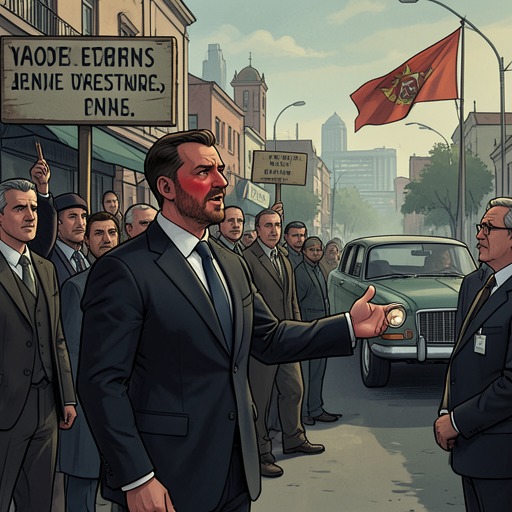
Tony's attempt to prevent the Hagenströms from buying the family house
BuddenbrooksTony’s attempt to prevent the Hagenströms from buying the family house is a conflict between a practical property transaction and the family history Tony believes the house embodies. When Thomas tells her that Hermann Hagenström has expressed interest in the old residence on Meng Strasse, she answers not with a counteroffer but with a protest: the sale would make the Buddenbrooks appear to yield their place to a family she regards as a historic enemy. Her resistance cannot determine the outcome, since Gosch controls the property, but it exposes the difference between Thomas’s account of the family’s present and Tony’s attachment to its inherited identity.
News of a Possible Sale
The news arrives after four, five, or six weeks of winter have passed and the family has begun thinking about Christmas. Tony is preparing for a future in a different home, looking into apartments and furniture, but the possibility of selling the old house to Hermann Hagenström abruptly interrupts that forward-looking activity. Thomas presents it as an idea that has arisen, not as a completed decision: Hagenström wants to inspect the property with a view to negotiating a price. The distinction does not calm Tony. The prospect itself is enough to leave her stunned and to make her ask whether she has misunderstood what she has heard.
The transaction has a particular history. Thomas explains that the matter is in Gosch’s hands because the accounts with him have been settled. The proposed buyer is Hermann Hagenström, a successful wholesale merchant and consul for Portugal, whose family Tony sees as the Buddenbrooks’ old adversaries. In the course of their long rivalry, she says, the Hagenströms have watched the Buddenbrooks’ misfortunes with satisfaction, while Hermann has competed with Thomas in business and public affairs. To Tony, therefore, this is not an exchange of one residence for another. It is the possibility that a rival will acquire the house most closely associated with the family’s earlier position.
Tony’s Protest
Tony refuses to regard the house as an ordinary asset. She invokes the house as her mother’s home, the family’s home, and specifically its landscape room, arguing that it should not be treated like property whose next owner is immaterial. Her language moves from personal memory to a larger claim about continuity: if the Hagenströms take possession, the Buddenbrooks will seem to be pulling up stakes while their competitors occupy the place they leave behind. She calls that outcome a disgrace and a public affront, and declares that she will not participate in what she sees as a degrading performance of succession.
Her refusal is also directed at the proposed meeting with the buyer. Tony says she will not receive Hagenström and threatens to remain in her room with her daughter and granddaughter rather than let him enter. Thomas counters that such conduct would not wound Hagenström as she imagines: he would be surprised, perhaps, but not thrown off balance. In Thomas’s view, Tony assumes that the rival family shares her own intensity of feeling, although he believes Hagenström enjoys success without bearing the same resentment. Their disagreement is therefore not merely over etiquette. Thomas asks her to recognize the distance between her charged memory of the rivalry and the comparatively cool terms on which the sale is being discussed.
The Family House and the Rivalry
Tony grounds her opposition in both inherited grievance and remembered conflict. She recalls earlier hostility between the families, including the rivalry associated with their elders, and a childhood quarrel in which she slapped Hermann in public and his sister Julie retaliated. She acknowledges that this was a childish episode, but places it within a longer pattern of antagonism. Her account also draws on more recent competition: she says that Hermann has tried to eclipse Thomas in business and public life, and connects the Hagenströms to the family’s distress over Erika’s marriage and Hugo Weinschenk’s imprisonment. These events reinforce her sense that a sale would reward adversaries who have benefited from the Buddenbrooks’ troubles.
Thomas does not deny the rivalry, but interprets it differently. He accepts that Hagenström has surpassed him in business and sometimes opposed him in public affairs, yet treats this as evidence of the other man’s ability rather than proof of personal hatred. He also argues that the old house no longer carries the family’s central significance: that importance has gradually shifted to his own residence. His response does not erase the old home’s associations for Tony; instead, it reveals how differently the siblings assess what can be transferred. Thomas separates family continuity from ownership of a particular building, while Tony sees the buyer’s identity as making the transfer a public symbol of replacement.
The Visit to Meng Strasse
When the visit takes place, Tony has composed herself into formal restraint. Wearing a black mourning dress, she remains seated as Thomas receives Gosch and Hagenström, then rises to offer a controlled bow and joins the polite invitation to sit. Her posture maintains social decorum, but it does not signify agreement. Hagenström’s arrival makes the proposal concrete: accompanied by Gosch, he explains his interest in inspecting the premises and suggests that a mutually satisfactory price might be arranged.
A childhood memory briefly unsettles Tony’s composure. Hagenström alludes to sweets from their youth, and she answers that she remembers little beyond a morning snack of lemon buns with sausage, without knowing whose it had been. She then redirects the matter to its practical authority, saying that the house is, of course, in Gosch’s hands. The reply neither welcomes Hagenström nor openly obstructs the inspection; it recognizes that the decision is not hers to make. Thomas notices her distress and helps carry the meeting forward by asking whether the visitors would like to tour the property.
Thomas shows them through the rooms on the third floor and the rooms opening off the second-floor corridor, as well as the ground floor, kitchen, and cellar. They do not enter the offices occupied by the insurance company, so the tour is limited to the house’s available spaces rather than a complete view of the premises. During the visit, Hagenström praises the insurance company’s new director as honest; Thomas falls silent. The exchange offers no resolution of Tony’s emotional objection. Instead, the tour proceeds under Thomas’s management, making visible the difference between the family’s remembered home and the property now being considered by a prospective buyer.
Significance and Limits
Tony’s resistance gives the possible sale a meaning that its commercial terms cannot contain. She treats the house as evidence of belonging and historical standing, and the Hagenströms’ interest as a symbolic challenge to the Buddenbrook name. Thomas, by contrast, distinguishes the family’s fortunes from the old residence and regards the buyer’s success as part of business competition rather than an insult demanding retaliation. Their exchange shows that inherited identity persists unevenly within the family: for Tony, history remains attached to rooms and rivalries; for Thomas, it can be separated from the building and carried elsewhere.
The limits of Tony’s position are part of the conflict. She can make her refusal known, insist on the house’s associations, and maintain a cool formality during Hagenström’s visit, but she does not control the property or the negotiations. Her protest changes the moral and emotional frame of the proposed sale without stopping the inspection. The scene thus leaves the sale’s practical authority with Gosch and Thomas while preserving Tony’s objection as a measure of what the family’s changing circumstances cost her: not simply a home, but the visible continuity she believes the old house represents.