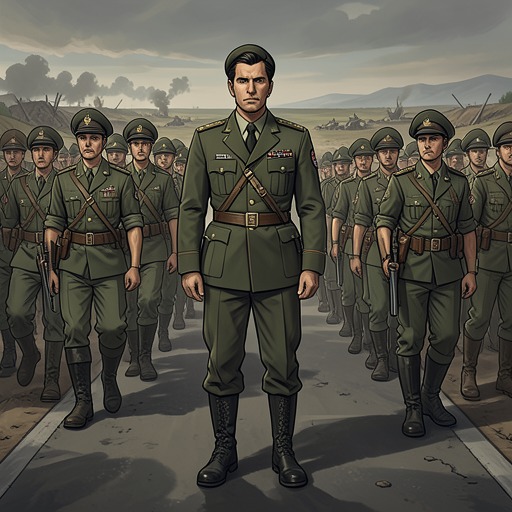
The U.S. infantry’s frustration and sense of futility in the Iraq war
CherryThe U.S. infantry’s frustration and sense of futility in the Iraq war is presented not as a single collapse of morale but as a widening contradiction: soldiers are recruited with assurances of choice and security, then sent into a conflict where they feel exposed to bombs, unable to shape events, and unable to make sense of the deaths around them. Through the narrator’s path from enlistment to medical failure and exhaustion, the war becomes at once an institutional promise unfulfilled and a series of injuries that cannot be neatly resolved.
Recruitment and the promise of choice
In the first week of 2005, Kelly assessed the narrator at an Army recruiting center. The narrator’s urine test was clean; he completed twenty push-ups and sit-ups and ran two kilometers on a treadmill, wearing Vans while his trousers kept slipping down. A practice exam placed him in the 85th percentile. Kelly explained that a strong score on the real exam could let him choose his occupational specialty, and presented his government car, housing allowance, and health coverage as attractive benefits. The exchange carries an early irony: the recruiter was excited to have found a recruit at a time when news of young people being killed or mutilated in the field was making recruitment harder.
The narrator’s parents regarded his plans as foolish but accepted that he would proceed. He told them he expected to start classes within two weeks, and that a list of preferred postings would probably keep him near Ohio, allowing frequent visits home. He also mentioned life insurance of $300,000 if he elected the supplemental payment. The package made military service sound bounded by choices and practical safeguards; the promise of a nearby posting would soon sit uneasily beside the reality of deployment.
At the physical examination, the narrator learned that he was color-blind. It did not disqualify him from 91W, one of the few specialties open to color-blind soldiers; the explanation was that medics already knew what color blood was. The examination itself was a long, uncomfortable process: recruits waited until their legs hurt, stripped to their underwear, and duck-walked around a large room while their bodies were inspected. The narrator describes himself as skinny rather than strong and the assembled men as visibly unfit. The medical role he entered was thus framed both as a narrow accommodation and as a job whose most basic fact, blood, made color vision unnecessary.
Assignment to the infantry
At Fort Hood, the narrator found a bleak environment that seemed designed to instill fatalism in young people. The 4th Infantry Division assigned him to an armored battalion whose mixed organization included armored, infantry, mechanic, support, and command elements. The medical section belonged to the command and logistics company. Its older members spoke in a professional vocabulary the narrator did not understand, and he disliked the prospect of remaining among first-aid personnel. He asked to join a combat company and was assigned to Echo Company; the decision placed him in the infantry rather than keeping him in a medical unit away from patrols.
That distinction did not give him the combat role he imagined. After an operation in which another section killed forty men within minutes, the narrator’s group had stayed where it was and heard nothing. He learned what had happened from Yahoo! News the next morning. The episode sharpened his sense that the unit was present to be hit or killed by bombs, and to waste each day, while others doubted that its soldiers were capable of fighting. The contrast was not simply between action and inaction: the narrator could be close to violence yet feel excluded from any consequential part in it.
Medical duty and the burden of witnessing
The narrator’s medical responsibilities exposed another form of helplessness. After soldiers shot an Iraqi man, the narrator was expected to treat him. He packed gauze into the apparent entry wound, covered it with plastic and tape, and tried to locate an exit wound, but could not find one. He later recognizes that he should have used much more gauze and laid the man on his injured side; at the time, he did not know what to do. The man’s veins were flat when the narrator tried to start an IV. His offer of morphine was framed as a way to prevent shock, but the scene does not establish that he administered it. Medical procedure here is not a clean counterweight to violence: it is a set of actions performed under uncertainty, with the narrator’s later account dwelling on what he failed to do.
After the man died, the narrator placed his body in a bag. An elderly woman came out of a house screaming and tried to reach it; soldiers pushed her back. She fell to her knees, poured handfuls of dirt over her head, struck her face against the ground, and repeated the gestures of grief. A heavily pregnant young woman began to do the same, while two small boys screamed. Soldiers carried away the bag as the older woman followed and tried to pull it back. Gunfire from AK-47s then broke out, and the group scattered. That evening, the patrol returned without incident. Sullivan later told the narrator that the elderly woman had been killed by American fire that morning. The delayed revelation gives the scene its devastating force: the narrator’s memory of grief and his subsequent knowledge of the woman’s death are separated in time, while the fighting that interrupted the family’s mourning remains part of the same event.
Exhaustion, losses, and the sense of futility
By autumn, the narrator sees the soldiers as damaged by what they have done and witnessed. Those who kicked in doors, wrecked homes, and shot people seemed, in his account, psychotic and unfit for ordinary society. They were ready for the deployment to end, but found little meaning in it: they had lost time, and felt they had lost. Death arrived without the shape of a battle or a heroic story, sometimes alone and sometimes in pairs. The soldiers seemed to be walking the roads merely to look occupied, at enormous expense.
The reported dangers were persistent and often arbitrary. A medic in Bravo Company resigned because he could no longer bear leaving the perimeter. One bomb-disposal soldier was reportedly lost after a second explosive device had been planted beneath the first. A patrol base was destroyed by a car bomb. Women were shot, including one holding a baby and another who was pregnant. These incidents accumulate not as a sequence of victories but as evidence of a mission whose risks multiply without giving the infantry a clear sense of purpose. Autumn provided a calendar marker: the unit had arrived in autumn and was approaching the end of its time there. The narrator reflects that a year was barely enough to learn how to function in the field before leaving.
The strain also entered relations within the unit. The narrator had gone on perhaps more than a hundred patrols with North, including roughly half of his trips outside the base, and says they had endured difficult experiences and boredom together. By autumn, he believed North disliked him. North’s irritation when the narrator lit a cigarette during the day was not, as the narrator saw it, a particular danger; it was one more daily friction in a life of repeated patrols. In a confrontation with a lieutenant, the narrator accused him of ignoring warnings about soft ground and blamed him for the deaths of four men. He immediately qualifies the accusation as exaggerated: the men had been acquaintances rather than friends, and the lieutenant had not killed them. The narrator also concedes that without getting bogged down, the soldiers themselves would have been killed. The contradiction captures the state’s moral and emotional pressure: anger seeks a responsible target, while the narrator’s own account refuses to let that accusation stand as a simple truth.