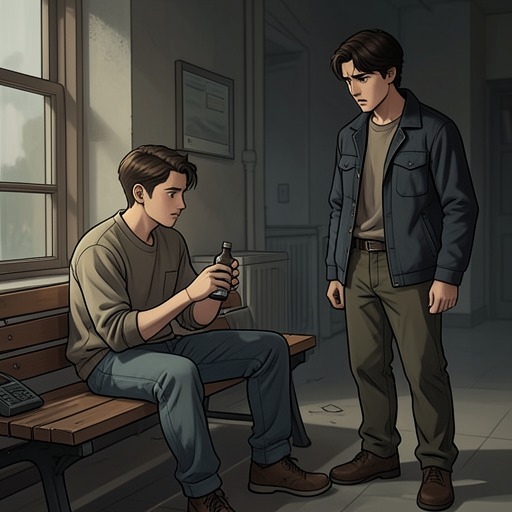
Emily’s heroin addiction
CherryEmily’s heroin addiction develops from an experience she describes as both intimate and frightening into a shared routine with the narrator. Its central contradiction is that heroin brings them closeness and a temporary sense of brightness, even as her earlier near-overdose and the couple’s worsening circumstances reveal the danger and damage beneath that feeling.
Florida: beginnings and a near-overdose
Emily tells the narrator that she began injecting heroin in Florida while living with her father and working as a receptionist at his dental office. She was bored, she says, and had met a decent man with whom she started using. The account places her addiction within an ordinary setting of work and family residence, but describes how an affair and the drug quickly became part of her life there.
She recounts a serious episode in which she injected too much over the course of an hour or two. Her boyfriend was present at his home and watched over her as she struggled to breathe. She survived, but remembers him saying that she had turned blue. The details make the overdose less a single, instantaneous act than a period of worsening danger witnessed by someone close to her; his care is what she identifies from that moment, not medical treatment or a recovery plan.
The story does not remain safely in the past for the narrator. After he drops Emily at the bus station, the image of the man watching her turn blue continues to trouble him. He imagines her on the floor of a shabby Florida house, surrounded by carpeting and what he pictures as a dismal atmosphere. That imagined scene is the narrator’s, not Emily’s description of the room, and its persistence shows how her account alters what he carries away from their meeting. His fear coexists with his continuing love for her.
Reunion and renewed use
The narrator picks Emily up at a Greyhound bus station while she is traveling to Elba. She has lived with her father in Florida and started injecting there; during a three-hour stop, she tells him that she wants to get high. He takes her to meet Trois-Cents, and Emily pays for the heroin. The reunion therefore turns quickly from her disclosure of an earlier drug life to a new occasion of using together.
They go to Walgreens for syringes. Emily goes inside and comes back out with them for both of them. The narrator calls her an angel, a tender response that sits uneasily beside the practical role she plays in making the next injection possible. Back at his apartment, they wait before using. He cleans spoons, and they have saline solution bought at Walgreens; he has deliberately given her money for the supplies. He describes the day as special, framing the preparations and the shared drug use as part of their reunion rather than as an isolated lapse.
When the heroin takes effect, Emily injects with the ease of someone who knows what she is doing. That competence contrasts with the frightening story she has just told: she is experienced enough to use confidently, but the experience includes having once injected too much and struggled to breathe. Their renewed closeness does not erase that danger. The narrator remains in love with her, but Emily does not want to have sex with him, keeping emotional attachment, drug use, and physical intimacy distinct rather than making them interchangeable.
A shared life organized around heroin
Later, Emily and the narrator live together, and their days appear bright to them. The narrator links that brightness to being young and using heroin, while also describing the practical arrangements that sustain their life. They have no jobs to worry about, but can access student aid, student loans, and scholarships by attending college. If they receive the GI Bill, veterans’ education funding covers tuition, leaving other available money for drugs. In his account, the prospect of education does not displace heroin as their priority; the financial support becomes a means of paying for it.
Their household also grows high-quality marijuana in the cellar and uses it to pay the rent. This arrangement gives their drug-centered life a measure of material support, but it does not make it secure. The narrator acknowledges mounting debt and feeling unwell all the time, including constipation. The brighter surface of their days is sustained by benefits, borrowed money, and marijuana, while the costs accumulate beneath it.
Addiction also reshapes their social world. The narrator says that the new friends they meet would take both of a person’s eyes for a spoon or twenty dollars, while old friends no longer come near. The contrast describes a narrowing circle in which small amounts of money or drug equipment become objects of desperate value, and established relationships recede. Taking more heroin can usually make them feel stable again, but that relief belongs to the same cycle that leaves them sick and indebted.
The promise and cost of the high
The narrator’s retrospective language deliberately holds incompatible judgments together. He presents youth and heroin as beautiful and describes the couple’s days as luminous; in the same account, he names gradual self-destruction, debt, physical discomfort, and the loss of old friends. The appeal is not presented as evidence that their situation is safe. It is the felt reward that helps make the destructive arrangement persuasive from within.
Age twenty-five marks the limit of the pose: the narrator says that at that age they could still pretend. Her earlier overdose story gives that pretense a concrete and personal counterimage, while the shared household shows how heroin extends beyond a single frightening episode into the organization of money, shelter, work, and companionship. Emily’s addiction is thus presented through both her own experience of surviving a dangerous injection and the couple’s later daily life, where temporary brightness and practical resourcefulness coexist with escalating harm.