Opioid withdrawal
CherryOpioid withdrawal in the narrator’s and Emily’s lives is not a single crisis but a recurring cycle: they try to stop, endure hours or days of sickness, and then resume seeking drugs. The physical ordeal isolates them even when they are in the same home, while its brief intervals of hope make relapse feel less like a simple defeat than a reward they have learned to expect. The narrative sets that intimate cycle against the practical damage of addiction: depleted money, dependence on dealers, and a narrator who goes out to prepare for a bank robbery while still sick.
The Repeated Attempt to Stop
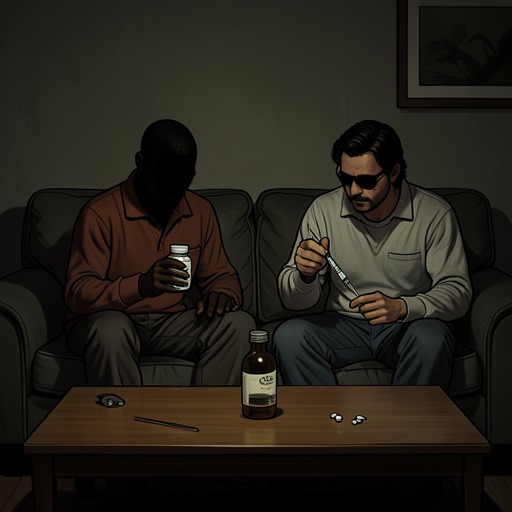
The narrator describes withdrawal as something the couple could imagine undertaking whenever they had grown tired of spending all their money and dealing with people trying to cheat them. Their plan is modest and time-limited: make it through a weekend. Fever, vomiting, and an urge to die mark the attempt, which may last until Sunday evening. The couple’s own account of the ordeal then supplies its undoing. After enduring the symptoms, one of them proposes a small reward, and the other agrees. Abstinence has not ended their dependence; it has become a challenge whose apparent completion licenses another dose.
That pattern is rendered as shared habit rather than as one person persuading the other from outside. The proposal passes between them, and each can occupy the role of the one who offers or accepts the reward. Their attempts to stop therefore reproduce the same relationship to drugs: they recognize the cost, endure withdrawal for a limited stretch, and then treat the suffering they have survived as a reason to use again. The cycle contains both knowledge and evasion. They know that they are spending their money and that the attempt will be painful, but their short horizon makes Sunday evening seem like an endpoint.
In another episode, the narrator and Emily have been without an injection for more than twenty-four hours and have no money left. Their circumstances make the urgency of withdrawal inseparable from the urgency of obtaining cash. The contrast with the weekend attempt is telling: there, the couple can describe a planned period of endurance; here, the narrator says they are broke and in trouble. Withdrawal is not confined to the body. It narrows the available choices until relief and the means to pay for it dominate the scene.
The Body and the Couple
The withdrawal attempt also changes how the couple can inhabit the same space. Emily lies on a mattress on the floor beneath a window, wrapped in blankets and disheveled. The narrator is in another room. They cannot lie beside one another during these attempts because both are sweating and vomiting into small plastic wastebaskets. The domestic setting offers no refuge from the symptoms: a mattress, blankets, and household bins become the equipment of endurance.
At the kitchen sink, the narrator drinks water for three quarters of an hour, trying to put something in his stomach besides bile and mucus. The water comes back up, and he describes it mixing with what is already there before it trails from his lip toward the sink drain. The detail stretches the episode beyond a general statement that he feels ill. Drinking, ordinarily a basic act of care, becomes another failed attempt to manage the body. The account’s duration and repeated motion make the labor of withdrawal almost procedural: water goes down, returns, and leaves him where he began.
Yet the same sickness that keeps the couple physically apart intensifies the narrator’s attention to Emily. When she groans, he wants to hurry to her, and her appearance remains sharply present to him: her carefully formed lower lip, beads of sweat, closed eyes, bare upper body, damp pajamas, and a lock of hair against her cheek. He describes her voice and the sight of her in a way that makes the scene beautiful to him, even as both are suffering. In his account, only a few seconds of closeness are needed to produce pleasure. The passage does not make withdrawal benign; rather, it shows how affection and bodily distress occupy the same moment, and how the narrator’s perception of Emily remains intimate amid the practical indignities of being sick.
Brief Relief and Renewed Hope
The couple’s decision to resume using is accompanied by a sudden change in emotional weather. After agreeing on four pills, they feel better even as the discussion unfolds between bouts of vomiting. The narrator recalls an urgent hopefulness in such moments and a sense that life is magnificent. The scale of the relief is striking beside the smallness of the bargain: after fever and sickness, a limited quantity of drugs can make the world seem newly bearable. That change helps explain the cycle’s force without suggesting that the relief lasts.
The journey to meet Big turns this expectation into an ordinary errand. The narrator and Emily drive across town in their pajamas in the rain, with enough money for five pills, priced at two hundred and twenty-five dollars. Big arrives on time in his white Blazer, as he usually does, and the narrator notes that Big does not treat them like junkies, unlike most people. The detail places their dependence within a social exchange: money, transportation, punctuality, and the dealer’s manner all matter alongside the drug itself. Withdrawal propels the couple from their home and back toward a familiar source of supply, while the brief respect they receive helps distinguish this encounter from the contempt they expect elsewhere.
Withdrawal Carried into the Street
Later, the narrator leaves home while Emily remains sick on the mattress. His own legs are soaked with sweat, and he takes a small wastebasket with him in case he vomits. He dresses in thrift-store trousers and an Oxford shirt, a baseball cap his mother gave him, fake eyeglasses, and a pea coat. The outfit and the bin make visible two realities at once: he is arranging his appearance for an outside purpose, but he cannot leave the physical crisis behind.
That purpose is a bank robbery. He drives past the bank and sees a police car parked across the street, though it is empty. Turning into a side street, he vomits into the small green wastebasket before continuing and parking nearby. The scene does not establish the robbery’s outcome; it shows the narrator approaching it while sick, dressed in disguise, and carrying a container for his vomit. Withdrawal and criminal action are placed in the same chain of movement rather than separated into different parts of his life. He describes himself as melancholy but calm, and says that life remains precious even while he recognizes that it is a mess. That composure sits uneasily beside the practical desperation of needing money and the bodily evidence of illness.
The later account gives the cycle no clean resolution. After calling Rider and reaching voicemail, the narrator receives no response until Tuesday; by then, withdrawal has left the couple extremely sick. The delay extends the ordeal beyond the narrator’s short-lived hopes of getting through a weekend. Across these episodes, withdrawal recurs as physical suffering, a test the couple cannot sustain, and a pressure that reorganizes their movements and choices. Its most revealing contradiction is that the same pain that makes them desperate to stop also helps make the next dose feel earned.