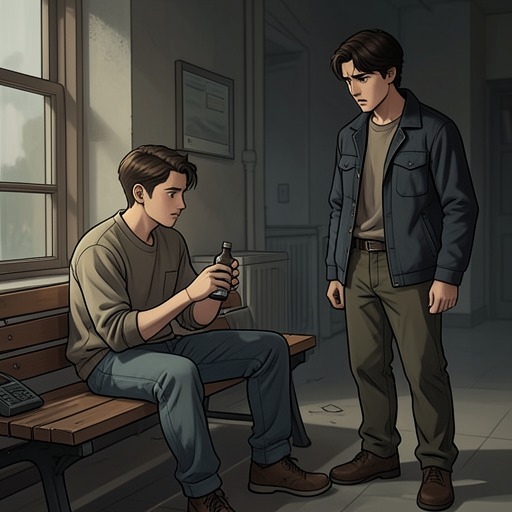
War trauma and suspected post-traumatic stress disorder
CherryWar trauma and suspected post-traumatic stress disorder are presented not as a confirmed diagnosis but as an unresolved condition shaping the narrator’s memories, sleep, self-judgment, and attempts to obtain care. His distress is rooted in both combat and the responsibilities placed on him as a medic: he is expected to treat the wounded and make decisions under pressure, while repeatedly confronting the limits of his training, authority, and available help.
Training in Care and Its Limits
During a two-week rotation at Brooke Army Medical Center, five young recruits were assigned separate rounds in a clean hospital that treated civilians as well as military personnel. The narrator’s early mistakes made the work’s human stakes immediate. He mishandled a blood-pressure cuff for a patient recovering from a motorcycle accident, and the patient’s wife regarded him as callous. Elsewhere, he was responsible for basic care for a man injured in a street fight. The narrator understood these tasks through the language of duty, but his confidence was fragile: when caring for a cognitively impaired man whose mother was grieving at his bedside, he was relieved to have learned how to use the blood-pressure equipment correctly, because he feared adding to her distress. The rotation ended with his pride in having got through it intact, a confidence that would not survive later encounters with suffering he could not contain.
On the final day of Operation Radiant Honor, the narrator helped establish a medical station in a school. An older man waiting for treatment said that restraints had left deep marks on his wrists. The narrator cleaned and dressed the wounds, noticed that one hand was swollen and trembling, and worried that the condition was serious. Unsure how to assess it, he sought advice from two senior noncommissioned officers sleeping outside in a five-ton truck. The chief medic identified the problem as cellulitis. When the narrator asked what he could do for the patient, the answer was that there was nothing. The exchange exposes a recurring divide in the account: the narrator is placed in a position of care, yet the knowledge and authority needed to help are not necessarily his to command.
Combat, Responsibility, and Loss
That divide becomes acute when a young man is shot during a pursuit. The narrator is assigned to treat him and tries to manage the wound, but cannot locate an exit wound or determine exactly where the bullet has lodged. In retrospect, he itemizes what he should have done differently: he should have used more gauze and positioned the patient on his side. He also recognizes that a proposed measure to prevent shock was offered partly because he did not know what else to do. His account preserves the distance between performing a procedure and feeling capable of saving someone. He asks for a medical evacuation helicopter and stresses the need for emergency surgery, but it does not arrive before the patient’s condition worsens.
The patient briefly stops breathing and loses his pulse. The narrator and Bautista perform resuscitation, and the man begins breathing again. The temporary return of life does not settle what follows. After the patient dies, the narrator places the body in a mortuary bag. Members of the dead man’s family come out of a nearby house, and the scene overwhelms him; he later recalls being close to crying and possibly shooting himself. Gunfire then breaks out, forcing the soldiers to take cover and return fire. The abrupt shift from a family’s grief to immediate combat leaves no space for mourning or for the narrator to make sense of what he has just witnessed.
Later, Sullivan tells him that an older woman from the family was killed by the soldiers’ own fire that morning. The narrator accepts this as true because he trusts Sullivan’s account. The delayed confirmation adds another loss to a scene already marked by death and helplessness. It also makes the narrator’s recollection more than a record of an unsuccessful rescue: the consequences of the shooting extend to the family, and the danger comes not only from an opposing force but from the soldiers’ own actions.
The narrator’s strain also surfaces in his confrontation with a lieutenant. He accuses the officer of ignoring warnings and says that four soldiers were killed because of him. The narrator then corrects his own accusation: the lieutenant did not kill them, and they were acquaintances rather than friends. He also recognizes that the alternative course he had urged might have exposed the unit to greater danger. This self-correction does not erase the anger; it shows how, under pressure, blame and fact pull against each other. His outburst conveys a need to make a superior hear him, while his later qualification reveals that he knows his charge was exaggerated.
After the War: Symptoms and Attempts to Seek Help
In the years after the deployment, the narrator describes being unable to sleep reliably. When he does sleep, he dreams of violence, Iraq, and films he has seen; in the dreams, he dies and does not wake, and he rises tired. He says that he is unhappy regardless of what happens. These recurring dreams connect wartime experience with later distress without making every dream a direct recollection of a particular event. The account presents their repetition and their effect on his waking life, rather than offering a definitive clinical explanation.
The narrator had previously seen a psychiatrist through veterans’ services after Zoë left. He missed an appointment while accompanying Roy to a motor-vehicle office on the West Side, called to cancel, and later tried several times to arrange another appointment. No one returned his calls. Three years passed, and by the time he recounts this history he and Roy are no longer friends. The failed follow-up is a concrete break in access to care: the narrator made efforts to reconnect, but those efforts did not lead to another appointment.
He later sees Dr. Kaufmann, whose consultations are free because his work is government-funded research involving people like the narrator. Rather than asking him to describe what is troubling him, Dr. Kaufmann asks him to rate his condition on a scale from one to ten every hour, day and night, and to keep a record. The narrator does not maintain the record and feels as though he has done something criminal. The procedure gives him a task for measuring distress, but, as he describes it, does not give him a way to tell its story.
Dr. Kaufmann arranges an appointment with a specialist in drug treatment. The narrator struggles to find the poorly marked office, arrives fifteen minutes late, and then waits for more than an hour. A nurse draws his blood and treats him kindly; the specialist, by contrast, dismisses his account of Suboxone, which he says has not relieved his withdrawal symptoms, and calls him a liar. When asked why Dr. Kaufmann is treating him, the narrator says he believes it is for post-traumatic stress disorder. He explains that he served in Iraq in 2005 and returned in 2006. The specialist responds that the war was over by then. The narrator leaves, unable to remain in the appointment. His suspected diagnosis is therefore voiced but not confirmed; the scene instead records how his effort to explain himself is cut short by disbelief.
Wartime Memories and the Meaning of the Diagnosis
The specialist’s dismissal brings the narrator back to chest pains he experienced whenever he left the base in Iraq. The pain left him unable to breathe and felt to him like a heart attack. Shoo took him to the battalion aid station, but a captain who was acting as a doctor declined to see him and told him to return during morning sick call. The narrator did not go back. He explains that he was normally away from the base during those hours, potentially exposed to an explosion or gunfire. His recollection joins physical distress to the conditions of deployment and to a medical system whose available appointment did not fit the routine of his duties. It does not establish what caused the chest pain, but it shows how symptoms went untreated.
The memory of Arnold supplies another view of how wartime loss persists in the narrator’s social world. Arnold had been treated as a nuisance by older soldiers while he was alive; after he was killed, those same soldiers recast him as one of the good men, and speaking ill of him could provoke a fight. The narrator says he did not know Arnold well enough to call him a friend, though they shared a room for eight months, sometimes talked, and he helped recover Arnold’s belongings. The sudden change in how the dead are spoken of makes remembrance a contested practice: the narrator can acknowledge Arnold’s decency without pretending to a closeness they did not have.
Across these episodes, suspected post-traumatic stress disorder remains an uncertain label rather than a resolution. The narrator’s account connects violent dreams, exhaustion, remembered chest pain, combat deaths, difficult medical encounters, and the burden of having been responsible for care. It also preserves distinctions that a simple diagnosis could flatten: fear is not the same as responsibility, an accusation is not always a settled judgment, and witnessing suffering does not mean the witness had the power to prevent it. The narrative gives no clinical verdict. Instead, it shows a person trying to describe distress to institutions and clinicians, recalling what happened in Iraq, and repeatedly confronting the gap between needing help and being heard.