The narrator and Emily’s heroin addiction
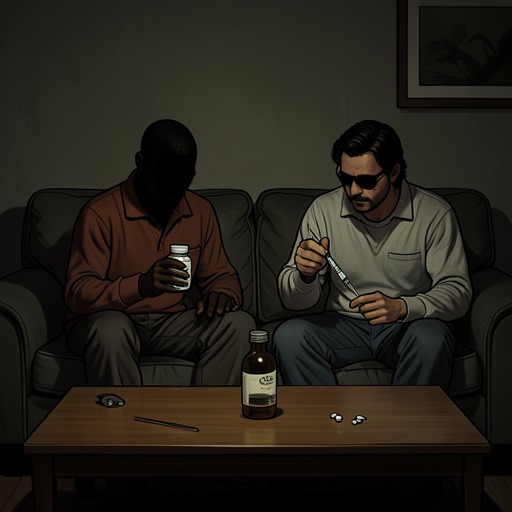
CherryThe narrator and Emily’s heroin addiction shapes their shared life through repeated routines, practical cooperation, and a danger that can abruptly overturn the ordinary. In the prologue, their morning is organized around preparing and taking heroin before Emily has to reach college. The intimacy of the ritual does not protect them from its risks: after the narrator injects, an unexpectedly powerful effect leaves him on the kitchen floor, with Emily above him. Their addiction is also measured against a promise they made when they got a dog: they would stop using. They kept the dog, but not the promise.
Identity and Household
The addiction belongs to a couple who use together, not simply to one person acting alone. Emily and the narrator share the drug, prepare doses in the same kitchen, and speak to one another in the familiar language of partners. When Black arrives, the narrator calls Emily downstairs to join him. He divides the heroin between them and sets out a clean spoon for each. The arrangement makes their use a joint activity, organized around both of them rather than concealed from one another.
Their home gives this shared dependence a domestic setting. Before the dose, the narrator looks for a shirt without bloodstains and finds none; his trousers, too, are damaged by cigarette burns. These details establish the disorder of the household without interrupting the practical demands of the morning. He cleans up after their dog, Livinia, then returns to the preparations. The ordinary tasks of caring for a pet and managing a home continue alongside drug use, but they do not displace it.
The Morning Routine
The scene fixes the couple’s dependence in a schedule. At twenty minutes to nine, Emily is expected at college by ten, and the narrator calculates that they have just enough time. New syringes will have to wait. The ones in the cupboard are stained and bent, and the needles are blunt; he nevertheless expects to use what is available. Black is expected to arrive on time with something for them, and the narrator’s attention to the clock and the household supplies shows how access to heroin governs the morning’s practical decisions.
Preparation is methodical. The narrator divides the supply, takes out two clean spoons, fills a glass with water, and draws water through the syringe to clear a possible obstruction before putting water into a spoon. When Emily comes downstairs, he dissolves the heroin and directs her to her portion on the counter. The sequence shows how familiar the procedure has become: the shared dose is treated as a task to complete within the time available, even though the equipment is visibly worn and unsuitable for reassurance.
The narrator’s confidence depends partly on how the injection goes. Despite the blunt needle and the possibility that finding a vein might be harder, he finds one without difficulty and reads that ease as a sign of good luck. His optimism is immediate and practical: a smooth start makes the day seem favorable. The scene thus places confidence and risk side by side, without suggesting that the former cancels the latter.
Crisis and Unequal Turns
After the narrator injects, the expected progression changes. The taste and the onset of the drug become stronger than usual, and he understands the experience as if he had been dead all along. The thought is followed by a concrete reversal: he is on the kitchen floor, while Emily is above him. The episode gives their shared routine a severe limit. The same preparation that brings them together can become an acute crisis, and Emily is the person present when the narrator collapses.
The account does not describe a separate intervention or explain exactly what Emily does. It does show that the narrator is able to speak again shortly afterward. He tells her that he is all right and encourages her to take her turn, citing the approaching time to drive her to college. That quick return to the routine is significant: the frightening episode does not, in the passage, produce a decision to stop. Instead, the remaining schedule and Emily’s dose come back into view. The exchange makes clear how ordinary obligations and continued use occupy the same morning.
The Dog and the Broken Promise
The narrator’s clearest acknowledgment of the relationship between addiction and responsibility comes when he reflects on Livinia. He sometimes feels guilty about the dog because he and Emily had agreed to get one and stop using. They followed through on getting the dog but remained users. His compressed conclusion is that they have become addicts who also have a dog. The contrast turns a domestic choice into evidence of a promise left unfinished: taking on responsibility did not bring about the change they had intended.
That guilt does not become a resolution in the scene. The narrator cleans the dog’s urine from the living room, refills three differently colored ice trays, and then attends to the day’s other plans. These chores show a household still functioning in small, concrete ways, but they do not alter the couple’s dependence. The addiction’s significance lies partly in this coexistence. Care, routine, and affection remain present, yet the couple continues to organize time and action around heroin, even after a crisis and despite a promise that was meant to change their lives.