Calcutta's Transience and the Shahjahan's Historical Memory
ChowringheeCalcutta's transience and the Shahjahan's historical memory form a study of what a city preserves and what it lets disappear. People of different origins arrive, struggle, and sometimes prosper, but time sweeps their distinctions and their names into oblivion; the Hotel Shahjahan, by contrast, outlasts its founder and gathers traces of many lives. Its survival does not restore a complete past. Instead, statues, stories, old drawings, and newspaper cuttings offer scattered evidence of people whom official history may leave behind.
A city that erases its inhabitants
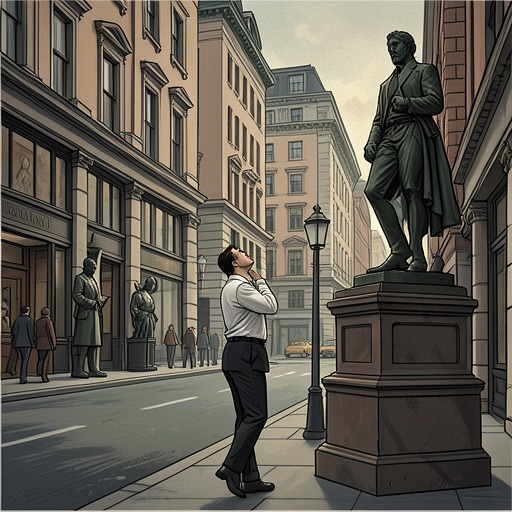
The narrator's walk through Calcutta makes its changes visible in the contrast between present-day Chowringhee and the city's historical remains. At the western end of Curzon Park, Sir Hariram Goenka's statue still faces Raj Bhavan. The narrator sees the statue as one of the few forms in which the dead have survived: thousands have settled in the city over the centuries, coming from different places, speaking different languages, and bringing distinct customs and cultures. Many arrived penniless and accumulated wealth and renown, yet time eventually swept away boundaries between familiar and strange, rich and poor, native and foreign. Almost everyone was consigned to oblivion; only a few escaped it in the form of statues.
The scene gives public commemoration a narrow, even ambiguous, power. A statue keeps a figure visible, but it is also a remnant left on the banks of the Ganges after the lives and worlds around it have vanished. The narrator addresses Sir Hariram as a dead citizen of a dead city and tells him that circumstances have changed: the narrator now works at the Hotel Shahjahan. The imagined conversation joins two eras, but it cannot make the statue answer or recover the vanished city in full. The surviving monument marks both remembrance and loss.
The hotel as a durable witness
The Hotel Shahjahan's own history begins, in Bose-da's account, with the absence of hotels. Job Charnock arrives by ship on the Hooghly River, exhausted and beset by misfortune, but no inn is available to shelter him; the inhabitants of Sutanuti and the Hooghly district have not even heard of a hotel. He must manage as travelers have always done. Other foreigners later come to Calcutta, yet, in this recollection, the city still has no hotel for them. The tale makes the hotel a measure of historical change: a form of hospitality that later seems ordinary was once unimaginable there.
The building that eventually houses the hotel seems to contain more history than its founder could foresee. Simpson plans to build near Fort William because he expects Calcutta to shape India's future and draw people willing to pay for a night's lodging. His imagined legacy is not a statue but the hotel's daily meals: he expects to live on in each breakfast, lunch, and dinner served there. Yet even Simpson does not imagine the many generations that will follow. The hotel survives him, and the narrator imagines that its continued life would astonish its founder. Bose-da's account sets this persistence against the city's instability: fame, youth, fortune, and even life are transient, while the hotel continues to hold the pleasures, griefs, celebrations, desires, and sacrifices of successive nights.
The narrator experiences that endurance bodily while waiting through a night in the building. Though the hotel is old and its history has languished amid dirt, the narrator senses the disturbance of another century in it, as if the vast structure were waking. The roof where the narrator waits for morning belongs neither to the present moment nor simply to the narrator's own time. The building becomes a keeper of unread chapters, a place where the past remains present without becoming fully legible.
Drawings and clippings as partial archives
The hotel's memory is also carried by material records. Sketches by artists of the period hang in its lobby, greeting strangers and announcing that this is an old hotel east of the Suez Canal, with a history and a tradition. A framed clipping from the Englishman likewise includes a drawing of the Hotel Sajan. The narrator studies the image at length. Such objects make the hotel's age visible to newcomers, but they preserve the establishment as an image and an institution more readily than they preserve the full lives of the people who passed through it.
Hobbs's collection of newspaper clippings, gathered over decades, makes that selectivity especially clear. He retrieves an old Hotel Shahjahan advertisement announcing the arrival of Marian Booth and Jane Grey at Kidderpore aboard the SS Hawaii. It promises that the women will serve the guests' pleasure and comfort, then proudly declares that they will be locked up during the day and after their nightly work. Sutherland raises the possibility that the women were enslaved; Hobbs distinguishes their legal status from the humiliations he witnessed and heard about. The advertisement remains as documentary evidence of their confinement, but its promotional voice treats them as attractions and workers rather than as narrators of their own experience.
Hobbs's clipping collection links such an apparently modest record to later events. He recalls knowing Silverton, who would eventually buy the hotel, and describes an earlier period when the neglected building was crumbling and supplies were scarce. A guest's complaint about the hotel's condition prompted Silverton to respond in person. The fragment therefore preserves not just an advertisement but a changing institution: its deteriorating state, the people associated with its management, and the beginnings from which consequential developments followed. Its archival value lies partly in its unintended reach beyond the occasion for which it was printed.
Hotel workers and the unwritten past
The hotel's most important record may be the memory of people who worked there. As a receptionist, the narrator imagines the hotel employee who witnessed the embrace between Vidyasagar and Michael Madhusudan Dutta. The English guest greets everyone in the lobby, then embraces and kisses the Brahmin, who can only ask to be released. The scene would have been startling to those present, but the receptionist is the only person the narrator says is remembered. Thousands of others, including the narrator and colleagues, may also have stood close to dramatic events without realizing that they were witnessing history.
That recognition leads Bose-da to distinguish between two kinds of history: one written in detail and made into books, and another that remains unwritten, known to people but not put into words. The hotel provides a setting for both. Its guests and workers encounter events, conflicts, and private decisions as they happen, yet proximity alone does not make those experiences part of the recorded past. The receptionist remembered beside the celebrated encounter is a rare exception; the larger population of witnesses risks vanishing without a trace.
The novel thus presents historical memory not as a single authoritative account but as an uneven circulation among buildings, statues, oral stories, and archival scraps. These forms preserve something, but each also has limits: a monument reduces a life to a figure, a clipping retains the language and priorities of its publisher, and a hotel can outlast its inhabitants without recording them all. The Shahjahan's endurance offers a counterpoint to Calcutta's relentless forgetting, not a cure for it. Its rooms hold the possibility that overlooked lives and unrecorded scenes belong to history, even when no book has yet made them visible.