Connie and Harry (Lambreta)’s sibling and performing-partner relationship
ChowringheeConnie and Harry’s relationship binds a travelling performance act to a private bond of sibling care. Onstage, they offer the audience a carefully staged spectacle; offstage, Connie tries to steady a brother whose drinking and anger can overwhelm them both. Their partnership is not simply a professional arrangement: when the Shahjahan conflict makes the two difficult to separate, Connie gives up her contract rather than abandon Harry, and they leave together.
Siblings and the Family They Support
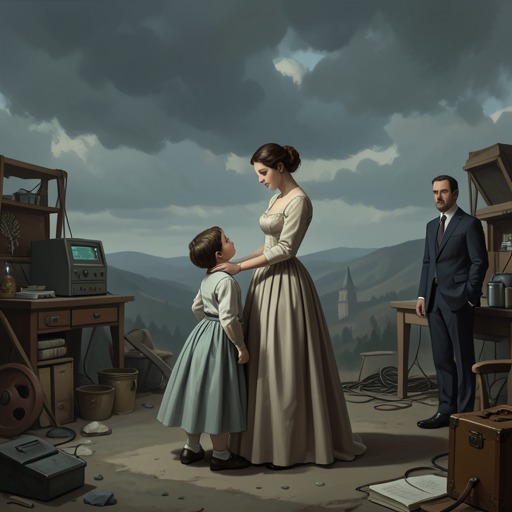
Connie’s account of their past begins with a photograph: their mother holds the infant Connie, while Harry, then a boy of seven or eight, stands beside them. She identifies the woman as their mother and Harry as her brother. The family’s history is marked by hardship and distance. Their mother, Harry, and a sister were in Scotland, with no one to care for them; Harry’s work and Connie’s later performing career became ways of supporting the family.
Harry first earned money at a restaurant, where his height kept him from reaching the tables. The staff put him at the entrance instead. He bowed to welcome customers and opened the swinging doors; customers found him amusing and left tips. That work made him the provider for his widowed mother and sister. His small stature was thus part of his public working life before it became central to his stage identity, but the story also shows the practical limits imposed on him by an environment not adapted to his body.
Connie says she never had the chance to attend school. She learned to sing from Harry, who taught her when he was in a good mood, and he sometimes showed her how girls danced in restaurants. Other people laughed at his eccentricities, but Connie and their mother did not. When Connie chose a career as a dancer, she did not let Harry continue working. Their later act therefore grew out of an earlier exchange: he had taught her, and she took responsibility for earning through performance.
Care, Drinking, and Their Private Roles
As Harry grew older, Connie recalls, he became difficult and began drinking. Their mother was the one person who could partly control him, sometimes going out at night to bring him home from bars. Harry could ask Connie for money, spend it drinking, and return to face their mother’s authority. After their mother died, she left them with a final appeal: Harry agreed to obey Connie as he had obeyed her. Connie continued to invoke their mother when she could not manage him, and the reminder could bring him back to himself. It could also leave him angry and tearful, requiring Connie to comfort him until he settled.
The roles between them were not simply those of guardian and dependent. Connie recounts soothing Harry by reminding him that she is his younger sister and that he, too, can correct her if she is wrong. He would then turn from distress to tenderness, calling her his little sister and urging her to sleep, while she refused to go to bed until he did. The scene makes their care reciprocal in feeling even when Connie bears much of the practical burden. Her authority rests on their mother’s request, but keeping Harry calm also requires affection, patience, and reassurance.
Harry’s drinking and temper follow them into their working life. When he bursts into the narrator’s room drunk, clutching whisky and refusing to leave, Connie comes in to fetch him. He protests and threatens to make a mess of the room; Connie asks the narrator to wait outside. In less than a minute, her intervention calms him. The ease of that change is striking beside his outburst: Connie knows how to reach him, though the scene does not make that knowledge a simple power to control him. Later, Harry cries that people blame him but said nothing when he was called a chimpanzee. His complaint exposes a humiliation that the people around him had failed to acknowledge. Connie’s care cannot erase the insult or the anger it has stirred.
A Stage Partnership and Its Reversal
Connie and Harry travel around the world as performing partners. Their act puts their relationship before an audience but does not reveal its private balance. At the Shahjahan, Connie is introduced as a singular female spectacle; the lights go out, and the wandering spotlight searches the stage before settling on Harry, a dwarf in evening dress with an oversized top hat and a cane. The contrast between the expected entrance and Harry’s appearance makes the act’s theatrical construction visible: the audience is led to anticipate Connie, while Harry occupies the stage first.
The public performance also reverses their private dynamic. Karabi observes that Harry plays a supplicant to Connie in the show, while in life Connie is devoted to him and does not dare protest his temper. The stage offers one arrangement of power; their life together offers another. That reversal complicates any easy reading of Harry as merely the comic figure in the act or Connie as simply the person in command. The performance depends on an image of their relationship, while backstage Connie must manage the consequences of Harry’s distress.
The strain becomes visible after a performance at the Shahjahan. At the end of the first act, Connie is backstage, wrapped in a robe and out of breath, and immediately asks where Harry has gone. His absence interrupts the routine even as the show continues around her. For Connie, the act and the person she performs with cannot be neatly separated: she may appear alone onstage, but Harry’s presence and welfare remain part of the work.
The Departure from the Shahjahan
When the conflict at the hotel threatens Harry’s place in the act, Connie decides that she cannot continue performing while he leaves. She asks for a favour and wants Harry kept from learning what has happened. She plans to tell him that she argued with the hotel and cancelled the contract in anger. Connie worries that the others might harass him; she believes he is trying hard to improve his lot but cannot manage it, and fears that learning the true reason could make him give up. She also remembers that someone mocked her decision as throwing away her prospects for a dwarf, a judgment she rejects because those people do not know what Harry means to her.
Connie’s choice has a concrete professional cost: she gives up the contract rather than stay and perform without her brother. When Harry later packs, he announces that they are leaving and will never return to the city. They do not return. The narrator’s closing image does not establish where they go or what becomes of them; it imagines that a reader might encounter Connie dancing with a dwarf in some dark bar and asks that she be recognized. Their ending is therefore both decisive and open: they leave the Shahjahan together, while their life beyond the hotel remains unknown.