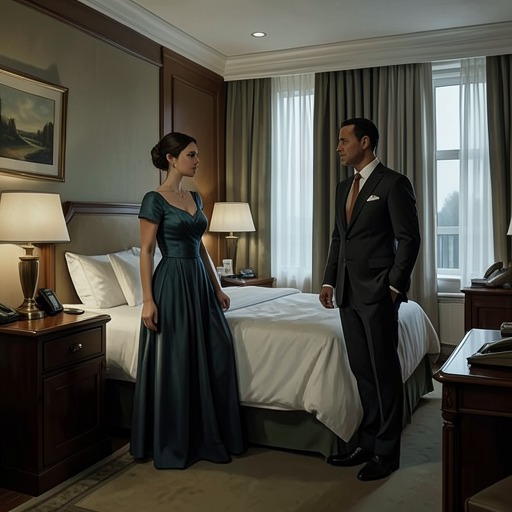
Madhab Pakrashi and Mrs. Pakrashi’s marriage
ChowringheeMadhab Pakrashi and Mrs. Pakrashi’s marriage is a study in the distance between possessing the outward signs of wealth and possessing a spouse. In the account given by Satyasundar Bose, the couple’s relationship is marked by secrecy, suspicion, and failed attempts to catch the other in an affair. The hotel’s fragmentary observations make their private life legible only in glimpses—and leave the central accusations unresolved.
A marriage seen from the hotel
Satyasundar Bose describes Mrs. Pakrashi as already removed from Madhab Pakrashi’s bank accounts, a detail that gives their estrangement a material as well as emotional dimension. Madhab is said to have cars, companies, houses, and money; Bose’s bleak assessment is that the abundance has not secured the intimacy of marriage. His image is of a husband who has his wife and yet does not have her. It is a judgment about their relationship, not evidence that the marriage has legally ended.
The Hotel Shahjahan becomes an unofficial vantage point on the couple’s separation. Mrs. Pakrashi comes there at night wearing dark glasses, although her husband owns seven or eight cars; she takes a taxi instead. Bose treats the contrast as part of a recognizable pattern of secrecy. He also says that, on such nights, Madhab is not in Calcutta and may have left on business for Bombay, Delhi, or England. The hotel can record arrivals and absences, but those movements do not by themselves establish what either spouse is doing elsewhere.
Her visits and the suspected affair
Bose says Mrs. Pakrashi visits the hotel at night while spending her days on social work, making speeches and expressing concern for the country. He describes a sharp divide between these public appearances and her private conduct: by day, she presents herself as thoroughly Bengali; at the hotel, he says, she is international in her choice of company and that he has never seen her with an Indian man.
A regular visitor to the hotel has an office in Calcutta and stays in Ballygunge as a paying guest with an Englishman. He comes alone, but always hires a double room, and visits four or five times a month. Because he is a Commonwealth citizen, the hotel does not have to report each visit to the police. Bose suggests that this may help explain why Mrs. Pakrashi chose him: a previous regular visitor to the suite was French, and a non-Commonwealth guest had to be reported. These details invite the inference of a secret intimacy, but Bose reports hotel patterns rather than confirming what happens in the room.
Suspicion turns toward Madhab
Mrs. Pakrashi’s suspicions are not limited to her own conduct or to the English visitor. Bose says she believes Madhab may also be taking single or double rooms at the Taj Hotel in Bombay or at the Maidens in Delhi. She has never caught him in an affair, however, and Bose’s own impression is that Madhab is a decent man. Bose has sometimes seen him at the Hotel Shahjahan around lunchtime, where he does not even order a beer. That limited observation complicates the wife’s suspicions without disproving them: a restrained visit to the hotel is not proof of fidelity, just as a double-room booking is not proof of adultery.
Mrs. Pakrashi has put B. Byron on Madhab’s trail. Bose says B. Byron followed him to Bombay a couple of times, but, as far as Bose knows, the investigation produced nothing. The marriage therefore generates surveillance without resolution. Each spouse appears, in the hotel account, to suspect the other; yet the evidence remains circumstantial, and no affair is demonstrated.
Secrecy, wealth, and uncertainty
The relationship reaches the reader through Satyasundar Bose’s talk of hotel routines: taxis, rooms, recurring visits, absent husbands, and reports required by the police. Such details give the marriage a public outline while withholding the private truth. Wealth is no guarantee of companionship, and suspicion does not become certainty simply because the hotel sees the same patterns recur. The account leaves Madhab and Mrs. Pakrashi suspended between marriage and estrangement: materially connected, privately distant, and unable—or unwilling, as far as the evidence shows—to prove the accusations that shadow their union.