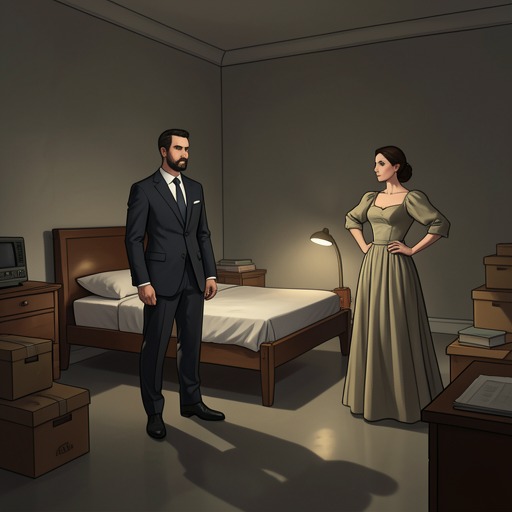
Marco Polo and Byron’s commissioned investigation relationship
ChowringheeMarco Polo and Byron’s commissioned investigation relationship grows out of Marco’s attempt to end his marriage to Susan Munro and the disappearance of any clear legal path to a divorce. Byron follows the matter from the failed arrangement to Marco’s arrest and the search for Susan, but the evidence leaves the commission unresolved: even as Byron asks for help, he is still trying to discover what happened.
The commission and its stakes
Byron’s connection to the case comes to light when he asks Shankar about the manager. Shankar explains that he has travelled a long way to see Byron at the manager’s request. The exchange establishes a chain of delegated work: Marco has called on Byron, Byron has involved Shankar, and Shankar is carrying information between them. Marco’s request is not a routine inquiry about hotel business. It concerns a personal crisis whose outcome could determine whether his marriage has actually ended.
The difficulty lies in the difference between intending to divorce and securing a divorce. Marco and Susan had planned to proceed through a fabricated adultery claim, but the lawyer warned that the petition must deny collusion between the spouses. If the court suspected an arrangement, the scheme could become dangerous; the lawyer also insisted that Susan alone was the firm’s client and that Marco must not contact the office. The secrecy required by the plan therefore cuts Marco off from the very people who might tell him whether it is progressing.
A case overtaken by events
Byron recounts what followed. After settling some matters in Calcutta, Marco returned to work and managed to gather about five hundred rupees, which he sent to Lisa with a promise to send the balance later. He had no way to write to her or find out what was happening, and no friend who could keep him informed. Meanwhile, Susan wrote once to say that she had bought a new car. Marco’s anxiety about the divorce was increasing, but the lawyer asked for more money; Marco borrowed it and sent it to Susan’s address.
The expected legal resolution never becomes visible. Instead, the police arrested Marco because his connection with Italy again drew their attention during wartime, when Italy’s relationship with the Allies made that background consequential. His arrest interrupts the effort to settle the matter and helps explain why the case later has to be reconstructed from fragments: payments sent, a brief letter from Susan, and information sought from lawyers and the court.
Byron’s search and the missing record
After Marco’s return to Calcutta, he obtained the vacant manager’s position at the Hotel Shahjahan. His professional standing had helped the owners accept him, but his new job did not answer the private question that remained: where was Susan, and what had become of the divorce? The woman who had set events in motion during wartime had disappeared into the human crowd. Marco asked at the lawyer’s office, only to be refused information. The elderly lawyer had sold his share to his partner and died; the office offered no account that could resolve the uncertainty.
Marco then asked at the court. No divorce petition had been filed in his name. That absence is the decisive finding in Byron’s account: whatever the spouses had planned, the legal process had not produced a recorded case. It does not establish where Susan went or why the petition was never filed. Rather than supplying a solution, the investigation exposes how little can be verified once the people and records on which the arrangement depended are gone or inaccessible.
Sympathy and an unfinished task
Byron presents the story to Shankar as an account of events that should make a listener feel deeply uncomfortable, then admits that it would have been better if Marco had consulted Shankar’s former employer. Shankar replies that his former employer would never have accepted a case involving collusion between husband and wife. Their exchange marks the ethical and practical limits surrounding the original plan: the arrangement depended on concealing its true nature, while a lawyer unwilling to participate could not offer a simple alternative.
Byron does not treat Marco’s predicament as merely a file to close. After setting aside his teacup, he takes out a cheap cigarette, lights it, and compares the emotional distance expected of a great doctor with the difficulty of remaining detached when someone brings a problem for help. He says that he cannot help feeling for Marco. The gesture and confession qualify the professional role: Byron knows that an investigator may fail, yet Marco’s misfortune has become personally affecting. Shankar, watching Byron extinguish one cigarette and light another in the closed, smoky room, registers that strain.
The commission remains open at the end of the account. Byron says Marco sent for him and that he is still trying; he tells Shankar not to let Marco become impatient because something will change soon, and asks Shankar to help now that he will know Marco well. Shankar agrees, recalling that Byron was the person who secured his job. Their relationship thus extends beyond a single investigation: Byron’s earlier assistance to Shankar becomes the basis for asking him to aid Marco. Yet no discovery about Susan or completed divorce is reported here. The inquiry binds the three men through delegated trust while leaving its central question unanswered.