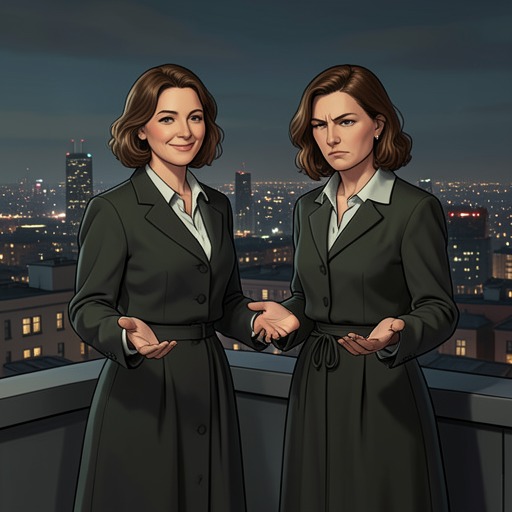
Satyasundar Bose and Sujata Mitra’s relationship
ChowringheeSatyasundar Bose and Sujata Mitra’s relationship changes the settled course of Bose’s life, turning his work at the Hotel Shahjahan from a dependable identity into the other side of a painful choice. Sujata’s affection and confidence in him draw him toward a future beyond the hotel, but he delays deciding what that future should be. Her death makes the cost of that delay irreversible: Bose learns that she had named him her closest person, while he had postponed their wedding in the hope of protecting his career.
A Relationship Takes Shape
Sujata first appears in these episodes through the narrator’s anticipation at the Hotel Shahjahan reception. The staff are waiting for a coach bringing airline employees, and Bose expects to see her at the counter in a light-blue sari, her leather handbag over her shoulder and a smile ready for the familiar question of whether everything is all right. The detail places her within the hotel’s ordinary routine, but Bose’s attention gives the encounter a private significance. She is not merely one of the people passing through reception: her arrival has become something he looks forward to.
The narrator recognizes that a few remarks have already altered Bose’s life. Bose cannot master what the narrator describes as his runaway heart; unease continually shakes his composure, and he seems reluctant to share his thoughts. This inwardness matters to the relationship’s development. Bose’s feelings are powerful, but they do not readily become decisions or declarations. He remains, in the narrator’s account, enclosed within himself even as the relationship presses him toward change.
Sujata’s visits also transform the rooftop, a shared setting in which their closeness can be observed without being explained away. On one occasion she finds a way into Bose’s room and examines it closely before commenting. The account records the scrutiny but not what she says about it, leaving the visit as a small indication of familiarity rather than a fully reported conversation. The rooftop becomes a place associated with her repeated visits and with the life Bose might choose beyond his work.
Care, Gifts, and Possibility
A motorcycle becomes a concrete expression of Sujata’s attentiveness to Bose. When he wistfully imagines having one like it, she later gives him its papers. She tells him that she will be away from Calcutta when the motorcycle is delivered in a couple of days, and that this time she will not return after only a week or two. Her absence will give him time to learn to ride it. She also acknowledges anxiety at the thought of him navigating Calcutta traffic.
The gift carries both practical care and a glimpse of the life they share: Sujata makes provision for Bose’s enjoyment while imagining his future movements through the city. Yet Bose’s response is constrained. Bound by a promise, he simmers with anger but says nothing at first; eventually he rebukes her. The episode does not make their closeness effortless. It shows affection existing alongside restraint and frustration, with the promise limiting what Bose feels able to say even in an intimate exchange.
By the time Bose must make a larger decision, he speaks of Sujata as a woman whose qualities he values. He admires her employment and hard work, but especially her childlike heart and the somewhat unruly breeze he feels surrounds her. His description presents her as both capable and free-spirited, and his question to the narrator about whether that quality is noticeable suggests that he wants another person to recognize what draws him to her. His affection is no longer a passing disruption; it has become a measure against which he assesses his whole life.
Work Against a Shared Future
Bose frames his predicament as a choice between keeping his job and choosing Sujata. The decision feels urgent because he has promised to tell her that day, and he is surprised that his heart can unsettle the easy existence he has maintained for years. The language of a crossroads captures the change: what had been a stable professional life now seems to require a decision that could remove him from the Hotel Shahjahan.
Sujata believes he is wasting himself at the hotel reception. Bose considers whether the experience he has gained there could help him obtain a good position with an airline. He is clear that he has not yet discussed their future with her, and that the time for that conversation has not arrived. Still, he understands that choosing a different career would make continued work at the hotel impossible. Their relationship therefore presses on his professional identity before it has produced a settled plan for marriage.
When Bose goes to see Marco Polo, the narrator remains on the rooftop with Sujata, who is about to leave on a night flight. She confirms that the employment matter has been arranged, then asks whether the two of them have settled their commitment. The distinction is revealing: a work decision has been completed, while their personal future remains unresolved. Soon Bose joins them. In the darkness, his face appears shadowed; he draws up a stool and studies the sky above the Hotel Shahjahan, perhaps for the last time. The narrator cannot bring himself to ask what has happened, and Sujata has to prompt him before he speaks. Bose’s silent regard for the hotel makes departure feel imminent, but the scene does not present the relationship as securely resolved by that departure.
Loss and Aftermath
The later account reveals the consequence of Bose’s hesitation. Sujata dies in a car accident while travelling to the Delhi airport. The airline informs Bose by telephone late at night, and he discovers that she had listed him as her closest person on a form she completed for the company. The airline arranges for her body to be sent to him in accordance with her final wish. Bose has just returned from scattering her ashes in the Arabian Sea when he writes of the loss; his memories of her now seem like an unending dream.
Bose understands the relationship through an painful contrast between her certainty and his postponement. He says that he delayed their wedding while thinking of himself and his career, whereas Sujata never hesitated to acknowledge him as her man. He also remembers her as someone who did not put her own interests ahead of others. Her choice to identify him as her closest person confirms the depth of her attachment, but it arrives after he can no longer answer it with a shared future. Their relationship ends not through a stated quarrel or separation, but through death, leaving the decision Bose delayed without any possibility of repair.
The compensation from the airline makes Bose financially better off, but it cannot make his life in Calcutta bearable. He describes himself as unable to survive there alone and says that returning to the Hotel Shahjahan is out of the question. He decides instead to work at Marco Polo’s hotel on the Costa Dorada in Africa. The move links his professional future to the loss of Sujata: the work he once weighed against her now becomes a way to leave the place in which their unfinished life remains. Their relationship thus changes Bose’s direction, but its final consequence is absence rather than the future he had postponed.