Rosie—Banerjee
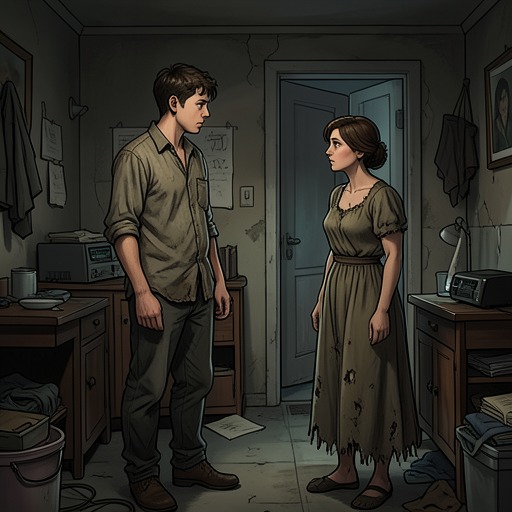
ChowringheeRosie and Mr. Banerjee’s relationship is an attempted escape that turns into betrayal: Rosie considers marrying him and leaving Calcutta, but discovers that he has concealed his existing marriage. The affair exposes the pressures surrounding her life as a hotel worker—poverty at home, racial prejudice, and the damage that public rumor can do to her reputation—while the news of Mr. Banerjee’s return to his family leaves Rosie’s future uncertain.
The proposed escape
Rosie’s relationship with Mr. Banerjee takes shape against severe financial pressure. Her parents and two unmarried sisters depend on her, and she describes her family as living on bread, potatoes, and onions while she has better food at the Shahjahan. She considered marrying Mr. Banerjee and leaving with him, and asked Jimmy to give her hotel job to her sister so that her sister might also have the chance to eat at the Shahjahan. The prospect of marriage thus carried both personal hope and a practical possibility of helping her family.
That hope rested on a false understanding. Rosie says Mr. Banerjee told her he was unmarried. She had learned that he had a wife, and later that he also had a brother; her discovery makes the intended departure repellent rather than liberating. Rosie also rejects the rumor that she went with Mr. Banerjee for money. Although they were in Bombay at the same time, they stayed in different hotels, and hotel restrictions prevented her from visiting his room. Her account distinguishes an attachment and a contemplated marriage from the degrading story others tell about a woman supposedly paid to accompany a man.
Exposure, rumor, and racial stigma
The relationship becomes public through other people’s actions and interpretations. Rosie accuses Bose-da of telling the manager that she had left for Bombay and of presenting a man as Mr. Banerjee’s brother-in-law in front of others. She believes that Shankar, his supposed relative, and his cousin have all damaged her reputation. She also imagines that people will say she took a large sum from Mr. Banerjee and ran away with him. Her distress is intensified by the sense that the hotel community has turned an ambiguous relationship into a settled accusation.
Rosie links that judgment to racial prejudice. She says people call her black behind her back and that, although Calcutta’s residents criticize racial segregation abroad, they treat people like her as outsiders at home. Her family history gives this exclusion a longer context: she tells William Ghosh that her ancestors were Africans, brought in chains to Chandpal Ghat in the early nineteenth century and sold in Murgighata for twenty-five rupees each. Though slavery was later abolished, the descendants remained in Calcutta; many took the surnames of former owners, and, Rosie says, their community still had not entered the native mainstream. Her conflict with Mr. Banerjee is therefore bound up with more than romantic disappointment: the rumors attach social shame to a woman already marked by race, work, and poverty.
Separation and the likely return
The relationship does not end in a marriage. Mr. Banerjee’s wife receives news from her husband, and his brother, Khoka Chatterjee of Bombay, traces him using an address Byron had sent. Chatterjee’s admonitions persuade Mr. Banerjee to return to family life and also succeed in calming Rosie. Since Mr. Banerjee has set out back, Byron considers it likely that Rosie will return as well. This is presented as a likelihood, not as a confirmed account of her eventual destination.
The prospect of Rosie’s return follows the collapse of the escape she had imagined, but it does not erase the conditions that made escape attractive. In a later account of her growing intimacy with William Ghosh, Rosie says she would require at least five years before considering marriage, until her sick parents had died and her sister had married. That later decision underscores the continuing pull of family responsibility: the relationship with Mr. Banerjee offers a rushed way out, whereas Rosie’s stated terms with William make marriage dependent on the future of those who rely on her.