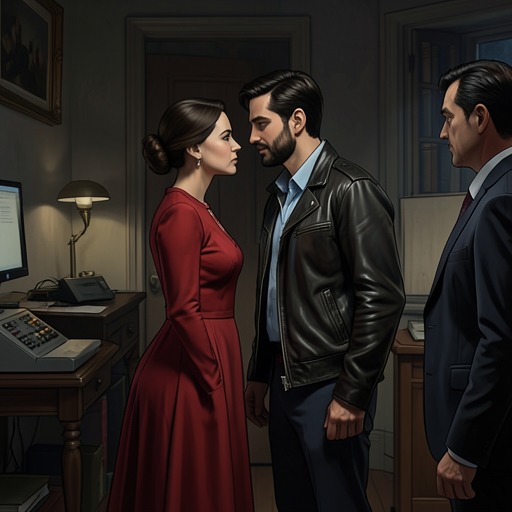
Connie and Lambreta Leave the Shahjahan Hotel
ChowringheeConnie and Lambreta leave the Hotel Shahjahan after the hotel decides to remove Lambreta from their act. Connie refuses the alternative of performing alone: her departure makes clear that the glamorous public role sold to the banquet audience cannot be separated from the private bond she has with her brother. The hotel’s commercial judgment may keep the show running, but it cannot dictate the terms on which Connie will stay.
Background: The Banquet and the Show
The conflict unfolds against the hotel’s grand philanthropic banquet, hosted by the newly established Calcutta branch of the international Sociedad Filantrópica. Three hundred and fifty boar heads prepared by Nityahari waited in the banquet hall, while Agarwalla, Langford, and Khan Bahadur Huq welcomed the guests. The evening was presented as a sacrifice of private pleasure for humanity, the nation, and the world. Satyasundar Bose quietly undercut that public image: Calcutta’s social gatherings recycled the same guest lists, and the newspaper accounts of speeches and summaries had already reached editorial offices before the banquet began. The charity spectacle thus provides a pointed setting for Connie’s own staged appearance, where public presentation and concealed circumstances repeatedly diverge.
The hotel introduces Connie to the assembled guests as an exceptional woman, but the performance begins by withholding her. The lights go out; a restless spotlight searches the stage and finds, instead, a dwarf in evening dress, wearing a towering top hat and carrying a cane. Lambreta’s conspicuous costume turns the audience’s expectation into part of the act. The performance’s theatrical misdirection has a private counterpart: the audience sees roles arranged for entertainment, while the people inside the show are struggling over the conditions under which those roles can continue.
The Hotel’s Decision
The immediate crisis follows Lambreta’s angry outburst at the hotel. He shouts at the waiters and demands a drink on a dry day, ignoring Gurberiya’s warning. Jimmy directs him to approach the manager, and Lambreta knocks on the manager’s door. His confrontation takes place just as the hotel has reason to worry about the show’s business: another hotel has booked the act for ten days, while demand for the Shahjahan performance is lower and some advance reservations have been cancelled. Satyasundar Bose explains that the manager had previously disregarded Jimmy’s suggestion but is now discussing it; Connie may be summoned at once.
The decision that follows is to dismiss Lambreta from the performance. The hotel has no contract with him and intends to send him back as soon as possible. Satyasundar Bose also identifies Connie’s indulgence toward her brother as the practical difficulty, since she has continued to accommodate him. The hotel’s reasoning is commercial and managerial: customers come to see Connie, not Lambreta. The dismissal therefore treats the act as a separable commodity, even though Connie experiences the partnership as inseparable from her family obligations.
Connie’s Choice
Connie tells the narrator that she too is leaving. She will not go on performing while Harry, her brother, is sent away. She asks the hotel for only one favor: that he not learn what has happened. She plans to tell him that she argued with the management and cancelled the contract in a burst of anger, and she hopes the hotel will not pursue or harass him. Her explanation gives the departure its central reversal: rather than tell her brother that the hotel has rejected him, she takes responsibility for the break herself.
Connie believes Harry is trying with all his strength to improve his place in life, without succeeding. If he learns that she gave up her prospects for him, she fears he will lose his struggle altogether. She recalls that Jimmy’s peculiar mockery made her feel sick, but does not cast the hotel staff as simple villains; she recognizes that they know little of the circumstances behind her decision. The narrator sees Connie examining a small photograph, which shows a woman in an unfamiliar city across the ocean, holding a newborn, with a boy of about seven or eight nearby. The image accompanies the disclosure of a family history, but the account does not identify the people in it or explain their full significance.
Connie’s earlier distress is clarified when she asks where she could have gone while leaving Harry to his fate, or how she could have found peace by abandoning him in Scotland. She had included him in the act because she could not leave him behind. Yet the stage work itself torments him: he cannot accept that what Connie must do before an audience is only a performance. She calls him her brother and says she cannot make him understand that this is the profession they have chosen. The show that joins them economically and professionally also exposes the strain between its public fiction and their private understanding.
Departure and Aftermath
Lambreta enters before Connie can say more, and the narrator leaves the room. Later, on the rooftop, Lambreta is packing. He tells the narrator that the hotel has angered them and that they are leaving; he declares that they will never return to the corrupted city. The narrator confirms that they never did. Connie’s departure is therefore not a temporary pause or a negotiated return to the same engagement: both siblings leave the Shahjahan, and the hotel loses the performer whose name had been its attraction.
The ending does not resolve where Connie and Lambreta go or what becomes of their lives. Instead, the narrator’s recollection keeps several versions of Connie in view: the woman seen at dawn, in the afternoon’s quiet, amid the bustle of the show, and in the darkness of night. She remains at once performer, young woman, and sister, an enigma rather than a completed story. The event’s lasting significance lies in that refusal of a neat backstage explanation: the hotel can classify the act by its market value, but Connie’s choice reveals a bond and a vulnerability that its account of the performance cannot contain.