Shankar Is Fired from the Shahjahan Hotel
ChowringheeShankar’s dismissal from the Hotel Shahjahan turns a change in staffing policy into a sudden personal rupture: at the end of the month, the new management tells him his services will no longer be required, and the familiar hotel that had seemed to depend on his versatility becomes a workplace from which he is excluded. The decision is delivered as business, softened by an extra month’s pay, but Rosie’s explanation makes its gendered logic plain: the management wants women at the counter.
The Work Behind the Counter
The dismissal comes against a background of hotel work that depends not only on routine but on carefully managed interactions. At reception, the flow of guests grows after breakfast, leaving little time for idle conversation. Sata Bose turns the repeated exchange of greetings into practiced service, answering each guest with a polished welcome and a personal touch. The counter is thus both a practical workplace and a stage on which staff are expected to keep the hotel’s face composed, whatever the demands behind it.
The pressure of service is especially visible when a guest summons the manager over the color of the bed linen. Marco Polo hurries to answer the complaint, while Shankar follows; faced with the guest’s anger, Marco Polo apologizes and offers three replacement sets. The episode shows how complaints can travel upward through the hotel hierarchy and how employees are required to absorb the strain without displaying irritation. Shankar’s own work likewise extends beyond a single routine: Sata Bose praises his performance as the cabaret’s presenter and imagines him becoming indispensable across the counter, bar, and cabaret. His eventual removal therefore contrasts with the breadth of service he had been encouraged to provide.
The Dismissal
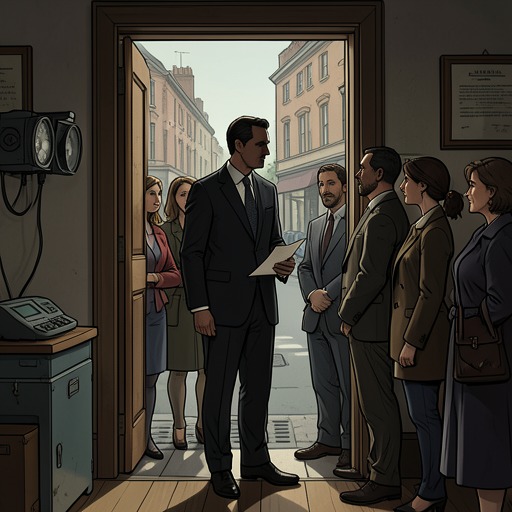
The decision is conveyed in Jimmy’s office, where Phokla Chatterjee is also present. Jimmy apologizes for summoning Shankar at that hour and explains that Phokla Chatterjee will soon inspect the cabaret. Because it is the last day of the month, Jimmy says, the timing is convenient for the hotel as well as for Shankar: from the following day, the hotel will no longer need his services. The notice is abrupt and framed as an administrative arrangement, not as a discussion of his work or a judgment on his competence.
Phokla Chatterjee explains that Marco Polo had employed Shankar on a temporary contract. Under its terms, Shankar has no right to an additional month’s salary. The new management nevertheless chooses not to rely on that provision and gives him an extra month’s pay. Jimmy passes him an envelope full of banknotes, and Phokla Chatterjee ends the meeting without giving him room to respond. The payment recognizes a measure of obligation or consideration, but it does not alter the central fact: Shankar’s employment ends immediately, and the decision has already been made.
Rosie’s Explanation
Shankar feels that his world is collapsing around him and heads toward the roof. There, Rosie is waiting. She tells him that she tried to stop Jimmy while he was typing and pleaded on Shankar’s behalf, but Jimmy had already presented his plan in detail to Phokla Chatterjee. Her explanation identifies the staffing preference behind the upheaval: the management wants only women at the reception counter. Rosie’s presence also makes the decision more painful and complicated. She has not simply accepted Shankar’s dismissal; she says she tried to prevent it, yet her appeal could not overcome the new management’s settled plan.
On the starry roof, Shankar does not blame Rosie. He acknowledges that there was little she could have done and thanks her. That brief exchange places mutual regard beside institutional powerlessness: Rosie can explain the decision and testify to her effort, but neither she nor Shankar can reverse it. The scene closes not with a formal farewell or a new job, but with Shankar receiving her sympathy after the hotel has made his future there impossible.
Significance
The episode draws together two aspects of hotel employment. Shankar’s value has been described in terms of his ability to serve different parts of the establishment, and the scenes around reception and cabaret show the social skill that work requires. Yet his usefulness does not secure his position when management changes its staffing policy. The contrast is sharper because the hotel compensates him beyond the strict terms of his contract while still ending his employment: considerate payment and exclusion coexist.
The firing also exposes the limited power of personal loyalty inside a workplace governed by decisions made above the counter. Rosie’s unsuccessful plea cannot outweigh Jimmy’s plan, and Shankar’s good work, as recognized by Sata Bose, cannot guarantee continuity. The dismissal is therefore more than an individual loss of employment. It marks the point at which the hotel’s changing organization overrides the relationships and abilities that had made Shankar feel needed there.