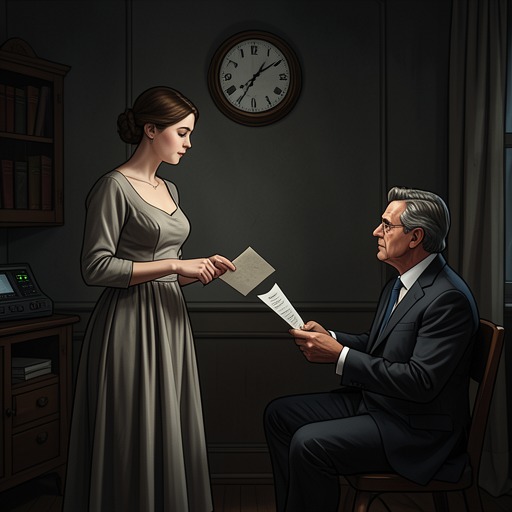
Marco Polo and Lisa Leave the Shahjahan Hotel for Africa
ChowringheeMarco Polo and Lisa’s departure from the Shahjahan Hotel is both a farewell to the hotel and the unexpected resolution of a relationship that began in deception. A plan to fabricate adultery for a divorce has become genuine love; because the law prevents them from marrying in India, they leave for a hotel job in Costa Dorada, intending to spend their lives together as husband and wife. For the narrator, their departure is also a personal loss: the hotel that had filled with familiar faces now seems empty.
From a Divorce Scheme to a Shared Future
The departure’s emotional force rests on the reversal in Marco Polo and Lisa’s relationship. Marco had once paid Lisa to pose as his lover so that he could use the supposed affair as grounds for divorce. The arrangement belonged to a practical plan, not a declaration of love. Much later, however, Marco’s feelings for her became real. Lisa initially doubted that change, but came to believe him when she understood that he had no other motive.
Byron describes the difference not as a grand declaration but as care in the midst of illness. He had seen Marco tending to Lisa and cleaning up after her when she vomited. Lisa’s body had been greatly weakened, and Byron wonders what Marco sees in her now that she has, in his view, nothing left to offer him. The question exposes the inadequacy of treating their bond as a bargain: the relationship that began with a paid performance has come to rest on a care that persists when Lisa is ill and vulnerable.
Lisa has been receiving treatment and has improved considerably in the days before the departure. She wants to visit the Shahjahan Hotel, but Marco does not agree. His reluctance is tied to his distrust of Jimmy: he expects the manager’s bad reputation eventually to reflect on the hotel itself. Their decision to live together therefore accompanies a refusal to return to the hotel as it is changing under new management.
Why They Leave India
The obstacle to the couple’s future is legal as well as personal. Marco does not want to live with Lisa without marrying her, but the law does not allow them to marry in India. Rather than abandon the wish to share a married life, he chooses a different route: he accepts work at a small hotel in Costa Dorada, in Africa. Byron presents it as far from both Europe and Asia, in a poor and unremarkable town. The modest destination contrasts with the couple’s hard-won hope; their future is not promised comfort or status, but the possibility of living together openly as husband and wife.
The move also concludes Byron’s role in the matter. He says that he expects to hear of Marco Polo’s departure within a few days and that he has received money from him. Having spent a long time scarcely able to move because of that responsibility, Byron now feels free to leave as well. Marco’s departure thus releases more than the couple from their immediate predicament: it ends the obligation that had held Byron in place.
The Farewell at the Hotel
The departure becomes visible through the hotel’s ordinary arrangements. Marco’s luggage is loaded into a hotel car, and waiters and other employees stand in a long line in front of the staff office. Dressed in shorts and a white shirt, Marco resembles a ship’s captain. The comparison gives the leave-taking the air of a voyage, although the scene records no grand ceremony: he moves down the line, shaking hands with the staff one by one, while Jimmy stands close beside him.
Before leaving, Marco asks the employees to keep the flag flying and says that, if he ever returns to the Shahjahan, he wants to find its reputation improved. He then turns to the butler and entrusts him with the care of his staff, whom he calls his boys. The appeal links his departure to the hotel’s future: he is leaving its daily life behind, but still measures its prospects by how it treats its people and how it is regarded. His goodbye is directed not only to the building or its managers, but to the employees with whom he has worked.
An Empty Hotel and a New Regime
After Marco leaves, the narrator feels as though he is alone in an empty, cursed castle. He remembers how the hotel had filled with familiar faces when he arrived, then emptied in stages: some people left after breakfast, others after lunch, and others after tea. By dinner, no one remained. The image of a family leaving its patriarch at an empty table turns the staff’s departures into a more intimate loss. Marco’s exit is not simply one more change in hotel personnel; it makes the narrator feel that the community he had belonged to has dispersed.
The hotel’s transformation soon becomes explicit. Jimmy makes clear that it will no longer be run as before, and that everything is to change. In keeping with modern fashion, he brings in a young woman to replace Satyasundar Bose. Rosie had hoped to take that position, believing Jimmy would need her knowledge of correspondence, but he tells her that her appearance makes her unsuitable as the hotel’s principal receptionist. He increasingly assigns William the accounts and records, leaving him to focus on payments and cheques. These changes follow Marco’s farewell and sharpen its meaning: the institution he asks the staff to improve is already moving away from the arrangements and loyalties of his tenure. His departure gives the hotel a new manager and a new direction, while the narrator is left to experience that transition as the emptying of a home.