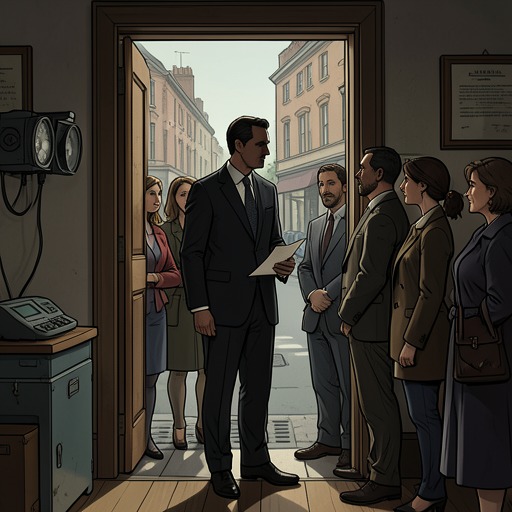
The Narrator Makes a Living Selling Wastepaper Baskets and Gets Help from a Doorman
ChowringheeSelling wicker wastepaper baskets becomes the narrator’s precarious means of survival after his search for work fails, but the episode turns on more than a small sale: a doorman’s practical intervention and unexpected generosity restore the narrator’s belief that kindness still exists. The baskets are worth only a few annas each to him; the greater return is the recognition that someone has helped without asking for a share.
From joblessness to basket selling
After sending applications by the dozen and spending most of what he had saved, the narrator is exhausted and faces hunger. He takes a job as a traveling salesman, a more respectable label for visiting offices and trying to sell wicker wastepaper baskets. His employer, Magpil & Clerk, has the grand sound of an established firm, but its scale is almost comically small. Its owner, a young man from Madras, has only two pairs of rather dirty trousers and a tie; a gloomy room in Chhatawala Lane serves at once as factory, office, showroom, kitchen, and bedroom. The company name itself is fashioned from its owner’s name, while Clerk is simply the firm’s own secretary.
The arrangement offers the narrator four annas for every basket sold. At first, even that modest commission sounds like a route out of his immediate distress. In practice, the work demands repeated rounds through offices, where he looks beneath desks to see whether a basket might need replacing. His prospects depend on the condition of other people’s wastebaskets: when one is damaged, he can present a new one as a useful purchase and advertise its ten-year guarantee. Yet a chief secretary tells him that the basket under his desk is in good condition and could last another year. The narrator’s outward disappointment conceals a more urgent fear: the basket may last, but he feels he cannot endure even one more day. The comic logic of salesmanship is thus set against the bodily pressure of poverty.
A sale and the cost of the commission
An earlier prospective buyer asks for six baskets and warns the narrator not to forget his share. The order promises a commission of one rupee and a half. When the sale is made, the narrator hands over the proceeds and invites the man to take whatever seems fair. The exchange establishes how vulnerable the salesman is to intermediaries who may expect a portion of earnings that are already meagre. The narrator learns to anticipate such demands and, later, arrives prepared to offer the whole commission from another six-basket sale.
That later order begins badly. A woman in an office dismisses the narrator, and he leaves with tired feet after his sales appeals have failed. On a bench near the entrance, however, sits a uniformed doorman with a large moustache and an enormous turban, chewing tobacco and wearing the company name on his chest. He asks what the narrator earns per basket and what one costs. The narrator, having learned not to be naïve about such inquiries, answers cautiously. The decisive change comes when the doorman addresses the woman and points out that Mr. Ghosh has no basket, Mr. Mitra’s is broken, and the director’s is deteriorating. The office should keep replacements in reserve. The woman finally agrees, converting a rejection into an order for six.
The narrator hurries back to Chhatawala Lane, collects the baskets, and returns to the office. They are sent to the storeroom. The doorman’s intervention is concrete and specific: he has noticed the condition of the baskets around him and uses that knowledge to make the case the salesman could not. His help does not erase the narrator’s need to earn a living, but it makes a sale possible where persistence and advertising alone had failed.
The doorman’s refusal of a reward
When the payment is settled, the doorman gives the narrator a voucher and asks whether he can sign, adding that a thumbprint would do if he cannot. The narrator signs in English, prompting the doorman to laugh in surprise. The detail marks a small reversal in their positions: the poorly paid salesman, treated as an object of suspicion and pity, possesses a skill the doorman had not expected. The narrator leaves with the money and, remembering other doormen, expects to divide his commission. This time he has already prepared for that possibility.
He holds out one rupee and fifty annas, identifying it as his commission and telling the doorman to take what he wants. The gesture is meant as a fair, perhaps cautious, payment for assistance. Instead, the doorman turns pale, his upright figure trembling as his friendly expression disappears. The narrator initially mistakes this reaction for dissatisfaction with the amount and is ready to insist that the six baskets have earned him no more than a rupee and a half. He has misunderstood the man entirely. The doorman rebukes him for assuming that he arranged the purchase to obtain a commission: he had felt sorry for the narrator and intervened to help, not to profit.
The misunderstanding makes the kindness legible. Until the narrator offers money, the doorman’s motives remain open to the ordinary suspicion that an intermediary expects a cut. The offer exposes that expectation and lets the doorman reject it plainly. His anger is not over the size of the payment but over the assumption that compassion must conceal a bargain. The narrator cannot hold back his tears. The sale has brought in money, but the deeper consequence is the collapse of his conviction that the world has been stripped of all goodness.
Encouragement and significance
The doorman asks the narrator to sit and gives him a cup of tea. As the narrator drinks, the man puts a hand on his shoulder and invokes Sir Hariram Goenka, whose bronze statue stands in front of the governor’s house. He says that Goenka, too, had struggled to survive, recognizes the same fire in the narrator’s eyes, and predicts that he may one day become as great. The encouragement links the narrator’s present vulnerability with a story of eventual achievement, without pretending that his immediate hardship has disappeared. The tea and the hand on his shoulder make the reassurance physical as well as verbal.
The episode’s movement is from hunger and failed applications, through the humiliating uncertainty of street-level selling, to a six-basket order and an act of assistance that cannot be reduced to money. Its two figures occupy different positions in an office hierarchy, but the doorman uses his local knowledge and authority to make the sale happen, then refuses the commission the narrator assumes he must want. The narrator leaves not simply with the proceeds of his work but with a renewed sense that survival may depend on unadvertised acts of solidarity. The doorman’s reference to the statue gives that hope a measure of ambition; his own conduct gives it immediate proof.