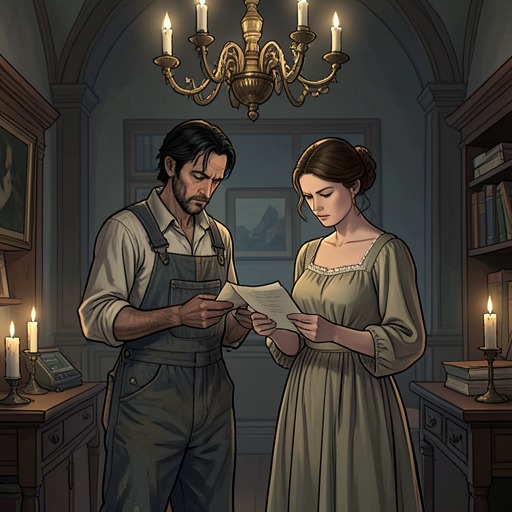
Marco Polo Meets and Marries Susan Munro
ChowringheeMarco Polo Meets and Marries Susan Munro is a turning point in Marco Polo’s life: a chance encounter over dinner becomes a marriage, and the marriage prompts him to leave Calcutta for Rangoon. Their courtship grows from his fascination with Susan’s singing and sympathy for her precarious circumstances; their move reflects his belief that a fresh city might give her a future unavailable in the place where she was already known.
Identity and Background
By the time Marco Polo meets Susan, he has worked his way up through the hotel trade to Calcutta. He is described as diligent, and his advancement has brought him into a world shaped by hotels, restaurants, and bars. Yet he has tried to keep clear of the life’s temptations: he attends church on Sundays and, when he can, travels by train to Bandel Church to light candles and pray. His hotel career is therefore both the setting for his encounter with Susan and a life from which he sometimes seeks respite.
Susan has also had to make her own way. Both her parents are dead, and a charitable organization raised her, trying to equip her to manage independently. As an adult, she first sold cakes at a Swiss bakery near New Market. Music, however, mattered more to her than that work: she was drawn to singing and the possibility of fame, and was willing to perform in restaurants without pay. Her story, as Marco later learns it, runs parallel to his own in the hardships and uncertainty each has faced, though the account does not reduce their different lives to identical ones.
The Encounter and Courtship
Seeking a break from the bustle of his hotel, Marco goes one night to a small restaurant on Park Street for dinner. Susan is singing there. Her voice quickly takes his attention from his meal; he listens, then invites her to his table. Marco sees her as a striking, almost mythical figure, although the account makes clear that this impression is not simply a judgment of conventional beauty. His response to her performance is immediate: the singer, rather than the dinner or the room, becomes the focus of the evening.
The meeting also exposes the instability of Susan’s work. She explains that she has been allowed to sing because another performer, Lisa, is recovering from a broken leg. When Lisa’s doctor removes the cast, Susan expects to lose her place. The opportunity she has found is thus temporary, dependent on another woman’s injury rather than on any secure position of her own.
Marco and Susan meet again at the restaurant. He tries to reach her emotionally and asks how she learned to sing; she tells him that music school was beyond her means. Gradually he hears more of her history, first at the restaurant and later in her rooms. Her route to performing has required long days: she stands selling cakes at the bakery, then goes straight to the restaurant to change and sing, without time to return home. The venue offers no women’s bathroom. She has to ask a waiter to stand guard while she changes in the shared lavatory, whose stench nearly makes her vomit. Her artistic ambition is real, but so are the indignities and bodily discomforts built into the work through which she pursues it.
Marriage and Departure
Susan’s lack of parents moves Marco and draws him closer to her. His sympathy does not rest on her voice alone, or on youth as a guarantee that the relationship will last: he recognizes her vulnerability and lets himself commit. The narrative presents this change as a surrender of caution, culminating in his taking Susan to the hotel as his wife. It gives no wedding date or account of a ceremony; what it emphasizes is the decisive change in their relationship, from the singer he met over dinner to his spouse.
Marriage does not make Calcutta an easy place for Susan to begin again. Marco believes that everyone there knows her and that her history of selling her singing in Park Street will prevent her from rising to the heights associated with Chowringhee. To give her a chance beyond that reputation, he accepts a hotel-manager position in Rangoon. The owners tell him there is no need to hurry and that he may one day manage their hotel; he laughs, but the move is nonetheless a deliberate choice. He is prepared to leave the city where he has advanced in order to seek a place where Susan’s past is unknown.
Significance of the Episode
The marriage is formed through both attraction and practical care. Marco is captivated by Susan’s singing, but the account gives equal weight to the insecurity beneath her performance: the job may vanish when Lisa recovers, her training has been blocked by poverty, and even changing clothes requires help from a waiter. Their affection emerges amid these pressures rather than outside them. The parallel between their histories helps explain Marco’s attachment, while his decision to relocate gives that attachment a concrete consequence.
The episode also establishes a tension that its hopeful gesture cannot settle: a new city may conceal Susan’s past, but the account does not promise that a change of place will secure the fame she wants. Rangoon is presented as a chance to begin without Calcutta’s knowledge of her, not as proof that every obstacle has disappeared. Marco’s marriage and departure therefore mark a new shared course, built on his commitment and his hope that distance can loosen the hold of reputation.