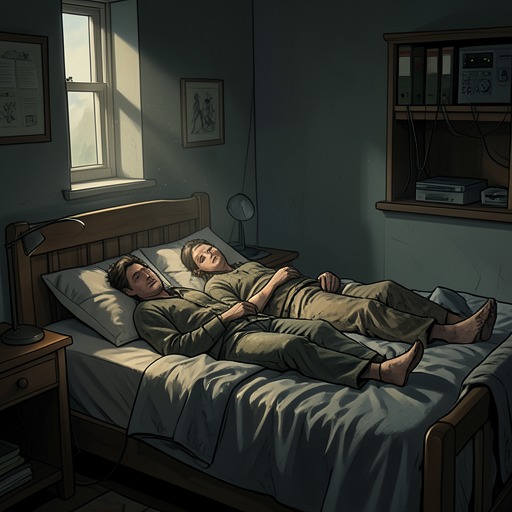
The Smallpox Tragedy in Williams Lane
ChowringheeThe Smallpox Tragedy in Williams Lane is a chain of illness and loss witnessed, and partly carried, by the poor neighborhood boys who refuse to abandon Jane Grey and Robert Adam. As Hobbs recounts it to Shankar and Sutherland, their care takes the form of saved coins, temple flowers, borrowed funeral money, and a willingness to serve as pallbearers. Those gestures cannot prevent either death, but they give the tragedy its measure of human solidarity—and sharpen its contrast with the hotel bar continuing to serve whisky while a family’s life collapses.
A story told by Hobbs
The episode reaches Shankar and Sutherland through Hobbs, whose narration carries them into events the two listeners did not witness directly. The structure matters: a local tragedy, largely absent from official accounts, survives because someone tells it and others listen. Shankar is moved to tears at the end; Sutherland, accustomed as a doctor to encountering death, shows no outward sign of being similarly shaken. Their different responses frame the story not as distant medical information but as testimony that can still overwhelm a listener.
The central figures are Jane and Robert, a married couple living in poverty in Williams Lane. During Robert’s illness, the neighborhood boys visit him at the hospital, though a sign marks the place as forbidden to visitors. They bring flowers from the temple and give the guard coins they have saved, asking him to place the flowers beneath Robert’s bed. Their explanation is simple: Robert is not a relative, but he lives in their neighborhood and is as poor as they are. The boys have little money to offer, yet they make what they can into practical care.
Illness, mistaken news, and Jane’s death
The guard tells the boys that patient number thirty-two has lost his sight. The report reaches them as total blindness: they ask whether Robert will never see again, and, in tears, consider collecting enough money to take him to a specialist who charges eight rupees for a consultation. The guard has disappeared before they can learn more. The detail exposes both the boys’ limited access to reliable information and their immediate impulse to search for help, even when the cost is beyond their means.
They do not want to tell Jane what they have heard. When she asks how Robert is, they attempt to hide the truth, but they are unused to lying; their tears give them away, and one boy breaks down. Jane faints. The boys carry her to the priest’s house, where that same night she gives birth prematurely. In the early morning, the priests kneel and pray for her as she lies dying. She dies before the night is over, leaving the boys devastated.
The story places this death beside the continuing noise of the Hotel Shahjahan bar. Even as Jane dies, the bar has not closed and customers are still calling for whisky and soda. The contrast does not suggest that the two worlds are wholly separate: the hotel’s ordinary service continues within the same city as the boys’ grief. But its unbroken routine makes the loss seem all the more exposed. Jane’s death is intimate and consequential to those around her, while the city’s commercial night carries on without pause.
The boys’ care and the funeral arrangements
After Jane’s death, the priest corrects the frightening report about Robert. The doctor had found that Robert had lost the sight of one eye, not both; the other had been miraculously spared. By the time the boys hear the correction, however, Jane’s body has already been covered with a white sheet. The reversal restores a measure of hope about Robert’s condition but cannot undo the death that the boys’ earlier misunderstanding helped them conceal from Jane.
The boys ask to be present and offer to act as pallbearers, ready to do whatever is needed. The priest explains that a Christian funeral requires more than their willingness and that the arrangements must be made through Llewellyn & Company, which has handled such matters for years. That night the boys go to Llewellyn, the funeral director. Their involvement shows them trying to cross the gap between their poverty and the practical demands of burial: they cannot take charge of everything, but they will not leave the dead without care.
Robert, meanwhile, begins to recover. His ulcers have dried, his fever has fallen, and the agonizing state he had endured has passed. During his illness he seemed to have forgotten everything; as he improves, his memory returns, including the fact that he left Jane alone in a miserable flat in Williams Lane. He asks where his wife is. The question marks the turn from bodily recovery to the knowledge that will undo it: Robert has survived the acute illness, but the person he expects to find is gone.
Robert’s death and the boys’ final offering
When the boys report what has happened, the priest consults the doctors, who leave the ward open to him so he can explain the news. He has often brought comfort to people in distress, but his care cannot soften the truth enough to protect Robert. On hearing that Jane has died, Robert collapses. That night his fever rises; he throws his glass of milk to the floor and refuses food. The doctors make every effort, but nothing succeeds. Recovery gives way to another death, now precipitated by the news of the first.
The boys return to Llewellyn in the darkness. The funeral procession sets out from the hospital for the Lower Circular Road Cemetery. For Jane, the boys had bought a large wreath; for Robert, they have borrowed money to buy a cheaper one, which they place on the hearse. The distinction records the hard limit on what they can afford without diminishing what they give. Their resources are meagre, but they spend them on remembrance, and the borrowed wreath becomes a final, visible expression of neighborhood loyalty.
The account closes without resolving the newborn’s future. The priest returns home with the baby, and Hobbs says he does not know what happened afterward. That admitted gap keeps the ending from turning grief into a complete, consoling resolution: Jane and Robert are dead, the boys have done what they could, and the surviving child passes into the priest’s care beyond the reach of the story as told. The tragedy’s final emphasis is therefore not on rescue, but on acts of care that persist even where they cannot prevent loss.