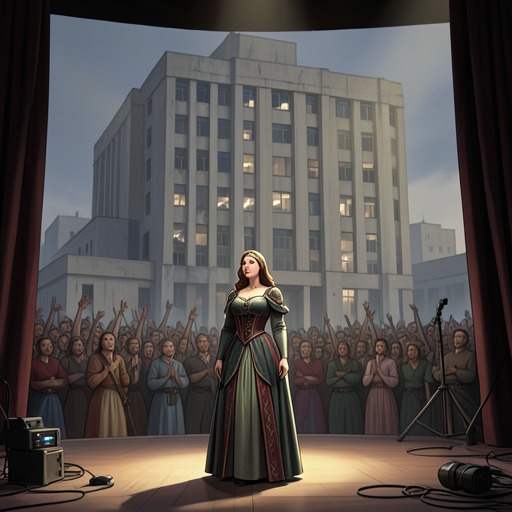
Connie's First Performance at the Mumtaz Bar
ChowringheeConnie's First Performance at the Mumtaz Bar is presented through a hotel banquet where a carefully managed stage deception gives way to Connie’s dance and undressing. The performance makes its audience wait, misrecognize what it sees, and then participate in the spectacle; its glamour depends as much on the crowd’s expectations as on Connie’s skill. In the episode, the narrator is not merely an observer: Sata Bose recruits him to announce the act and help sustain its elaborate misdirection.
The Banquet and Its Public Script
The show unfolds amid a formal banquet hosted by the recently established Calcutta branch of the international Sociedad Filantrópica. Its organizers and guests describe their presence as service to humanity: busy people, they claim, have set aside private troubles and pleasures to spend the evening serving society, the nation, and the world. The tableau is carefully dressed. Agarwalla wears a bandhgala and churidar, Langford a formal Western suit, and Khan Bahadur Huq clothing that reflects Mughal tradition. The banquet hall itself has been prepared by Sata Bose, while Nityahari’s handiwork has supplied three hundred and fifty boar heads for its decoration.
The charitable language sits beside the hotel’s less public arrangements. Sata Bose tells the narrator to keep an eye on Agarwalla because his company permanently rents suite number two as a guest house. Karabi works there as his housekeeper and receives a large additional payment alongside her salary. That detail places the banquet’s public display of benevolence against the private arrangements and unequal relationships that it leaves out of view.
Sata Bose also describes the social circuit that fills such occasions: the same guests receive invitations drawn from the same lists, dressing for a different hotel, club, or private house each night. He warns the narrator that tomorrow’s reports will not record what actually happened. The newspapers, he says, publish speeches and summaries already delivered to their offices before the banquet begins. The event thus has a public script before its guests arrive: its respectable account is prepared in advance, while the live performance is something else entirely.
The Announcer and the Substitute Connie
By the time the act is due, Sata Bose is suffering from a bad cold and can barely speak without coughing. Marco Polo agrees to give the younger narrator his opportunity. The band led by Gómez keeps playing in a corner as Sata Bose signals from the doorway; the bright corner lights go out, the narrator takes his place before the stage with a microphone in his left hand, and the orchestra stops at his cue. Facing the expectant attention of seven hundred eyes, he introduces Connie as a singular woman, made by God in this century.
The introduction raises anticipation, but the stage initially refuses to satisfy it. All the lights go out. A narrow spotlight wanders across the darkness, briefly searching the stage without settling on its occupant. When it strengthens, the figure revealed is not Connie but a dwarf, half a metre tall, in evening dress, sporting a one-metre top hat and carrying a cane. Climbing onto a chair, he begins to introduce himself as Connie, then stumbles between calling himself the man and the woman before insisting that he is Connie the Woman. The audience responds with boos and demands for Connie.
The confusion is part of the act. The narrator steps back to the microphone and pretends to be bewildered too. He tells the guests that, minutes earlier, he saw Connie in her dressing room, already dressed and ready after taking a vitamin pill, and that she had sent him to announce her. The sudden appearance of the tiny figure is presented as an inexplicable interruption. Rather than expose the trick, the narrator helps keep it alive, turning the audience’s disappointment into another beat of suspense.
Connie Appears and Takes Control
A moving spotlight finally reveals Connie sitting on a man in the front row, her arms around his neck. She wears a tiara and necklace beneath a multicoloured robe that covers her from neck to ankles. Other lights converge as she draws her captive toward the stage and greets the audience. The man struggles free only with difficulty, then returns to his seat, panting. The narrator introduces Connie by recalling her television appearances and performance before King George VI, before recasting each guest as her king and emperor for the evening.
The next turn sends the substitute back into the act. Connie throws Lambreta to the floor; some guests roll with laughter, and he runs away when the lights briefly flare. The narrator announces the dance. Connie smiles at him, removes the heavy robe, dances away from the stage, and settles on a guest’s lap. She takes the handkerchief from the man beside him to wipe away sweat. The movement of the performance through the room brings the guests physically into its space: they are not only watching from their seats but becoming its props and participants.
As the dance continues, Connie begins removing her clothes one piece at a time. Her tiara and gloves come off, followed by her blouse, and the audience’s excitement rises at the prospect of seeing more. Instead, successive layers of clothing prolong the reveal. The narrator remembers Gómez’s face tightening with revulsion and weariness while the musicians continue to play frantically, like machines. At the moment Connie is fully exposed, the hall goes dark. She picks up a garment, covers herself, and disappears. When the lights return, the guests erupt in prolonged applause; Lambreta, by contrast, slowly gathers the scattered skirt, underwear, bra, and blouse from the floor.
Balloons, Participation, and the Close
The performance moves into another sequence of darkness, with the sound of a necklace and Gómez’s instruments filling the hall. As the lights gradually return, Connie is onstage without clothing, covered instead by hundreds of balloons. Coloured lights mingle with their colours as she dances among the guests. She gives one spectator a pin and invites him to burst a balloon near her breasts. Another guest bursts one in turn. As the balloons disappear, more of Connie’s body is exposed, and the narrator describes the room’s excitement becoming increasingly difficult to restrain.
The balloon sequence makes the audience’s role unmistakable. Spectators do not simply receive the spectacle: invited forward with pins, they help uncover it, one burst balloon at a time. The show’s suspense is built from a controlled alternation of concealment and exposure, but the crowd’s response grows beyond the neat boundaries of a seated audience. Connie’s performance is a crafted act; the guests’ participation makes visible the appetite on which that act trades.
When the lights come on again, the narrator notices one of Connie’s shoes nearby. Gómez and his assistants pack their instruments with lowered eyes, and the narrator thanks the guests on behalf of Connie and the Hotel Shahjahan before wishing them good night. There is no response. The silence after the applause leaves the close oddly bare: the public address ends, the band packs away, and the guests offer nothing back. The episode has moved from a humanitarian banquet’s prewritten public face to a live performance whose central attraction is the crowd’s own involvement.