Veni Creator
ConclaveVeni Creator is the hymn sung by the cardinals as they return to the Sistine Chapel after the attack, and it marks a turning point in Jacopo Baldassare Lomeli’s response to the papal election. The hymn moves from a collective plea for peace and protection to a private act of surrender: as he sings with the others, Lomeli senses the Holy Spirit among them and becomes willing to accept the outcome, even if the papacy falls to him.
The Procession and the Hymn
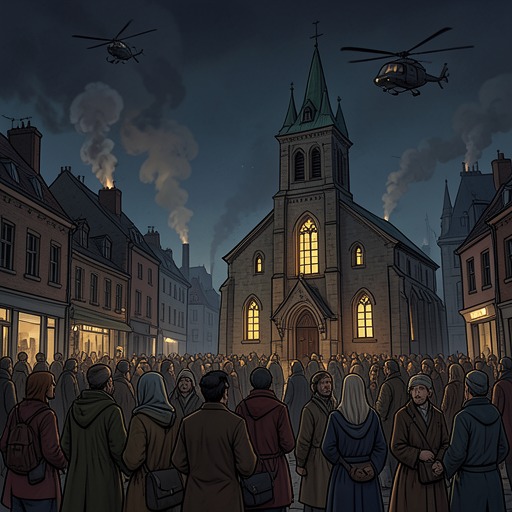
The singing begins within a group moving through the Vatican complex. Lomeli walks at its centre, holding the hand of the Archbishop of Genoa, De Luca, with one hand and holding on to Löwenstein with the other. Behind him, Joshua Adeyemi starts the Veni Creator in a voice described as magnificent; the others gradually join in. The hymn is not presented as a solo prayer or a formal performance. Its force lies in the way one voice becomes the voices of the procession.
The words heard in the passage ask that the deadly foe be driven away, peace be brought, and the singers be led safely through peril beneath a sacred wing. Their appeal carries particular weight after the violence that has shattered the ordinary course of the election. As the cardinals sing while crossing the courtyard and climbing the steps to the Sala Regia, the prayer for safety belongs both to the words of the hymn and to the vulnerable group singing them together.
Prayer in an Unlikely Setting
The setting sharpens the hymn’s significance. Lomeli experiences the moment in a cobbled courtyard, with bare brick as the Conclave’s immediate surroundings: hardly a setting that seems to offer religious grandeur. Yet it is there, rather than in a richly adorned chapel, that he feels the Holy Spirit moving among the cardinals. The hymn makes that plain, unadorned space the site of a spiritual change without making the physical scene itself splendid.
The change is inward and decisive. Lomeli gives thanks to God and, for the first time, feels at peace with the outcome. His thought turns to the possibility that the election may choose him: should the lot fall to him, he will accept it. That willingness does not mean he has sought the office; it means that his earlier resistance no longer determines his response. The hymn’s collective plea for guidance accompanies his relinquishing control over what comes next.
From Communal Song to Personal Surrender
The passage sets the hymn’s shared voice against Lomeli’s intimate prayer. As he sings with the cardinals, he gives voice to their appeal for peace and protection; within that communal act, his own prayer accepts the possibility of suffering and asks that God’s will, rather than his own, be done. The movement is not from doubt to certainty about who should become Pope. It is from anxiety about the outcome to peace with accepting it.
That distinction matters to the hymn’s role. It does not reveal the result of the election or promise that danger has passed. Instead, it changes the terms on which Lomeli faces uncertainty. He can remain receptive to God’s presence without knowing whether he will be chosen, and he can regard the office as a burden he may have to receive rather than a prize to win. The hymn thus binds the cardinals’ shared vulnerability to Lomeli’s private act of surrender.
Return to the Sistine Chapel
The song continues as the cardinals climb to the Sala Regia and cross its marble floor. Lomeli looks up at Vasari’s fresco of the Battle of Lepanto, where a grotesque Death wielding a scythe stands behind the rival fleets of Christendom and Islam. The painting returns him to the conflict that has occupied the Conclave, but his attention also falls on the hopes that have been submerged: he wonders whether Goffredo Tedesco will ever again be able to look at the fresco. The procession’s singing carries the new peace Lomeli has found into a space marked by images of death and battle.
At the Sistine Chapel, the broken glass has been removed and timber sheets are stacked ready to board up the windows. The cardinals enter in pairs, pass through the screen, and disperse to their desks. Lomeli goes to the microphone beside the altar and waits for the assembly. His mind is clear and receptive to God’s presence. The hymn’s work is therefore not simply to accompany the return: it helps frame the threshold between the damaged, dangerous world outside and the discernment the cardinals must undertake within.
The Veni Creator’s place in this sequence is both communal and personal. Adeyemi begins it, the cardinals take it up, and Lomeli’s changed willingness emerges while he sings among them. The words ask for peace amid peril; the scene answers not with certainty about the election, but with an acceptance of uncertainty as a setting in which he can hear and answer God’s summons.