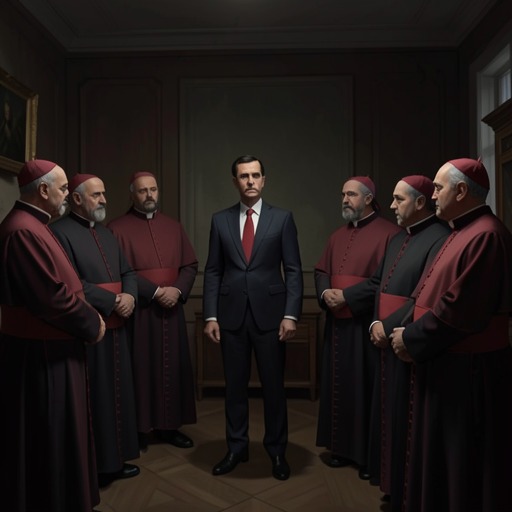
Let God grant us a Pope who sins, and asks forgiveness, and carries on
Conclave“Let God grant us a Pope who sins, and asks forgiveness, and carries on” is a line from Jacopo Baldassare Lomeli’s homily that returns during the conclave as both a statement of fallible faith and a contested defense of Joshua Adeyemi. Its second use gives the phrase a sharper edge: Adeyemi invokes it while answering questions about his past, making the distinction between having sinned and being fit to lead the Church part of the immediate dispute.
First Use: Unworthiness and Faith
Lomeli’s homily joins humility to doubt. In conversation with Vincent Benítez, Benítez argues that a truly worthy man must consider himself unworthy, connecting that stance to Lomeli’s claim that faith cannot exist without doubt. Benítez says that what he witnessed in Africa would make any man sceptical of God’s mercy; the homily’s appeal to a Pope who sins and asks forgiveness answers that uncertainty not by promising perfection, but by imagining continued faith after failure.
Lomeli then asks Benítez to vote for a brother with a realistic chance of winning, naming Aldo Bellini as his preferred choice. Benítez declines: Bellini seems to him, in the phrase the late Pope had once used, “brilliant but neurotic,” and he says he will vote for Lomeli instead. The line about a sinful Pope thus arises amid a practical effort by Lomeli to turn support away from himself, while Benítez reads the homily as a personal expression of experience rather than a reason to withdraw his vote.
Adeyemi’s Reuse of the Homily
The phrase returns when Lomeli confronts Adeyemi about his past relationship with a woman. Adeyemi insists that he has no current relationship with her, says he had not seen her for thirty years until she appeared outside his room the previous night, and claims he did not recognize her. Lomeli sets those circumstances aside for the moment and tells him that the condition of his soul is what concerns him.
Adeyemi answers by declaring his love for God and the Church and saying he sensed the Holy Spirit that morning. He then quotes Lomeli’s homily back to him, asking whether a single lapse thirty years earlier disqualifies him or might instead make him stronger. In the exchange, the line shifts from a general hope for a merciful, imperfect Pope to a direct defense of Adeyemi’s own claim to accept the papal burden.
Repentance and the Limits of the Phrase
Lomeli responds not by disputing the homily’s words, but by asking whether Adeyemi sought forgiveness and confessed. Adeyemi says that he confessed at the time, that his bishop moved him to a different parish, and that he never lapsed again. He adds that such relationships were not uncommon then and describes celibacy as culturally alien in Africa.
The two appearances therefore leave the phrase’s moral force unsettled rather than reducing it to a simple endorsement of Adeyemi. The homily makes room for sin, forgiveness, and continued service; Adeyemi uses that teaching to argue that a past lapse need not bar him. Lomeli’s questions keep attention on confession and the state of the soul, while Adeyemi’s account also introduces the circumstances of his reassignment and his claim that the lapse did not recur. The phrase’s return makes its central tension explicit: accepting human fallibility does not by itself answer how a candidate’s past should be weighed.