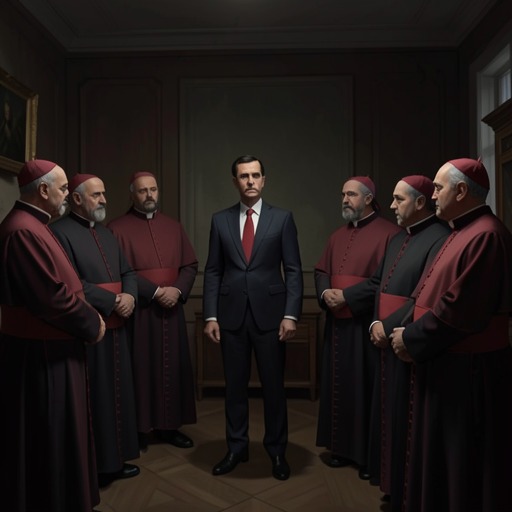
Dictatorship of relativism
Conclave“Dictatorship of relativism” is Cardinal Scavizzi’s name for the danger he sees in accommodating the Church to every competing modern idea. In his address to the cardinal-electors, the phrase turns a storm-tossed ship into an argument for firm doctrinal direction: the next pope, he says, must hold the rudder fast rather than let the Church drift. Its force is sharpened by the conclave around it, where appeals to certainty coexist with disputes over canon law, electoral procedure, and legitimate authority.
Meaning and Metaphor
Scavizzi places the phrase within an image of the Church as the Barque of St Peter, battered by winds and waves. He lists atheism, nationalism, agnosticism, Marxism, liberalism, individualism, feminism, and capitalism as forces seeking to divert it from its course. The list gathers sharply different movements beneath one nautical metaphor: each is presented as a pressure on the Church’s direction, not as an idea deserving equal weight.
His warning is not simply that change is constant. Scavizzi argues that accommodation to every passing sect or modernist fad would amount to surrendering judgment itself. Against that drift, he insists that some ideas possess greater value than others and that the Church cannot survive by treating every opinion as equally authoritative. The phrase “dictatorship of relativism” names the perceived paradox: a culture of unrestricted accommodation can itself become a coercive rule, compelling the Church to abandon distinctions it considers essential.
The Conclave Address
The expression appears in an appeal about the immediate choice before the electors. Scavizzi urges them to choose a new captain who will ignore internal doubters and keep the rudder steady. He closes by asking that the Holy Spirit guide them toward a pastor who can end what he calls the recent drifting and return the Church to knowledge of Christ, love, and joy. In this setting, the phrase is both diagnosis and electoral prescription: it frames the selection of a pope as a decision about whether the Church will resist or accommodate the currents Scavizzi has named.
The delivery gives the argument a striking physical ending. After letting go of the microphone, Scavizzi bows unsteadily to the altar and leans heavily on Archbishop Mandorff as he limps down the aisle. The room watches in silence. The frail speaker’s insistence on a firm course is thus carried away in a visibly precarious body, while the address itself has been forceful enough for Lomeli to suspect that the Patriarch of Venice had known what was coming and might even have written it.
Certainty, Law, and Authority
The phrase’s confidence sits beside a conclave in which authority is not self-executing. When Lomeli learns that the late Pope may have created a cardinal in secret, he recalls the revised canon law on in pectore appointments and the precedent of an unnamed cardinal created in 2003. The possibility that the concealed appointee is the Church’s senior representative in Baghdad makes secrecy a matter of safety as well as status. The dispute is not settled by a general appeal to papal authority: Lomeli argues that the relevant question concerns canon law, and invokes the Apostolic Constitution’s provision allowing a cardinal-elector to join the election re integra, before a new pope has been elected.
The ballot ritual supplies another contrast between fixed rules and contested judgment. Lomeli reads aloud the prescribed procedure: each elector displays and carries a folded ballot to the altar, swears that the vote reflects what he believes should be done before God, places it in the receptacle, and bows. He then writes BELLINI on his own ballot. The procedure regulates how a vote is cast, but its oath still locates the elector’s decision in personal judgment before God—a qualification that complicates any easy equation of unity with uniformity.
That tension becomes urgent after bombs explode in the Roman piazza while black smoke continues to rise from the Sistine chimney. Lomeli weighs suspending the conclave out of respect for the victims against the leadership vacuum that suspension would prolong; accelerating the vote, meanwhile, would violate the Apostolic Constitution and could leave the new pope’s authority open to challenge. O’Malley urges him to break the rules, but Lomeli fears that even slight doubt about the election’s legality would undermine the pontificate from its first day. The crisis makes the limits of certainty concrete: a desired result cannot by itself settle whether the process that produces it is legitimate.
The Phrase in a Divided Assembly
When Lomeli addresses the assembled cardinals after the attack, he first asks for the conclave’s authority to speak, citing the Constitution’s permission for special discussion when a majority agrees. The appeal to procedure is not incidental. It places disclosure within a rule-bound meeting even as the emergency threatens to overwhelm ordinary deliberation.
Tedesco objects, but a joke about whether the Patriarch of Venice also intends to ignore explosions draws laughter, and Lomeli moves to a vote on whether the conclave should receive the information. Scores of scarlet-sleeved arms rise in favor; Tedesco, Krasinski, Tutino, and roughly a dozen others oppose. Lomeli declares the motion carried and says anyone unwilling to hear him may leave. No one does. The sequence does not directly refute Scavizzi’s warning, but it reveals the contested ground beneath it: appeals to doctrinal firmness occur amid disagreement over information, law, and the authority to decide. The phrase is therefore less a resolution of the conclave’s conflicts than a polemical claim about what is at stake in them.