The Barque of St Peter
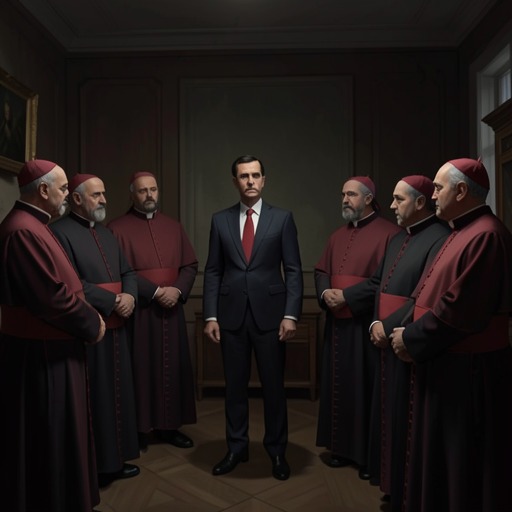
ConclaveThe Barque of St Peter is the image Cardinal Scavizzi uses for the Catholic Church in a speech to the cardinal-electors: a ship in a storm whose captain must hold to a true course. The metaphor turns a dispute over doctrine and leadership into a question of navigation, but the surrounding evidence makes the image uneasy. The Church is threatened not only by the outside forces Scavizzi names, but also by failures and conflicts within its own administration.
The Ship and Its Storm
Scavizzi invokes St Paul’s warning against being swept about by every wind of doctrine, then identifies the Church as a boat in a storm. The winds, he says, bear the names of atheism, nationalism, agnosticism, Marxism, liberalism, individualism, feminism, and capitalism. In his formulation, these currents threaten to divert the Church from its proper direction; the metaphor gives a concrete shape to his call for doctrinal unity.
The ship image also makes leadership a matter of steering. Scavizzi tells the cardinal-electors to choose a new captain who will hold the rudder fast, and rejects accommodation to every modern trend as a loss of direction. His desired Church is not one that moves with the world, but one that moves the world. The language casts the election as a choice between drift and purposeful passage, while presenting the captain’s firmness as essential to the vessel’s survival.
A Contested Course
The speech is not a neutral description of a shared danger. Scavizzi names diverse political, social, and intellectual movements as threats and warns against relativism; his storm is therefore also a rhetorical map of the Church’s ideological divisions. By presenting opposing currents as forces that would push the ship off course, he argues for a particular understanding of fidelity and authority.
The scene reveals the political stakes of the metaphor. Scavizzi’s address is met with a silent audience, and he leaves the chapel leaning heavily on Archbishop Mandorff. Lomeli recognizes that Cardinal Tedesco had expected the speech and considers whether Tedesco may even have written it. The ship’s call for a captain thus enters the conclave as an intervention in its contest over who should lead and what direction the Church should take.
The Image Against the Evidence
Elsewhere, the novel supplies a different account of danger to the Church’s course. A document prepared for the late Pope lists Curial apartments, including the unusually large residences of several cardinal-electors, against his own 50-square-metre quarters at Casa Santa Marta. An attached assessment estimates that the Administration of the Patrimony of the Apostolic See held 347,532 square metres of property, potentially worth more than €2.7 billion, while its stated book value was €389.6 million; the reported paid occupancy rate was only 56 percent, suggesting that much income was not properly declared. The facts shift attention from external winds to the stewardship of the ship itself.
Cardinal Bellini describes the late Pope’s efforts to confront that problem: he demanded proper accounts, disclosure, competitive tenders, and receipts, then brought in accountants and management consultants to examine the files. Bellini says the reforms provoked hostility and leaks, while allegations of misuse of funds and attacks from Tedesco’s faction further isolated the Pope. The Barque’s danger, in this account, includes not only what might divert it from outside but also the resistance of those responsible for its internal administration.
Leadership and the Rudder
The metaphor’s insistence on a captain contrasts with the actual limits of institutional oversight. The official timeline of the Pope’s death records when he ate, retired, was found unresponsive, received emergency treatment, and was pronounced dead. But Archbishop Woźniak later tells Lomeli that, after Cardinal Tremblay took control of the situation, Tremblay privately asked what the Pope had been concerned about at supper. Woźniak says he withheld details because he was frightened and believed he was not supposed to know them; he also suspects Tremblay discouraged Monsignor Morales from speaking. The orderly public record and the concealed conversation expose how much control of the narrative can matter alongside formal authority.
Scavizzi’s image ultimately makes the papal election a choice about direction, but the novel leaves the image under pressure. A ship may have a captain and a rudder, yet its passage depends on the conduct of those aboard and the integrity of its stores and records. The contrast between the speech’s call for steadfastness and the evidence of internal resistance gives the Barque its double force: it is at once an emblem of unity and a vessel whose dangers cannot be attributed to outside currents alone.