The detective's fair play
CurtainThe detective’s fair play is Hercule Poirot’s chosen standard for revealing his murder of Stephen Norton: although he could have presented the shooting as an accident, he instead leaves a trail of clues and explicitly invites Arthur Hastings to solve the case. The principle turns the conventional promise of a fair-play mystery inward. The detective, who ordinarily interprets evidence for others, makes himself the concealed culprit and puts the fairness of the puzzle to the test.
A deliberate alternative to concealment
Poirot contrasts Norton’s “perfect crimes” with his own, which he says were not intended to be perfect. The distinction is practical as well as moral: he says the easiest way to kill Norton would have been to shoot him openly with his small pistol, then profess regret and let others attribute the death to an accident. He rejects that course, not because it would be difficult to conceal, but because he has chosen to be “sporting.”
His explanation makes the choice a form of personal accountability. Rather than relying on a false account of an accidental death, he tells Hastings that he is playing fair, giving him a chance to discover the truth. The language of a game does not undo the murder; it defines the conditions under which Poirot is willing to face its discovery. His method is therefore a contradiction held in view: he has committed a crime, yet refuses to make the solution inaccessible.
The clues are made available
Poirot frames the disclosure as an enumeration of clues. He directs Hastings back to facts already supplied: Norton arrived at Styles after Poirot; Poirot later changed rooms; and the key to his room disappeared, after which another was made. These details become a linked inference rather than isolated curiosities. Asked who could have shot Norton and left the room apparently locked from within, with the key in Norton’s pocket, Hastings has reason to consider the person who possessed duplicate keys: Poirot himself.
The force of this clue chain lies in its retrospective clarity. The key is not introduced at the moment of the solution as a new device; Poirot points out that the relevant history had already been told. Fair play here depends on the reader’s ability to connect access, the missing key, and the apparently locked room. Poirot does not merely announce his identity as the killer: he explains how the evidence could have led to it.
Identity, disguise, and physical evidence
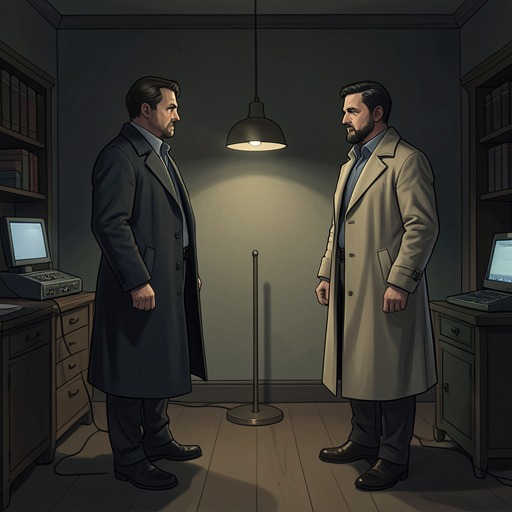
The reconstruction also depends on the man Hastings saw in the passage. Poirot recalls asking whether Hastings was certain that the figure was Norton, then redirecting attention to the men’s differing heights. Poirot was shorter than Norton, but raised heels or shoe elevators could make him appear taller. The possibility that the witness had seen Poirot disguised as Norton turns an apparently identifying observation into a clue about mistaken identity.
Other details strengthen that inference. Poirot points to the doctors’ evidence from Egypt and his own doctor in London, which showed that he was not incapable of walking about; Georges’s evidence that Poirot wore a wig; and the difference between Poirot’s pronounced limp and Norton’s lesser limp. Each fact revises the apparent meaning of Poirot’s physical incapacity and appearance. The solution is not secured by one spectacular revelation but by several pieces of prior information that, read together, expose the disguise and the concealed movement.
The shot as a revealing failure
Poirot identifies the pistol shot as his one weakness. He says that he should have shot Norton through the temple, but could not bring himself to produce an effect he regarded as lopsided and haphazard. Instead, he shot him in the exact centre of the forehead. The detail is both evidence and characterization: even while trying to make the death appear to be a murder, Poirot’s preference for symmetry interferes with the disguise of his act.
That choice completes the fair-play structure. The shot is not simply a means of killing Norton; its placement is an anomaly that Hastings should have recognized. Poirot emphasizes the missed clue to make the reader reconsider the evidence already in view. The method of murder bears the mark of its maker, so the attempt to stage a crime also exposes the person who staged it.
The reader’s chance to solve the case
Poirot’s final challenge rests on the difference between withholding a conclusion and withholding the evidence needed to reach it. He acknowledges that Hastings may have suspected the truth already, and addresses the possibility that the manuscript will be read after the clues have been considered. The disclosure therefore preserves uncertainty up to the solution while insisting, in retrospect, that the answer was available.
The principle is deliberately compromised by its circumstances. Poirot has not offered a fair contest before an ordinary investigation; he has killed Norton and only afterward explains the clues to Hastings. Yet his account presents the evidence openly, including the duplicate keys, the possibility of altered height, the wig, the limp, and the centred shot. Fair play becomes less an assertion that no wrongdoing occurred than a constraint Poirot imposes on the concealment of wrongdoing: he will not pass the death off as an accident, and he will leave Hastings with enough to name the killer.