About two weeks before the main action
The Staged Transmission
On the remote Arctic ice, two armed men forced geologist [Charles Brophy](entity:character-recall-character-charles-brophy-33e731bdb173) to broadcast a false emergency message at an unusually low frequency. After making him board their helicopter with his dogs and equipment, they threw the sled out over the ice chasms and pushed Brophy to his death, making the discovery he had reported appear to have no living witness.
The killing was the first concealed move in a scheme built around a meteorite buried beneath the ice. Brophy’s death would later be presented as an accidental loss in a storm, while his transmission supplied [NASA](entity:organization-recall-organization-nasa-564133535ff1) with the coordinates that its own failing satellite could not find.
Ten days before the public announcement
The Surveillance Team
A Delta team watched a newly built Arctic structure from a concealed storm tent. Its leader, [Delta-One](entity:character-recall-character-delta-one-1b7fdc4cebd9), directed a mosquito-sized PH2 microbot through the facility, where it overheard scientists speaking with excitement about an extraordinary discovery.
The team’s instructions were to monitor the site and report unexpected developments. Their covert presence transformed a supposedly scientific operation into a security mission, with deadly orders waiting if anyone endangered the secret.
Early morning on the announcement day
Rachel Meets Her Father
At a Washington power-breakfast restaurant, [Rachel Sexton](entity:character-recall-character-rachel-sexton-930f7d43f424) met her father, Senator [Sedgewick Sexton](entity:character-recall-character-sedgewick-sexton-a14b5ffd0096), who was riding a wave of primary victories and campaigning against government spending. He urged her to leave her intelligence post and join his campaign, framing the request as concern for her future while making clear that her work for the [White House](entity:location-recall-location-9fd5fefc5ad5) hurt his political image.
A reporter then planted a question about Rachel’s supposed plans to defect. She angrily denied it, and the exchange exposed the distance between father and daughter: Sedgewick wanted to use her as a political asset, while Rachel refused to surrender her independence.
Three months before the announcement day
The Secret Affair
Sedgewick had promoted [Gabrielle Ashe](entity:character-recall-character-gabrielle-ashe-3c68b155fa61) to a senior campaign role and then seduced her in his office. Gabrielle regretted the encounter and insisted that their relationship remain professional, while the senator treated her as both a valuable political aide and a conquest.
When rumors of the affair surfaced, Sedgewick publicly denied it with convincing indignation. Gabrielle watched him lie so easily that her admiration began to weaken, even as she continued supplying him with political intelligence and helping shape his campaign.
Three years before the main action, on Thanksgiving
A Mother’s Fatal Crash
During a snowbound [Thanksgiving](entity:time-recall-time-f7dc04eb44a0), Rachel learned that her father would not visit her mother, [Katherine Wentworth Sexton](entity:character-recall-character-katherine-wentworth-3a01e0306139), despite being nearby. Katherine chose to carry dinner to relatives instead. That night, freezing rain sent her car into a ravine, killing her on impact.
Sedgewick publicly blamed himself for not being home, but Rachel understood the speech as political theater layered over years of infidelity and neglect. Her mother’s death hardened Rachel’s estrangement from him and became the emotional measure by which she judged his later choices.
Late morning on the announcement day
The President’s Summons
At the [National Reconnaissance Office headquarters](entity:location-recall-location-d3445fbe625e), director [William Pickering](entity:character-recall-character-william-pickering-5d13955de0e9) told Rachel that President [Zachary Herney](entity:character-recall-character-zachary-herney-bb6416767dc9) wanted to meet her immediately. Pickering suspected a political maneuver: Rachel was the daughter of the president’s leading challenger, and the [White House](entity:location-recall-location-9fd5fefc5ad5) had not explained why it wanted her.
He nevertheless advised her to go, commit to nothing, and report back. A White House helicopter carried Rachel away, while Pickering’s unease foreshadowed the danger of placing her between the administration and her father’s campaign.
Late morning, shortly after the summons
The Flight to Wallops
The helicopter took Rachel across Chesapeake Bay rather than to Washington. Its pilot eventually landed at [Wallops Island](entity:location-recall-location-4ad23ff5330a), where Rachel discovered that Herney was waiting aboard [Air Force One](entity:object-recall-object-air-force-one-dbdfc1d5ac76), using the plane as a private meeting place away from the scrutiny of the [White House](entity:location-recall-location-9fd5fefc5ad5).
Herney greeted her warmly, served her coffee, and admitted that Pickering’s suspicion was justified: he did intend to use her in a political way. He then told her that [NASA](entity:organization-recall-organization-nasa-564133535ff1) had made a discovery and classified the information beyond Rachel’s clearance.
Around noon on the announcement day
The Arctic Assignment
Herney told Rachel that the Earth Observation System had found something extraordinary and that independent civilian scientists had confirmed it. He planned a worldwide announcement that evening, but wanted Rachel to examine the discovery firsthand before deciding what role she should play.
He took her phone, declared her off the grid, and sent her into a hangar, where [NASA](entity:organization-recall-organization-nasa-564133535ff1) pilot Wayne Loosigian put her aboard an [F-14 Tomcat Split-tail](entity:object-recall-object-f-14-tomcat-split-tail-0f5cd477a50d). Rachel crossed thousands of miles of ocean toward the Arctic, isolated from Pickering and unsure what NASA had found.
Afternoon on the announcement day
The Milne Ice Shelf
The fighter jet landed on a narrow ice runway on the [Milne Ice Shelf](entity:location-recall-location-7806e58a8730). Rachel learned that the vast glacier beneath her was a floating shelf over the [Arctic Ocean](entity:location-recall-location-arctic-ocean-0e465fe4ba03), then crossed the windswept ice in a tracked vehicle to [NASA](entity:organization-recall-organization-nasa-564133535ff1)’s inflatable research habitat.
NASA administrator [Lawrence Ekstrom](entity:character-recall-character-lawrence-ekstrom-1299add552bc) greeted her with open hostility. He resented that the daughter of a prominent NASA critic had been brought into the agency’s moment of anticipated triumph, and Rachel in turn objected to being transported so far without being told the purpose of her visit.
Afternoon, shortly after Rachel’s arrival
A Meteorite in the Ice
Ekstrom explained that [NASA](entity:organization-recall-organization-nasa-564133535ff1)’s Polar Orbiting Density Scanner, or [PODS](entity:object-recall-object-pods-449306536f67), had detected an unusually dense object two hundred feet beneath the ice. NASA’s team had identified it as a large meteorite, apparently buried in the glacier since an eighteenth-century impact.
Rachel initially saw the announcement as an overblown publicity opportunity. Ekstrom insisted that the meteorite’s size was not the real wonder and introduced her to civilian experts, including oceanographer and television host [Michael Tolland](entity:character-recall-character-michael-tolland-e911e47de843) and astrophysicist [Corky Marlinson](entity:character-recall-character-corky-marlinson-cc6524b06904).
Afternoon on the announcement day
Fossils from Space
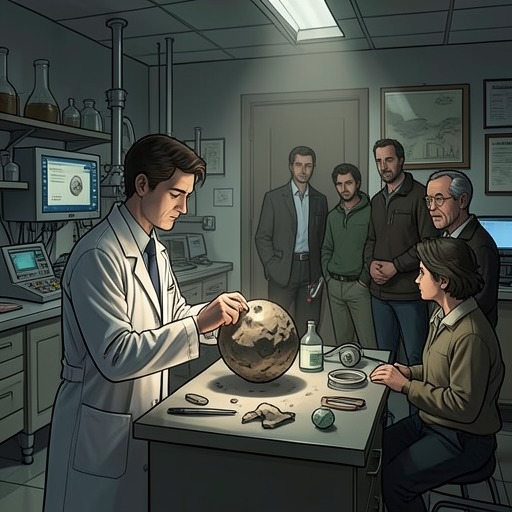
Corky showed Rachel ordinary meteorite samples and explained their fusion crusts, chondrules, and characteristic chemistry. He then gave her a core slice from the Milne object. On its reverse side, Rachel found the fossil of a large arthropod embedded in the stone.
The scientists said the meteorite contained numerous similar fossils, including a much larger specimen. To them, the find offered visible evidence of life beyond Earth and lent support to panspermia, the theory that life may have reached Earth from elsewhere in the cosmos.
Afternoon on the announcement day
The Civilians’ Endorsements
Rachel met paleontologist [Wailee Ming](entity:character-recall-character-wailee-ming-e69674e6ac2d) and glaciologist [Norah Mangor](entity:character-recall-character-norah-mangor-e292233a08da), who explained how the fossil fit the anatomy of terrestrial isopods and how ice cores dated the meteorite’s burial to [1716](entity:time-recall-time-1716-0d4d9b2ede5d). [NASA](entity:organization-recall-organization-nasa-564133535ff1) had recruited all four civilian experts to verify the discovery and support [Michael Tolland](entity:character-recall-character-michael-tolland-e911e47de843)’s documentary.
Rachel realized that the President’s choice to bring her north was not simply about her analytical work. Her family name and professional independence could reassure skeptical audiences inside the [White House](entity:location-recall-location-9fd5fefc5ad5), while Tolland’s celebrity could make the science accessible to the public.
Late morning on the announcement day
Sexton’s Secret Backers
While Rachel traveled north, Sedgewick met an intermediary in a hotel parking garage. The man represented wealthy private aerospace interests and told the senator that more major donors were ready to meet him. Their money was meant to advance his campaign, but their expected return was political support for opening space to private business.
The intermediary warned Sexton that winning the presidency would only begin their project. The exchange revealed that the senator’s anti-[NASA](entity:organization-recall-organization-nasa-564133535ff1) campaign was not merely fiscal rhetoric: powerful investors expected him to act on their behalf if elected.
Early afternoon on the announcement day
Tench’s Debate Trap
[Marjorie Tench](entity:character-recall-character-marjorie-tench-ac2296a7755d) volunteered to face Sexton in a televised [CNN](entity:organization-recall-organization-cnn-fc1d8abce1ee) debate, deliberately making the [White House](entity:location-recall-location-9fd5fefc5ad5) appear desperate. She steered the exchange toward [NASA](entity:organization-recall-organization-nasa-564133535ff1) and forced him to answer whether he would abolish the space agency if its budget could not be reduced.
Sexton committed himself to redirecting NASA’s budget to schools and declared that the space race was over. When he dismissed the prospect of finding extraterrestrial life and promised to eat his hat if proven wrong, Tench knew he had supplied the sound bite the White House wanted.
Late afternoon on the announcement day
The Meteorite Extraction
[Norah Mangor](entity:character-recall-character-norah-mangor-e292233a08da) explained that [NASA](entity:organization-recall-organization-nasa-564133535ff1) would raise the meteorite through drilled shafts by warming the stone with a laser, melting the surrounding ice as the winches hauled it upward. She also described her core samples as evidence of a flawless, uninterrupted ice sheet and dated the object to [1716](entity:time-recall-time-1716-0d4d9b2ede5d).
The scientists and NASA staff gathered as the enormous, dripping rock emerged from the ice. Their celebration seemed to confirm the scale of the discovery, and Rachel felt the moment could restore NASA’s reputation and transform the election.
Late afternoon on the announcement day
Rachel’s White House Briefing
From a secure communications trailer, Rachel spoke with Herney and agreed to brief the [White House](entity:location-recall-location-9fd5fefc5ad5) staff privately. She thought her task was limited to an internal explanation, not a public endorsement, and the President assured her that the meeting would be private.
Herney then connected her to the crowded [Oval Office](entity:location-recall-location-f88e742384a9) without warning. Rachel recovered from the shock, introduced her role, and calmly described the discovery and its verification, winning over a staff that had grown doubtful of the President’s [NASA](entity:organization-recall-organization-nasa-564133535ff1) policy.
Early afternoon on the announcement day
The CNN Victory
The televised debate had seemed to go well for Sexton, but Tench’s questions had drawn him into an uncompromising attack on [NASA](entity:organization-recall-organization-nasa-564133535ff1) and a sweeping dismissal of the possibility of extraterrestrial life. The senator’s confidence obscured the trap until it was too late.
Herney watched from the [White House](entity:location-recall-location-9fd5fefc5ad5) and recognized that Sexton had supplied exactly the contrast the administration needed. NASA’s impending announcement would now confront not only the senator’s policy but his public certainty that no such discovery could occur.
Early evening on the announcement day
Ming Finds the Pit’s Secret
After the habitat’s lights went out, [Wailee Ming](entity:character-recall-character-wailee-ming-e69674e6ac2d) noticed something strange in the water-filled extraction shaft. He returned with a beaker to investigate and leaned over the unguarded edge to take a sample.
A tiny projectile struck his eye, making him fall into the deep, sheer-sided pit. The icy water and vertical walls trapped him below the surface, and he drowned before anyone could reach him. The attack concealed the first person to notice that the shaft’s water did not belong there.
Early evening, shortly after the fall
Ming’s Death Concealed
[NASA](entity:organization-recall-organization-nasa-564133535ff1) workers recovered [Wailee Ming](entity:character-recall-character-wailee-ming-e69674e6ac2d)’s body, but Ekstrom ordered them to hide it until after the press conference. He feared that reporting a fatal accident would eclipse the discovery and damage the morale of the team.
The concealment turned a preventable tragedy into part of a larger cover-up. At that point, Ekstrom did not yet know that Ming had stumbled upon a clue to the engineered origin of the meteorite.
Early evening on the announcement day
The Pit Glows
[Michael Tolland](entity:character-recall-character-michael-tolland-e911e47de843) noticed blue-green lights pulsing on the surface of the extraction water. He recognized the glow as bioluminescent plankton, an ocean organism that should not have been present in a sealed pocket of freshwater glacier ice.
Norah tested the water and confirmed both brine and [G. polyhedra](entity:creature-recall-creature-g-polyhedra-6db374b71ac2). The finding contradicted the pristine-ice claims on which [NASA](entity:organization-recall-organization-nasa-564133535ff1)’s historical dating depended, and Rachel proposed that frozen brine pockets might explain the anomaly.
Early evening, after the plankton test
The Hidden Borehole
Norah used ground-penetrating radar to settle the dispute over the ice. The printout showed a body in the shaft and, beneath the meteorite, a broad column of sea ice running down through the shelf toward the ocean.
Rachel and Tolland understood the implication: someone had drilled upward from below and planted the stone. Norah realized that her ice-core certainty had been used to legitimize a staged discovery, and the group turned back toward the habitat to expose the deception.
Night on the announcement day
The Ice-Shelf Ambush
Before the investigators could return, Delta operatives attacked them with experimental ice-pellet weapons. Norah and Corky were struck, while Rachel and Tolland crawled behind their overturned equipment sled and recognized the assault as a military operation rather than weather.
The soldiers began killing the scientists by packing snow into their airways and staging the deaths as exposure. Tolland saw the attack and understood that the meteorite secret was being protected with lethal force.
Night, during the ice-shelf ambush
The Mylar Escape
Tolland found a folded [Mylar weather balloon](entity:object-recall-object-mylar-43fbc9c4ace9) among the scattered gear and clipped it to himself and Rachel. The katabatic wind inflated it like a sail, dragging them across the glacier and yanking Corky away from his attacker.
The improvised escape saved the three from immediate execution but sent them hurtling toward the shelf’s cliff edge. They could neither control the balloon nor release their safety clips before reaching the ice berms.
Night, immediately after the escape
The Iceberg Survival
The balloon’s cable finally snapped after Rachel and Tolland cut at it with their ice axes. They slid over successive berms and off the shelf, but landed on a lower, partly detached platform of ice rather than plunging straight into the ocean.
[Delta-One](entity:character-recall-character-delta-one-1b7fdc4cebd9) dropped a concussion grenade into the crevasse to shear off the slab. The iceberg plunged into the sea and bobbed back to the surface, leaving Rachel, Tolland, and Corky soaked, battered, and drifting in the Arctic cold.
Late afternoon into evening on the announcement day
Tench’s Coercive Offer
At the [East Appointment Gate](entity:location-recall-location-a478e633828f), Gabrielle answered an invitation from her anonymous [White House](entity:location-recall-location-9fd5fefc5ad5) source and was escorted into the [West Wing](entity:location-recall-location-3a51446fd650). There she discovered that [Marjorie Tench](entity:character-recall-character-marjorie-tench-ac2296a7755d) had been sending her damaging information about [NASA](entity:organization-recall-organization-nasa-564133535ff1) to harden Sexton’s anti-NASA position.
Tench showed Gabrielle financial records and photographs of her affair with the senator, then demanded an affidavit admitting the relationship. She claimed that Sexton had accepted illegal aerospace bribes and offered Gabrielle a chance to discredit him before the White House exposed the scandal.
Evening on the announcement day
Sexton’s Donor Gathering
At his Westbrooke Place apartment, Sexton met with six private aerospace executives seeking access to space markets. He told them [NASA](entity:organization-recall-organization-nasa-564133535ff1) underpriced commercial launches, restricted advertising, and crowded private companies out of business.
He promised to remove those barriers and support NASA privatization if elected. Gabrielle secretly overheard the pitch and recognized that the senator’s relationship with the industry went beyond ordinary campaign donations.
8:00 p.m. on the announcement day
The President’s Announcement
President Herney went live from the [White House Briefing Room](entity:location-recall-location-f3131982c730) and announced that [NASA](entity:organization-recall-organization-nasa-564133535ff1) had recovered an eight-ton meteorite containing unmistakable fossils. He introduced Ekstrom and the NASA team, then presented the discovery as proof of extraterrestrial life.
The broadcast showed the fossil and [Michael Tolland](entity:character-recall-character-michael-tolland-e911e47de843)’s documentary to a global audience. Sexton’s guests abandoned their hopes for space privatization, while the senator watched the NASA triumph undo the political position he had built.
Evening, while the announcement aired
The SOS on the Ice
As Rachel and Tolland were believed dead or missing, Rachel used her ice ax to pound a distress pattern into the floating shelf. She knew the [National Reconnaissance Office](entity:organization-recall-organization-national-reconna-ed0eda12ebbd)’s undersea listening network could detect the signal even though the conventional ocean acoustic array did not cover the region.
The message was not a realistic plea for rescue so much as a way to preserve evidence. Rachel hoped that if the survivors died, someone would find the GPR printout and discover the artificial tunnel.
Shortly before and after 8:00 p.m.
The Submarine Rescue
The USS Charlotte, already listening for suspicious activity beneath the shelf, detected Rachel’s pounding and surfaced near the drifting iceberg. Its crew pulled Rachel, Tolland, and Corky aboard and treated their hypothermia.
Rachel realized that Herney’s press conference had not yet begun and hurried to contact him. Her attempt instead reached Tench, who dismissed the warning, accused Rachel of political sabotage, and threatened legal retaliation. The President began his broadcast without hearing that his evidence might be false.
Evening, immediately after the broadcast
The NASA Cover Story
At [NASA](entity:organization-recall-organization-nasa-564133535ff1) headquarters, Gabrielle confronted [Chris Harper](entity:character-recall-character-chris-harper-a4190655ab9d) about the [PODS](entity:object-recall-object-pods-449306536f67) software announcement. Harper admitted that the anomaly-detection program had failed and that he had been pressured by Ekstrom and Tench to claim a workaround had been found.
NASA had learned of the meteorite through Brophy’s intercepted distress transmission, then directed PODS to its coordinates and presented the result as a satellite discovery. Harper said the stone’s fossils had been unknown when the deception began, but Brophy had conveniently died before he could challenge NASA’s account.
Around 2:00 a.m., after the announcement
The Memorial Bombing
[William Pickering](entity:character-recall-character-william-pickering-5d13955de0e9) agreed to meet Tench discreetly at the [Franklin Delano Roosevelt Memorial Gardens](entity:location-recall-location-a0ab6b3ff63b). [Delta-One](entity:character-recall-character-delta-one-1b7fdc4cebd9) used a Kiowa gunship and a Hellfire missile to destroy her car, killing her in an attack designed to resemble terrorism.
Pickering had been trying to contain the scandal, but the killing removed Tench as a witness and marked a new escalation. Herney learned that she had disappeared and soon received word that a senior government official had been killed.
After midnight on the announcement night
Gabrielle Finds the Money
Gabrielle returned to Sexton’s Senate office and broke into his private room, using a ceiling passage from the adjoining restroom. She guessed his computer password and found checks from aerospace firms routed into offshore accounts.
The records confirmed that Sexton had lied about accepting only small, legal donations. Gabrielle’s faith in him collapsed, but she was caught between his political power, Tench’s coercion, and the growing evidence that both campaigns were concealing dangerous truths.
Early morning after the announcement
The Goya Attack
Rachel, Tolland, and Corky reached the research vessel Goya to consult its geologist, [Xavia](entity:character-recall-character-xavia-ce08bdb8dfdb). A Navy rescue pilot remained aboard while Tolland and Corky learned that a deep-sea rock could produce chondrule-like features under extreme pressure.
A black Kiowa jammed the ship’s communications, then attacked with machine guns and a Hellfire missile. The pilot and Xavia were killed when their Coast Guard helicopter exploded, and Corky escaped in a speedboat while Rachel and Tolland sought cover below deck.
Early morning, aboard the Goya
The Meteorite Discredited
[Xavia](entity:character-recall-character-xavia-ce08bdb8dfdb) compared the sample with research by [Lee Pollock](entity:character-recall-character-lee-pollock-710b301b742c) and found that the fossil’s chondrules had a chemical signature unlike true meteorites. The sample closely matched an ocean-floor rock shaped by the pressures of the [Mariana Trench](entity:location-recall-location-b6ae583316aa), while its fossil resembled the living deep-sea isopod [Bathynomous giganteus](entity:creature-recall-creature-bathynomous-giganteu-8d5545c7d502).
Combined with the planted shaft, the anomalous nickel, and the hydrogen-rich burn that could have come from [NASA](entity:organization-recall-organization-nasa-564133535ff1)’s slush-hydrogen engine, the tests dismantled the supposed extraterrestrial proof. Rachel and Tolland concluded that the stone was an engineered fraud.
After the press conference, during Gabrielle’s visit to NASA Headquarters
Harper Names the Source
Harper told Gabrielle that Brophy had been the true discoverer and that [NASA](entity:organization-recall-organization-nasa-564133535ff1) had intercepted his transmission through its INSPIRE receivers. He had been ordered to reposition [PODS](entity:object-recall-object-pods-449306536f67) over the reported coordinates and present the resulting detection as an independent satellite find.
Gabrielle suspected the scheme might reach back to Brophy’s death, and Harper admitted that the geologist had died in the storm after sending the message. The account gave Sexton a potential political counterattack, though it did not yet establish who had arranged the broader fraud.
Early morning, after the Goya tests
The Second Attack
The Delta team tracked Rachel and Tolland to the Goya and resumed its attack. Tolland incapacitated [Delta-Three](entity:character-recall-character-delta-three-5a5f779900d6) with a shark-control device and used the [Triton](entity:object-recall-object-triton-0dddd1ac2764)’s manipulator arms to trap [Delta-Two](entity:character-recall-character-delta-two-cfc7a331247d), while Corky’s boat circled back into the megaplume’s current.
The soldiers destroyed Corky’s speedboat with a missile. Tolland and Rachel lost their Coast Guard escape route, and their remaining struggle became a fight to survive aboard a damaged ship surrounded by sharks and a growing undersea vortex.
Early morning, aboard the Goya
Pickering’s Confession
[William Pickering](entity:character-recall-character-william-pickering-5d13955de0e9) arrived by helicopter and revealed himself as the controller behind the meteorite operation. He said he had staged the discovery to protect [NASA](entity:organization-recall-organization-nasa-564133535ff1) from privatization and feared that private companies would sell the agency’s technology to foreign interests.
Pickering explained that his team had found fossils and unusual chondrules while installing classified hydrophones in the [Mariana Trench](entity:location-recall-location-b6ae583316aa). They had burned and planted a deep-sea rock beneath the Milne shelf, then built a false discovery around it. He claimed that Herney and Ekstrom were innocent of the larger hoax, though Ekstrom had participated in the [PODS](entity:object-recall-object-pods-449306536f67) lie.
Early morning, while the confrontation unfolded at sea
Sexton Receives the Fax
Rachel sent the GPR printout, biological comparisons, and laboratory results to her father’s Senate office, hoping his political incentives would force the truth into the open. At the same time, Pickering left Sexton a message warning him not to publicize the material until Rachel was safe.
Sexton received the fax and immediately saw its value as a weapon against Herney and [NASA](entity:organization-recall-organization-nasa-564133535ff1). He chose political opportunity over his daughter’s safety, copied the evidence, and prepared to make a public announcement rather than wait for Pickering.
Early morning, during the Goya confrontation
The Trapdoor Struggle
Pickering ordered the Delta soldiers to finish the operation. [Delta-One](entity:character-recall-character-delta-one-1b7fdc4cebd9) forced Rachel onto the [Triton](entity:object-recall-object-triton-0dddd1ac2764) and tried to make Tolland release [Delta-Two](entity:character-recall-character-delta-two-cfc7a331247d) from the sub’s claws, using Rachel as leverage.
Tolland instead opened the Goya’s trapdoor and dropped [Delta-Three](entity:character-recall-character-delta-three-5a5f779900d6) into the shark-filled water. He then released the anchor spool and arrested the ship’s movement, throwing everyone across the deck as the damaged stern strut began to fail.
Early morning, moments after the trapdoor struggle
The Gunship’s Fall
The tilting Goya sent the idling Kiowa sliding toward the [Triton](entity:object-recall-object-triton-0dddd1ac2764). [Delta-One](entity:character-recall-character-delta-one-1b7fdc4cebd9) tried to lift off, but the aircraft’s rotor struck the sub’s winch cable and was torn apart, sending the gunship into the sea.
The severed cable dropped Rachel and the Triton into the water. [Delta-Two](entity:character-recall-character-delta-two-cfc7a331247d) was carried down in the claws and killed by the sharks, while Rachel became trapped inside the sinking sub with a jammed hatch and a flooding ballast tank.
Early morning, immediately after the Goya’s collapse
The Triton Escape
Tolland discovered bullet holes in the [Triton](entity:object-recall-object-triton-0dddd1ac2764)’s ballast tank and a damaged seal around its viewing dome. He routed compressed air into the cockpit, hoping pressure would force the dome loose before the sub sank too deep.
Rachel recognized the plan after the pressure made the window shift. Remembering her mother’s instructions from her childhood accident, she kicked the dome with all her strength and forced it open. A rush of water freed her from the cockpit as the Triton plunged away beneath her.
Dawn, during the final escape
The Undersea Eruption
The damaged Kiowa sank toward a magma dome beneath the megaplume. Its Hellfire missiles exploded under the ocean’s crushing pressure, rupturing the dome and triggering a submarine eruption.
Steam blasted upward and intensified the existing vortex into a vast whirlpool that began drawing the sea down into its center. Tolland found Rachel in the dark water and guided her away from the false glow of the eruption toward the surface, while the sea around them turned into a lethal machine.
Dawn, during the undersea eruption
The Goya’s Destruction
A [Coast Guard Osprey](entity:object-recall-object-coast-guard-osprey-71cccfc70b45) arrived after reports of an explosion and winched Rachel from the water. Tolland reached the rescue harness, and Corky was found alive nearby, having escaped the destroyed boat despite his wound.
On the Goya, Pickering watched the vortex expand toward the ship. The stern slid over the watery brink, and the vessel, still lit, was pulled down into the whirlpool with Pickering aboard.
Morning after the announcement
Sexton’s Press Conference
Sexton stood at the [Washington Monument](entity:location-recall-location-134577ee6422) with sealed envelopes containing Rachel’s evidence and prepared to accuse the [White House](entity:location-recall-location-9fd5fefc5ad5) of fraud. He knew Herney had now explained that the President and [NASA](entity:organization-recall-organization-nasa-564133535ff1) were innocent bystanders, but still saw the scandal as his route to the presidency.
Rachel arrived and pleaded with him to wait and let the President admit the mistake. Sexton refused, declaring that power mattered more than restraint and that the evidence was his opportunity to destroy his opponent.
Morning, during Sexton’s Washington Monument press conference
The Envelope Switch
Gabrielle, wearing a borrowed ABC press pass, substituted the envelopes Sexton intended to distribute. Instead of the meteorite evidence, reporters found compromising photographs documenting the senator’s affair with her.
Sexton had vouched for the authenticity of the material before seeing what was inside, leaving him exposed by the same certainty he had used to sell his accusations. Gabrielle then showed him the duplicate evidence and demanded that he stop exploiting Rachel’s fax.
Later that day
Herney Tells the Truth
after saxton's campaign was severely damaged, gabrielle left washington and refused an offer to immediately profit from the scandal. president henry thanked her and invited her to join the budget team, but she said she needed to step away from politics for a while. henry publicly admitted that the highly
That evening
The Final Reckoning
Rachel woke in the [White House](entity:location-recall-location-9fd5fefc5ad5) after a day of recovery and learned from the news that Herney had admitted the mistake. The political fallout now included the collapse of Sexton’s campaign and scrutiny of his financial dealings, while [NASA](entity:organization-recall-organization-nasa-564133535ff1) faced the loss of its credibility.
[Michael Tolland](entity:character-recall-character-michael-tolland-e911e47de843) joined Rachel in the [Lincoln Bedroom](entity:location-recall-location-925a7398ea3a), where they finally found a private moment after surviving the ice, the sea, and the conspiracy. Their connection offered a personal beginning after the day’s losses, while the public story moved from alleged alien life to the cost of lies and political ambition.
After the public confession
The Stone Returns to Sea
A [NASA](entity:organization-recall-organization-nasa-564133535ff1) transport carried the charred stone out over the Atlantic. Ekstrom ordered the cargo doors opened, and the rock fell into the ocean, sinking through darkness to the seabed.
There it settled among the deepwater habitats from which its fossils and unusual mineral features had originated. An unknown creature inspected the stone and moved on, closing the novel with the material truth behind the supposed visitor from space.