BLACK cipher
DecodedThe BLACK cipher is the formidable code at the center of Unit 701’s later cryptographic crisis, a system whose apparent impenetrability pushes Rong Jinzhen toward exhaustion and mental collapse before its key is revealed to be zero. More advanced than the PURPLE cipher, BLACK first appears not as a puzzle with a visible route to solution but as a darkness spreading over the work and life of the cryptographer expected to break it.
Emergence and Character
BLACK is described as the sister of the PURPLE cipher, but more advanced, sophisticated, and profound. Its first traces appeared on 1 September 1966, a date Rong Jinzhen would remember as terrifying. From his first engagement with it, he sensed that trying to crack BLACK could bring him close to annihilation. The image attached to that first encounter is of a bird discerning a snow-covered mountain hidden within a mass of cloud: the obstacle is present, but its scale and shape remain obscured.
Over the following three years, BLACK’s reach seemed to expand through PURPLE, like darkness engulfing light. Members of Unit 701 felt that an earlier period of crisis had returned, and placed their hopes in Rong Jinzhen, the unit’s star cryptographer and the man who had cracked PURPLE. Yet night after night he searched for even a small opening without finding one. The cipher’s narrative force comes from this reversal: the previous triumph does not supply a method for the new problem; instead, it raises the stakes of failure.
A Cipher Against the Usual Method
The conventional approach to cryptography is painstaking elimination. Intelligence agents gather relevant information, and cryptographers use it to develop hypotheses, effectively making and testing keys against possible locks. The process can be laborious, but it is presented as the safest and most effective way to attack a high-level cipher. In the metaphor of the novel, the amount of available material and the cryptographer’s sensitivity to a particular code shape how many doors can be tried.
Rong Jinzhen is drawn instead toward cryptographic history, despite the field’s isolation and its customary suspicion of inherited paths. The history of cryptography is figured as a lonely forest without guides: its practitioners face closed doors and traps, and cannot easily build on the work of those who came before. By immersing himself in that history, Rong Jinzhen hopes to narrow the many possible paths to BLACK. The approach could eliminate some possibilities, but it also takes him into territory treated as forbidden. The tension is not simply between a good and bad technique: the conventional method is safe and effective, while historical knowledge offers a possible shortcut whose risks may be severe.
National Stakes and the Symposium
The crisis became a matter of national security because BLACK was being deployed by X Country. At a research symposium jointly organized by Unit 701 and the General Headquarters, a senior official argued that this cipher threatened the integrity of the nation and that deciphering it was necessary to meet the danger. Four deputy heads of the Intelligence Service attended the conference’s grand opening. The scale of the rhetoric contrasted sharply with the lack of practical progress.
Rong Jinzhen was ordered to lead the professional lectures and report on his work. His presentation lasted well over an hour, but he had made no progress; afterward, he regretted publicly exposing his bewilderment. He found the symposium shallow, more discussion than rigorous research, with speeches and slogans in place of substantive debate or detached contemplation. Its calm, ceremonious atmosphere offered no answer to the cipher. He later recognized that his contempt for the conference and its participants had not helped him: the threat remained, and those who hoped the attendees could cure it had mistaken talk for a solution.
The Stalemate and Its Human Cost
Rong Jinzhen came to experience BLACK as a cancer eating at his body, while death seemed to shadow him. He had spent years trying to reach it and was no closer. In his isolation, he deliberately tried to dream every night. He had previously found a kind of lucidity in dreams, and suspected that BLACK’s creator possessed an intelligence alien to human beings; dreaming seemed to offer a way to approach that mind. What began as a source of renewed morale became another pressure. His deliberate effort produced disorderly, relentless dreams and disrupted his sleep, bringing him toward mental collapse.
To recover some normality, he dismantled the dream patterns he had become entangled in. He read novels before bed to settle himself and walked to tire himself out; both helped. The effort to enter BLACK through dreams thus gives way to a more modest routine aimed at sleeping. Meanwhile, Unit 701 considered why he found no errors in the cipher. Cracking PURPLE had made the adversary more cautious, as if BLACK’s creators had learned not to let even a drop of information escape. The organization also considered whether Jan Liseiwicz, who understood Rong Jinzhen’s abilities, might have warned the creators and helped them prepare countermeasures. Learning that Jan Liseiwicz was in fact Weinacht provoked Rong Jinzhen’s anger, but disclosure of that identity did not itself open BLACK.
The Zero Key
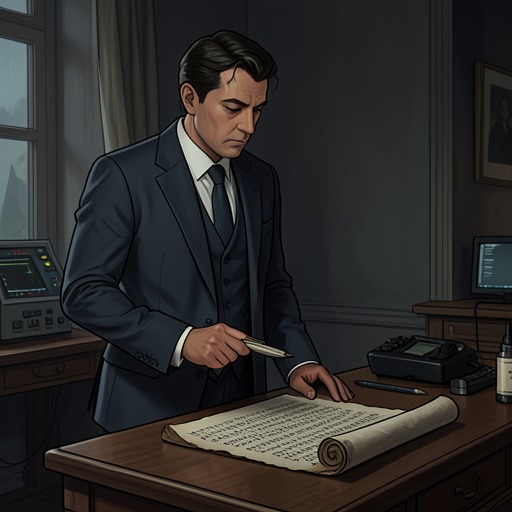
The breakthrough overturns the expectation that a cipher this formidable must have a correspondingly intricate lock. In a mountain-cave office, the narrator recounts confirming an unlikely assumption with a calculator capable of more than 40,000 calculations, which Headquarters had given Rong Jinzhen. After deciphering BLACK, the narrator rushed from the cave, fell to the ground, and wailed before dawn. The decisive disclosure is that the key to BLACK was in a leather attaché case: the cryptographic key was the number zero.
The revelation makes BLACK seem less like a lock that had been picked than a locked door that was never locked at all. Its appearance of resistance was a façade; a small push was enough to make it swing open. Yet the simplicity did not feel reassuring. The key was so strange that it was difficult to trust even after the door had opened and its contents were visible. BLACK’s final irony is that the long, punishing search had trained its pursuers to expect a hidden complexity, while its solution lay in the absence of the expected key.