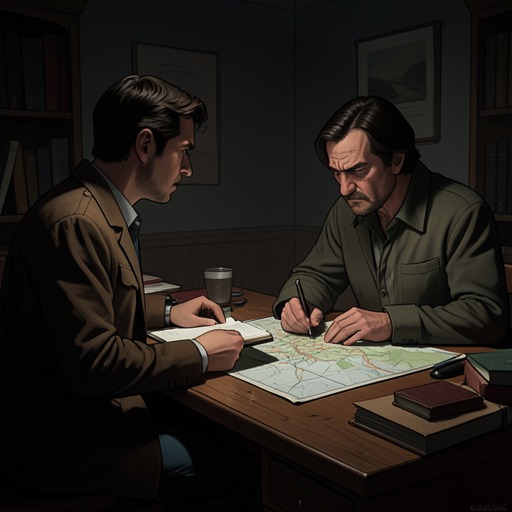
Jan Liseiwicz’s Farewell Letter to Young Lillie
DecodedJan Liseiwicz’s Farewell Letter to Young Lillie is both a goodbye and a proposal for Rong Jinzhen’s future: Jan Liseiwicz asks Young Lillie to consider artificial-intelligence research as the work best suited to Rong Jinzhen’s abilities, while insisting that the project depends on his recovery. The letter joins a personal parting to a larger argument about science, responsibility, and the uses of genius. Its final condition—that the letter may instead be preserved in a university library as a record of twelve happy years—leaves its vision deliberately contingent.
Delivery and Form
Young Lillie receives the letter at dawn, after a sleepless night. Two enormous cardboard boxes have been left in the tiny courtyard, one blocking the outer door and the other already soaked by wind and rain. Unable to move the heavier box, Young Lillie covers it with oiled paper; only then does he notice the letter on top, held down by the stone normally used to prop the door open. The message arrives, quite literally, as an obstruction at the threshold of his home.
The letter is addressed to Young Lillie and explains that Jan Liseiwicz is leaving without wanting to trouble anyone, so he has chosen to say goodbye in writing. Its timing is close to the departure: it is dated on the eve of leaving. This makes the letter not a later account of the separation but Jan Liseiwicz’s final opportunity to speak to Young Lillie before going. Within that intimate form, its subject quickly widens from farewell to the future of Rong Jinzhen and, through him, the future uses of scientific knowledge.
The Case for Rong Jinzhen
Jan Liseiwicz’s first concern is that Rong Jinzhen recover and that Young Lillie make the best possible arrangements for his future. He frames the question not only as a family decision but as a responsibility to humanity: Rong Jinzhen’s exceptional ability, he argues, should be put to its fullest use. The letter weighs two possible directions. Immersion in a large, difficult mathematical problem would suit Rong Jinzhen’s talent, but Jan Liseiwicz fears that a society increasingly impatient with purely theoretical work will favour research with an immediate, practical result.
He does not treat practical research as an uncomplicated good. Its incremental results can encourage a researcher and make the work deeply fulfilling, but completing a project can also mean losing control of what it produces. A creation may benefit the world or harm it; in either case, its maker may be left unable to direct its consequences. Jan Liseiwicz invokes Oppenheimer’s reported regret over work on the first nuclear bomb to sharpen this warning. Once a powerful creation is released, remorse cannot simply undo it.
Despite that danger, Jan Liseiwicz recommends artificial intelligence if Young Lillie decides that Rong Jinzhen should pursue scientific research. He sees computers’ ability to perform calculations as an initial, limited instance of machine intelligence and argues that other aspects of intelligence may also prove open to investigation. Solving that mystery, he proposes, could lead to robots: artificial, metal-bodied human beings able to undertake work that people currently perform in genuinely inhuman conditions. For him, the prospect gives the research a practical purpose as well as a vast horizon, without erasing the risk that its applications might escape their creators’ control.
Jan Liseiwicz’s Abandoned Ambition
The recommendation carries particular weight because Jan Liseiwicz once planned to devote the remainder of his life to solving problems of artificial intelligence. He says he abandoned that ambition before properly beginning, not because of a technical obstacle or a lack of ability, but at the express command of the Jewish people. For the preceding years, he explains, he had been working on something important on their behalf; their troubles and hopes moved him to set aside a long-held goal. The letter does not disclose the details of that work. Jan Liseiwicz instead offers this account as a way of piquing Young Lillie’s interest, leaving the reason for his sacrifice partly stated and partly withheld.
His argument also reflects his fear of war. After recalling two world wars within less than half a century, he suspects that another war is approaching and warns that humanity’s capacity for mass killing has grown more terrible. Against that prospect, robots might spare people from dangerous or degrading labour. The proposal therefore rests on a troubling contrast: scientific invention can magnify destruction, yet it might also remove human beings from some of the worst tasks imposed on them. The letter offers no guarantee that artificial intelligence would resolve that contradiction; it presents the research as a consequential possibility, not a safe promise.
The Condition and the Farewell
Everything in Jan Liseiwicz’s recommendation turns on Rong Jinzhen’s survival. If Rong Jinzhen dies of his illness, Jan Liseiwicz tells Young Lillie to give up the project, since Young Lillie is too old to undertake it alone. If Rong Jinzhen lives, Young Lillie may see one of humanity’s great mysteries solved within his lifetime. Jan Liseiwicz identifies Rong Jinzhen as the person best suited to the work and interprets his long experience of dreams as preparation for studying human intelligence: from childhood, Rong Jinzhen has faced dreams day and night and developed remarkable skill in interpreting them, without recognizing that this experience might bear on such research. Jan Liseiwicz presents the connection as a calling, even as something God has chosen him to do.
The letter ends by leaving the decision open. If Young Lillie and God agree that Rong Jinzhen is meant to develop artificial intelligence, the letter may help; if either is determined to prevent it, Young Lillie should give the letter to the university library as a memento of Jan Liseiwicz’s twelve happy years there. The alternative gives the letter two possible futures: an appeal that helps shape a scientific career, or a memorial to the time and ambition its writer is leaving behind.
Young Lillie reads the letter straight through while sitting on one of the cardboard boxes. Wind ruffles its pages and raindrops spatter them as if they, too, were reading. He remains silent for a long time, looking into space; then, turning toward the wind and rain, he wishes Jan Liseiwicz a good journey. The restrained response does not settle what will happen to the proposed research. Instead, the letter’s force lies in placing that unanswered future beside an unmistakable present: Jan Liseiwicz is leaving, Rong Jinzhen’s recovery is uncertain, and Young Lillie has been entrusted with a choice whose consequences reach beyond the household.