Rong Jinzhen’s missing notebook
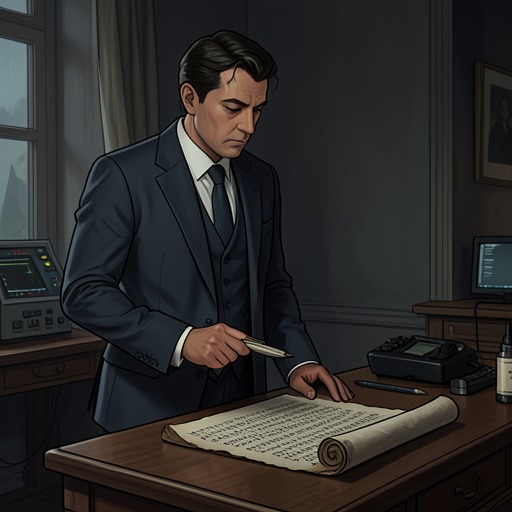
DecodedRong Jinzhen’s missing notebook is the portable record of his work on BLACK and, eventually, the means by which that work survives his collapse. Its apparent disappearance first turns an ordinary habit into an emergency: the notebook is not merely a collection of notes but a repository of thought, a guide to the cipher, and a channel through which its hidden history reaches his colleagues.
Physical Form and Daily Use
Director Zheng describes Rong Jinzhen as solitary and deeply absorbed in thought, prone to fleeting inspirations that came in dreams, in dreams within dreams, or behind the words of a book. The ideas seemed to arrive from beyond him, but Director Zheng understands them as issuing from Rong Jinzhen himself. They could vanish as quickly as they appeared, so he had learned to write them down at once. Carrying a notebook everywhere was therefore not incidental preparation: it was a practical answer to the fragility of his own insights.
The notebook was blue, made of leather, and sixty-four pages long. Its title page bore a top-secret number as well as Rong Jinzhen’s personal serial number; its pages held notes and scribblings accumulated over the years he worked on BLACK. Usually he carried it in his top left-hand pocket. Its habitual closeness to his body made it seem like a shadow walking beside him, an image that gives the object both a literal and a figurative attachment to its owner.
On this occasion, official credentials and papers forced a change in routine. Rong Jinzhen put the notebook inside a lightweight, delicate leather attaché case made of fine calfskin. Director Zheng had given him the case after returning from an overseas trip. Its wide elastic strap could be held in the hand or looped around the waist, allowing the case to become, in Director Zheng’s description, an extension of clothing. The notebook had not been abandoned; it had simply moved from its familiar pocket into a container that also held the papers required for the journey.
The Moment It Seems Lost
In the dark, Rong Jinzhen woke shivering and cried out that his notebook was gone. Vasili leapt from his berth to ask what was wrong, but the alarm proved mistaken: Rong Jinzhen had put the notebook in his briefcase. The episode turns on a brief gap between possession and awareness. The object is physically present, yet for a moment its absence from the pocket where it normally belongs is enough to produce acute distress.
That false alarm matters because the notebook has become inseparable from the continuity of Rong Jinzhen’s work. The case explains how it could be overlooked without establishing that it was actually lost in this incident. The distinction preserves the scene’s force: the immediate danger is not a confirmed theft but the discovery of how vulnerable a practice becomes when its indispensable object is no longer where its owner expects it. The notebook’s familiar place on his person had made it almost invisible as an object; its apparent absence makes that dependence visible.
Contents and Inherited Work
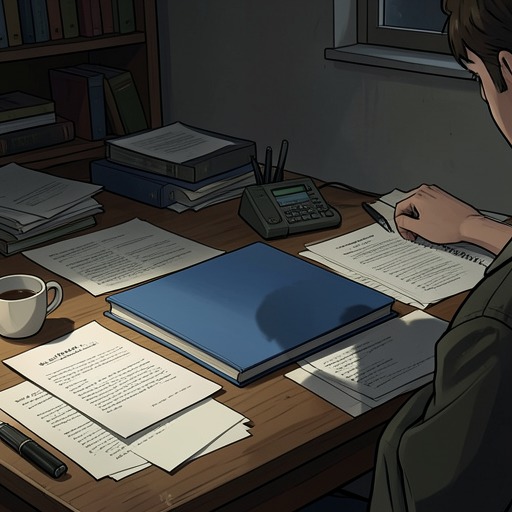
After Rong Jinzhen falls ill, the narrator of the interview says that he assumes Rong Jinzhen’s responsibilities, including deciphering BLACK, and that the notebook comes into his hands as the department’s most important piece of information. He reads it page by page, finding both mature reflections on the cipher and wild speculations. The notebook’s significance lies in the coexistence of those modes: it preserves developed reasoning while also exposing unfinished thought, rather than presenting discovery as a clean sequence of conclusions.
The interview narrator concludes that Rong Jinzhen had completed ninety-nine per cent of the work. Only the last step remained: finding the key to BLACK. This assessment makes the notebook more than a personal archive. It offers a successor a measure of how far the decipherment has progressed and where the unresolved problem lies, while revealing that the apparent distance between near-completion and solution can still be decisive.
BLACK’s Origin and the Notebook’s Legacy
Near the end of the interview, the old man explains that the enemy created BLACK without a key after the PURPLE cipher had been deciphered and its creators felt driven to a dead end. They had recognized Rong Jinzhen’s ability after confronting him and believed that persisting against him would bring their own destruction. In the account given to the interviewer, BLACK was their extreme response: a singular and malicious cipher born from that impasse.
The old man then says that Rong Jinzhen had already made a countermove and had passed the secret of BLACK’s strange origin to his colleagues through the notebook. The passage does not spell out the precise contents of that countermove, but it establishes the notebook’s function as a means of transmission: knowledge survives in the object and can outlast the person who recorded it. Its path from Rong Jinzhen’s pocket, into the attaché case, and later into a colleague’s hands thus links private notation to institutional work. The notebook preserves not only progress toward a solution but also an account of why BLACK was made, giving its material pages an importance that exceeds their size.