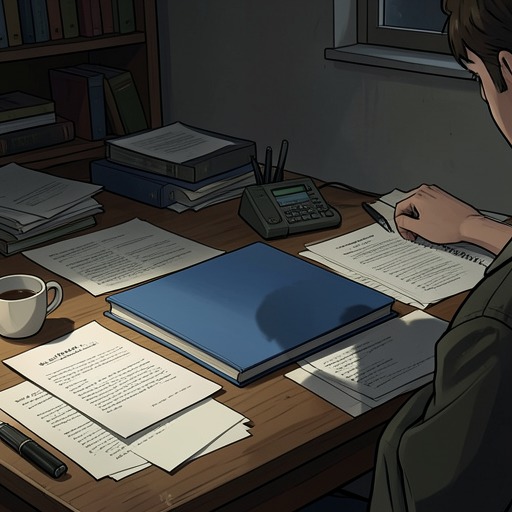
Rong Jinzhen’s notebook
DecodedRong Jinzhen’s notebook preserves traces of a private emotional life that the account’s narrator can never fully recover. Its scattered, obscure entries register the growth of his love for Di Li, but removed passages leave their intimacy encrypted from outside readers; the notebook is at once a personal record and a deliberate invitation to be read.
Contents and form
The notebook is not a clear, continuous account. Its contents lie in a jumble and are obscure at times, yet the narrator can discern how Rong Jinzhen’s love for Di Li grew and how his feelings changed. That development becomes especially apparent in the latter sections, where his attachment is deep and unmistakable even when the language resists easy interpretation.
Some passages are absent. The narrator believes the sections Di Li removed probably contained intimate feelings and may have been more obscure than the surviving material. Di Li said Rong Jinzhen had not expressed his love straightforwardly—or perhaps he had, since some of his words could carry that meaning. After repeated questioning, she identified those words as a passage from the fourth song of the Song of Solomon, its final verse: “Awake, O north wind; and come, thou south; blow upon my garden, that the spices thereof may flow out. Let my beloved come into his garden, and eat his pleasant fruits.” The narrator later looked up the verse and concluded that it must have been what Rong Jinzhen wrote; the account presents this as an inference, not as a recovered entry.
A private record under inspection
The notebook entered the account through a specific act of handover. According to Di Li, on the afternoon of the third day after his hospital discharge, Rong Jinzhen came to her office and personally gave it to her. Her work as a security guard required her to inspect every notebook being turned in, checking whether pages were missing or extra. He told her that it contained no work-related secrets, only personal ones, and invited her to read it if she was curious about him. He also hoped to receive her reply.
Di Li read until sunset and had to walk back to her dormitory in the dark. The narrator emphasizes the distance between their residences: she lived in three-storey red-brick Building Thirty-Eight, while Rong Jinzhen lived in the two-storey, bluish-green-brick specialists’ building. The narrator had stood outside that building and later looked at its photograph, using the remembered layout to situate Di Li’s account of what followed. She said that when she reached her building, Rong Jinzhen was there, watching her. He was sitting; he did not ask her to join him. She told him she had finished reading the notebook, and he asked her to speak while he listened. She asked him to let her be his wife. He agreed, and they married three days later.
The relationship the pages conceal
The notebook’s intimacy is inseparable from its incompleteness. The narrator considers it unfair to criticize Di Li for removing passages, but recognizes that their absence makes the relationship harder to understand. What remains does not disclose every private exchange, and the deleted material stays secret. The narrator can grasp Rong Jinzhen as a genius and formidable cryptanalyst more readily than as a man in love; on the emotional side, the evidence is partial, and the whole picture remains out of reach.
The account does not settle who removed every missing passage. It associates excisions with Di Li, while also entertaining the possibility that Rong Jinzhen himself tore out some of the intimate material, or that someone else did so for him. That uncertainty matters: the notebook offers access to his feelings, but never guarantees a complete or transparent record of them.
The notebook as cipher
The narrator explicitly compares the notebook to a cipher: it has encrypted Rong Jinzhen and Di Li’s relationship, closing it off to outsiders. The analogy turns on more than the presence of obscure writing. A cryptanalyst may be known through his work, yet his personal meaning remains inaccessible when pages have been withheld and surviving words admit more than one reading. The notebook therefore reverses Rong Jinzhen’s professional role: instead of deciphering another person’s system, he leaves a record that the narrator cannot entirely interpret.
Its disclosure is also relational rather than merely documentary. Rong Jinzhen gives Di Li the notebook, calls its contents personal, and asks for her reply; her reading is followed by the exchange in which she asks to become his wife. The narrator can set those acts and their sequence beside one another, but cannot fill the gaps in the pages. The notebook’s final significance lies in that tension: it carries a private message toward the person intended to receive it, while preserving enough secrecy to keep the relationship only partly visible to everyone else.