Rong Jinzhen’s Leather Briefcase
DecodedRong Jinzhen’s Leather Briefcase is the ordinary-looking container that changes the circumstances of Rong Jinzhen’s most private and consequential possession. Its light, delicate construction makes it convenient to carry, but the decision to put his notebook inside it instead of keeping the notebook on his person brings both objects into a single vulnerable chain of events. After the briefcase disappears during a train journey, its role becomes the subject of an unresolved question: was it simply an insecure place to keep the notebook, or might its apparent carelessness have served a purpose?
Gift and Design
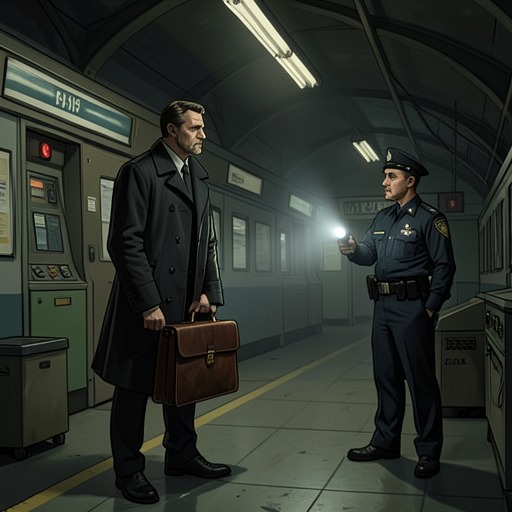
The briefcase was given to Rong Jinzhen by a director on returning from a trip overseas. Made of fine calfskin, it was described as delicate and lightweight rather than as a heavy or conspicuous piece of luggage. A wide elastic strap allowed it to be carried in the hand or looped around the waist, making it close to the body and, in the narrator’s description, almost an extension of clothing.
That portability suited Rong Jinzhen’s habitual relationship with his notebook. He carried the notebook everywhere because he feared that fleeting inspirations would vanish if he did not write them down. Usually he kept it in the top left pocket of his clothes. On this journey, however, he also had official credentials and papers to carry, so he placed the notebook in the leather briefcase with them. The case therefore began as a practical accommodation to the demands of travel, not as a container selected specifically to secure the notebook.
The Notebook Inside
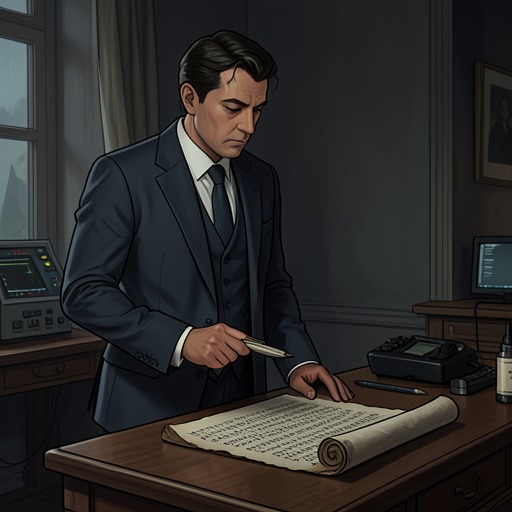
The object’s importance comes chiefly from what it held. The notebook was a 64-page blue leather volume, with a top-secret number and Rong Jinzhen’s personal serial number on its title page. Its pages gathered notes and scribblings from the years in which he worked on BLACK. The combination of identifying information and private working material made it more than a casual journal: it connected his individual thought to secret work.
Rong Jinzhen had regarded the notebook as something that would always be with him. Its usual place in his top left pocket made that assumption tangible; it was carried as constantly as a shadow. Transferring it into the briefcase altered that arrangement without apparently altering his confidence that the notebook remained safe. The case’s ease of use thus concealed a change in the notebook’s protection: the two were together, but no longer directly on his person.
Disappearance on the Train
During the journey, the next stop was A City. Rong Jinzhen had fallen back asleep when the train’s whistle and increasing clatter woke him. Moonlight entered the cabin, and its shifting shadows drew his attention to the wall hook where the briefcase had been hanging. It was gone. He searched his berth, the floor, the tea table, and under his pillow, but could not find it.
After he roused Vasili and the professor, the professor recalled seeing a young man in military plain clothes on the connecting platform about an hour earlier. The man had been leaning against a doorframe and smoking; when the professor later left the lavatory, the young man had disappeared. The professor had noticed that he was holding a case much like Rong Jinzhen’s, but at the time had not paid close attention to it. His recollection offered a plausible lead, not a confirmed identification.
Rong Jinzhen concluded that the man was most likely the thief. In his reconstruction, the apparent pause on the platform had concealed a choice of target, and the professor’s trip to the lavatory provided an opportunity to take the case. The briefcase’s familiar, everyday appearance had not protected it; while it hung in the cabin, it could be removed during a brief interval when attention was elsewhere. Rong Jinzhen could only laugh bitterly as he considered how the opportunity had been used.
Negligence or Concealment
The later account weighs the lost case against the notebook’s value. If the notebook was Rong Jinzhen’s most precious and sacred possession, a safety-deposit box would seem the proper place to keep it. Putting it in an unsecured leather briefcase could therefore be read as a moment of negligence. The mismatch is stark: a notebook containing sensitive material had been placed in a container that was convenient to carry, but not described as secure.
Yet the same mismatch supports a contrary hypothesis. If the thief had been an enemy agent tasked with taking the notebook, such an agent might have expected an item of its importance to be locked away and might have searched for it in a safety-deposit box. On that reasoning, placing it in the briefcase could have kept it away from the expected target. The narrator then considers a more deliberate possibility: perhaps Rong Jinzhen had chosen the briefcase as part of a special operation, using the notebook as bait for a trap. The account does not establish that this was his intention. Instead, the briefcase remains suspended between a practical travel bag, the site of a consequential loss, and a possible element in a strategic design.