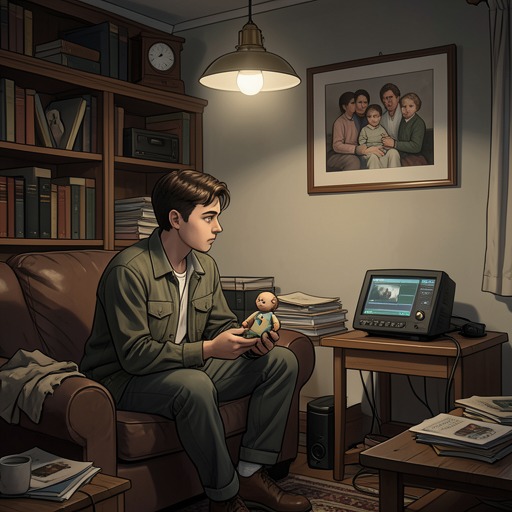
Mr Auslander's Last Letter to Young Lillie
DecodedMr Auslander's Last Letter to Young Lillie is a final appeal that turns a private bond between guardian and child into a request for family care and a future. Written as Mr Auslander faces death, it asks Young Lillie to take Duckling into his home, arguing that the boy needs love, education, and a name. Its long-delayed journey ends only after Mr Auslander has died, leaving Young Lillie to begin by asking where the child is.
Composition and Delay
Eight years after Duckling came to live with him, Mr Auslander began composing the letter as pear blossoms drifted from the trees. He planned each word carefully, writing out the lines he had formed during the day. The letter was addressed to Young Lillie, the son of Old Lillie, who was then at the provincial capital. Even after Mr Auslander had formulated it, it remained in a drawer for more than a year. He did not want to post it immediately: he hoped to spend more time with Duckling and acknowledged that sending the appeal might be a mistake. When he realized he had only days left, he took it out and told Duckling to mail it.
The circumstances of wartime communication extended the delay. Young Lillie had no fixed abode and moved frequently, so the letter took a couple of months to reach him. It bears the date 8 June 1944 and the place Tongzhen. By the time it arrived, the fighting around C City and N University had largely subsided, but the upheaval associated with the Nanjing puppet government had reached a point of no return. The letter’s slow passage thus separates the moment of its composition from the moment when its recipient can act on it.
The Appeal for Duckling
Mr Auslander frames the letter as a last testament, written by someone who expects to die soon and imagines that the dead might still observe whether their final instructions are obeyed. The conceit gives urgency and a touch of stern humor to a request that is also openly vulnerable. He says that his only regret is Duckling: he has been the boy’s guardian faute de mieux, but can no longer care for him. He begs Young Lillie to assume that responsibility.
The appeal proceeds through three reasons. First, Young Lillie and his father helped make Duckling’s birth possible through their bravery and generosity. Second, Duckling belongs to the Rong family: his grandmother was the person Old Lillie loved and admired above all others. Third, Mr Auslander insists on the child’s exceptional intelligence. He describes Duckling as cold and misanthropic, but says that he is as clever as his grandmother and resembles her closely in appearance. To convey the scale of the boy’s potential, the letter invokes Archimedes’ claim, “Give me a place to stand and I will move the earth.”
The request is not limited to physical guardianship. Mr Auslander urges Young Lillie to bring Duckling into his home because the child needs love and an education, and, perhaps above all, needs to be given a name. The emphasis makes the appeal about belonging as well as protection: the boy is presented both as a member of a family and as a child whose abilities require care and development. Mr Auslander closes by repeating his plea, calling it the first and last time he has ever begged anyone for anything, then signs himself “The dying R. J.”
Arrival and Consequences
Young Lillie’s response to the letter unfolds amid his own political and professional crisis. The Nanjing puppet government had offered him the chancellorship of N University, expecting his fame and the Rong family’s history with the KMT government to make him amenable. Instead, he tore up the appointment brevet publicly and declared, “We Rongs would rather die than betray our country!” His refusal cost him the prospect of official position. He had already been considering hiding in Tongzhen to avoid the government’s approaches and conflict within the university; Mr Auslander's letter hastened that departure.
When Young Lillie stepped off the paddle-steamer in Tongzhen, he was still thinking about the letter. He asked the Rong mansion’s steward about Mr Auslander and learned that he had been dead for several weeks. Young Lillie then asked where Duckling was. The steward said that the child remained at the Pear Garden, though few people saw him: he seldom came out, hardly anyone went in, and the steward could not understand what he said. The letter therefore brings Young Lillie to the place where the boy is, but its arrival cannot restore the guardian who wrote it. Its final effect in this passage is to redirect attention from the dead man’s appeal to the nearly unseen child he has entrusted to another.