Bombay
DevdasBombay is a chosen refuge in the final part of Devdas’s life: a place he has never seen, where he hopes to stay while feeling better, and where a year later he leaves a hospital leaning on Dharmadas. The city offers a temporary change of scene and some physical recovery, but not a cure or a return to family life. Its importance lies in that contrast: Devdas can travel to a new place, yet the deeper isolation he recognizes there travels with him.
Arrival and a Change of Scene
After recovering slowly from an earlier illness, Devdas sits up and asks Dharmadas to take him somewhere else. He packs his belongings, says goodbye to Chunilal, and returns to Allahabad, where he feels better. Some months later, he proposes Bombay specifically because he has never been there. His curiosity gives the move a forward-looking quality, but the text does not present it as a settled plan to return home or begin a permanent new life. It is a request for another place and another interval away.
Dharmadas agrees reluctantly, while Devdas’s excitement makes the journey possible. They arrive in May, when Bombay is not very hot. Devdas recovers somewhat after reaching the city. These details establish a limited but real change: travel has brought him to an unfamiliar destination, and his condition improves there for a time. The improvement remains partial, however, and the narrative gives no indication that the underlying illness has been overcome.
A Year of Staying and Treatment
When Dharmadas asks whether they can go home, Devdas declines. He says that he is doing well and wants to remain in Bombay longer. The exchange makes the city a temporary alternative to home, sustained by Devdas’s perception that his health has improved. It also shows Dharmadas accompanying and caring for him while himself hoping to return. Bombay is not described through a broad account of its streets or society; the setting is defined instead by their decision to stay and by Devdas’s changing physical condition.
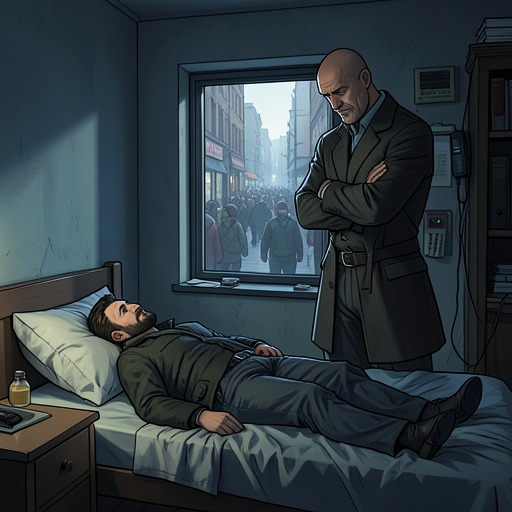
A year passes before Devdas comes out of a Bombay hospital one August morning. He is unable to leave unaided and leans on Dharmadas as he gets into a buggy. The image sharply revises the earlier promise of recovery: the man who had wanted to stay because he felt better now depends on his companion for support. His time in the city has included hospital care, but the account does not say that treatment restored his health. The transition from an improving condition to a hospital exit marks the limits of the respite Bombay had offered.
Departure and the Meaning of Bombay
As Dharmadas suggests going to Devdas’s mother, Devdas weeps. During his hospital stay, he has reflected that he has a mother, an elder brother, Parvati, who is more than a sister to him, and Chandramukhi, yet still feels that he has everyone and belongs to no one. The recollection makes the departure from Bombay more than a change of location. The city has given him time to see his relationships together, but that recognition does not enable him to return to them or feel securely held by them. Dharmadas’s presence beside him is concrete care; Devdas’s grief registers the gap between having people in his life and experiencing a place within theirs.
Bombay is not the place of Devdas’s death. In the later account, he continues to travel, and his last journey is directed toward Hatipota. After his death, two letters found in his pocket are addressed to him in Bombay: one from Dwijodas Mukherjee, saying that no more money can be sent, and another from Harimati Devi, asking how he is. The letters do not establish when Bombay was his address or how long it remained so. They do, however, retain the city as a destination for family correspondence. Bombay therefore belongs to an unfinished movement between places: it is at once a temporary refuge, the setting of a year-long stay and hospitalization, and an address that persists in the traces carried with Devdas when he is found far away.