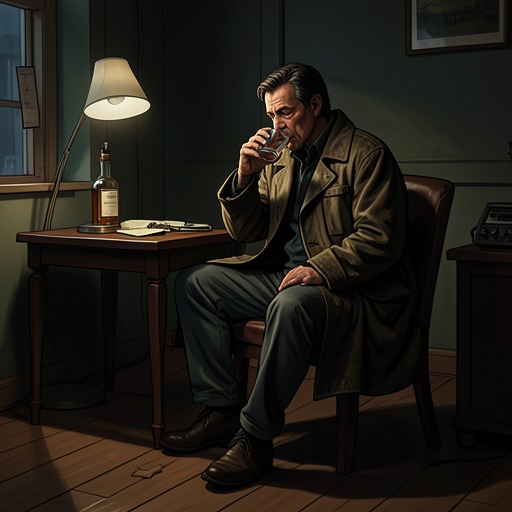
Devdas begins drinking
DevdasDevdas’s drinking becomes a form of self-destruction that also keeps him close to Chandramukhi, even as he rejects her love and declares his disgust for her. The scene in her room gives the habit a bitter logic: he says that he drinks because he is there, and that misery has made drink his companion. Later, Dharmadas’s report to Parvati shows the consequences extending into Devdas’s health, daily life, and finances.
The drinking scene
Devdas sits alone in Chandramukhi’s room with a glass, while she watches from a corner. Concerned that he has taken to drink only recently and may not be able to endure it, she asks him to stop. His answer turns the question away from endurance: drinking, he says, is not something he does in order to bear a burden; he drinks because he is there. The explanation binds the habit to the place and to the woman who occupies it. He does not present the room as a refuge he has chosen freely, but as the setting in which his drinking and his continued presence have become entangled.
His body and conduct make that dependence visible. He throws the glass against a wooden chair, where it breaks, then sinks back against the pillows. He says that he lacks the strength to get up and leave and is senseless enough to look at Chandramukhi and speak to her. Yet he insists that some part of his judgment remains: he cannot touch her and feels repelled. The scene therefore holds physical collapse beside a claim of restraint. Drinking loosens his speech and incapacitates him, but, in his account, it has not erased the boundary he insists on keeping.
Staying while rejecting her
Chandramukhi’s love makes that boundary painful rather than abstract. She wipes her eyes, and when she comes near to support his face, Devdas tells her not to touch him. He says that he hates her kind, yet will continue to come, sit, and talk because he has no choice. His words deny affection, while his repeated return and willingness to remain in her room place him in a relationship with her that he cannot simply end. Chandramukhi, who has heard versions of his reasoning before, is left to witness this contradiction rather than resolve it.
Devdas also imagines what giving up drink would mean. Although he says he never will, he adds that if he did stop, he would never come to her again. In his telling, drink is not merely a substance consumed in her room; it is the condition that permits him to keep returning while disavowing what that return might signify. He contrasts himself with visitors who come there without drinking, calling them worse sinners. His delirious anger shifts blame outward, but it also reveals how completely he has made the room part of his explanation for drinking.
Misery, performance, and humiliation
Devdas describes drink as a friend in times of trouble and says that he has taken it up out of great misery. His account does not offer a program for recovery. Instead, he treats the habit as inseparable from the sorrow that sustains it, while acknowledging that he cannot let Chandramukhi go. The resulting speech is divided against itself: he remains in her company, refuses her touch, and professes hatred even as he depends on the encounter continuing.
His comparison between love and acting extends that division into a broader image of life as performance. He likens declarations of love, tears, and changing roles to actors in costume, then describes his own life as one long act. Chandramukhi’s love, in his view, is another performance he watches rather than accepts as real. But his insistence that love is acted does not settle the matter: the scene itself shows her tending to him, and his own return keeps him within reach of the care he rejects. His speech ends in a catalogue of lost hope, faith, joy, and desire, while his conduct leaves Chandramukhi to manage the immediate consequences of his drinking.
Care and mounting consequences
After Devdas falls asleep, Chandramukhi wipes his face with her sari, changes the soaked pillow, and fans him. She remains beside him until nearly one in the morning, then extinguishes the lamp, closes the door, and leaves. These practical acts follow his refusal of intimacy without erasing his dependence on her presence. The episode ends not in reconciliation or a decision to stop drinking, but with Chandramukhi silently caring for a man who has told her not to touch him.
The harm also becomes visible beyond her room. Dharmadas tells Parvati that Devdas eats and sleeps little, stays away for days, and has spent large sums; he has heard that Devdas gave Chandramukhi jewelry worth many thousands of rupees. He warns that Devdas’s health is so poor that his days may be numbered and pleads with Parvati to intervene, since he cannot take the matter to Devdas’s parents or brother. Parvati had already encountered rumors in Manorama’s letters but had not believed them; Dharmadas’s account turns rumor into an urgent concern. The event thus connects Devdas’s private drinking to absence, depleted money, worsening health, and the distress of people who fear what may happen next. Its defining contradiction remains: he treats drink as both the reason he stays with Chandramukhi and the means by which he avoids confronting what that attachment requires.