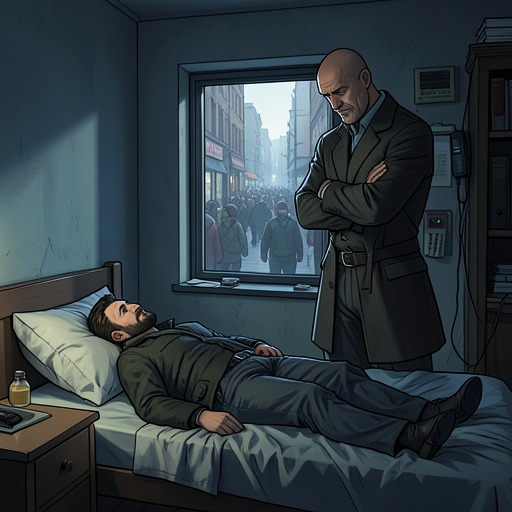
Parvati learns of Devdas’s death
DevdasParvati’s recognition of Devdas Mukherjee’s death comes only after the village has identified his corpse and removed it. When she finally understands that the dead traveler is the man she has loved, she runs toward him, but she cannot reach him: he is gone. The episode makes recognition arrive too late to become reunion, and leaves Parvati with an unanswered question about whether Devdas came to her in the night.
The news reaches Parvati
The news has circulated since morning, but Parvati has not been able to concentrate on it for long enough to take it in. As the village talks about little else, she calls a maid to her room just before dusk and asks what has happened. The maid can offer no name: the traveler had arrived to die there, she says, and had lain in damp and cold since the previous night before dying around nine in the morning. The delay matters. The death is already public knowledge, but for Parvati it is still an indistinct report, detached from the person whose loss it describes.
She asks whether anyone has identified the dead man. The maid says that Mahendra knows more, and Parvati sends for him. His answer changes the meaning of the whole day: the dead man is Devdas Mukherjee, from her village. Parvati steps close and questions how he can know. The ensuing exchange becomes a process of recognition, with each physical or documentary clue connecting the stranger’s corpse to a particular shared past.
Clues that establish his identity
Mahendra explains that two letters were found in Devdas’s pocket. One came from Dwijodas Mukherjee, Devdas’s elder brother; the other came from Harimati Devi, his mother, who was in Varanasi. Parvati already knows who each sender is. The letters establish the dead man’s family identity, but her immediate answers also show how completely she understands the people and history behind them. The report is no longer about an unknown traveler.
The remaining clues make recognition intimate rather than merely official. Devdas’s initial was tattooed on his wrist, a mark Parvati connects to his first trip to Calcutta. Mahendra also describes a ring set with a blue stone. Parvati knows that Devdas’s uncle gave it to him at his thread ceremony. A mark, a keepsake, and family correspondence converge: each item gives the absent man a distinct history, while confirming that the person to whom that history belongs is dead. The scene makes the confirmation cumulative. Parvati does not receive one abstract announcement and accept it; the details successively remove the possibility that Mahendra has mistaken someone else for Devdas.
The attempt to reach him
Once the clues have settled the matter, Parvati says she must go and dashes downstairs. Mahendra calls after her to ask where she is going. She answers that she is going to Devdas. Her movement is immediate, but the possibility of seeing him has already closed: Mahendra tells her that Devdas is no longer there and that they have taken him away. The interval between death and recognition becomes the decisive obstacle. Parvati can identify Devdas only after his body has been removed from the place where it lay.
She sobs as she runs and appeals to God for help. Mahendra moves forward to block her way and asks where she can go now. The episode thus sets her urgent purpose against the practical fact that there is nowhere left to reach Devdas: the body has been taken, and the information that would have let her identify him arrived too late. Her attempt is not a journey that can alter the outcome, but a physical refusal to remain still once the report has become personal.
Collapse and aftermath
Mahendra’s intervention is followed by the household’s effort to contain the crisis. The maids and servants gather around Parvati when she faints, catch her, and carry her back inside. She regains consciousness the next day, but does not speak about what happened. Instead, she calls one maid and asks whether Devdas came in the night, adding that he had been there all night. The question does not undo the discovery or establish that he actually returned. It leaves the ending suspended between the confirmed death and Parvati’s insistence on, or hope for, a presence she can no longer verify.
After asking, Parvati falls silent. The narrator then admits having no idea what became of her over the years and not wanting to find out. This shift from the closed scene to the narrator’s later uncertainty gives the episode a final consequence beyond the household’s immediate response: Parvati’s future remains unknown, while the memory of her last question is preserved. The story’s closing appeal asks readers to pray that a hapless person such as Devdas might not suffer the same kind of death, and insists that, at the final moment, a loving touch, a caring face, or a tear of remembrance should be present. Set against that appeal, Parvati’s failed rush carries a precise force. She has recognized Devdas, but cannot offer him the farewell or touch the narrator describes as the human dignity death should not erase.