Parvati’s marriage to Bhuvan Chowdhury
DevdasParvati’s marriage to Bhuvan Chowdhury is the decisive separation between her and Devdas: a match arranged under the pressure of money and social custom that moves her from the home where she and Devdas grew up into a new household, where she must become a wife and stepmother. Its quiet ceremony contrasts with the scale of the change. Parvati leaves at night; Devdas, far away in Calcutta, spends that night alone in Eden Gardens, beginning to comprehend that the familiar claim he felt upon her has ended.
Background and Arrangement
Parvati’s family was not wealthy, but her beauty was considered an advantage in securing her future. The marriage economy also shaped the family’s calculations: in their community, a bride-price was customarily received for a daughter’s marriage, while a family paid for a son’s. Nilkantha Chakravarty rejected the idea of selling his daughter, even though his own father had accepted a bride-price for a daughter’s marriage. The custom nevertheless forms part of the material setting in which Parvati’s marriage is arranged.
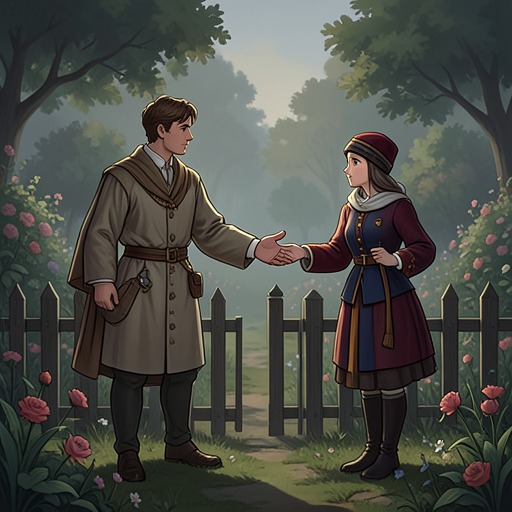
Parvati’s mother had hoped that her daughter might marry Devdas. Their intimacy from childhood seemed to her to offer grounds for that hope: Parvati had cried when he left for Calcutta as a child, and a letter from him could make her happy. Parvati’s grandmother tested the possibility with Devdas’s mother, who answered that the children had grown up like brother and sister. The exchange reveals how differently the families understood a closeness that Parvati’s mother had imagined as the beginning of a marriage.
That possibility gave way to an arrangement made by Nilkantha. He returned one night having fixed a match with Bhuvan Chowdhury, the wealthy zamindar of Hatipota, about twenty miles away in the Burdwan district. Bhuvan had been widowed the previous year and wanted to marry again. The initial report described him as below forty; at the wedding, however, he appeared well above forty. Most of Parvati’s household were unhappy with the match, but the prospect that two or three thousand rupees would come from Bhuvan left the women silent. The marriage therefore joins personal displacement to a financial calculation, even as Nilkantha’s stated aversion to treating his daughter as a commodity complicates any simple account of his motives.
When Devdas’s mother told him that Parvati was to marry, he asked when. His brief response marks the news as a turning point, but the arrangement proceeds without him: the families’ decision has already converted the possibility of a match between the childhood companions into a separation.
Ceremony and Departure
Parvati had sustained a cut to her head shortly before the wedding. She told those around her that she had slipped on the steps and struck her head on the bricks; the wound was not deep and healed within a week. Nearly ten days later, Bhuvan arrived at the Chakravarty home dressed for the ceremony. It was deliberately simple, appropriate to a second marriage and not staged as a public spectacle.
The groom’s appearance made the difference between the earlier report and the man at the ceremony unmistakable. He was described as stout and older, with a salt-and-pepper moustache and a receding hairline. Some onlookers laughed privately, while others kept silent; the women did not fall into their customary teasing, and Bhuvan took his place at the wedding mandap with an apologetic air. The ceremony was overseen by two fathers in contrasting roles: Nilkantha hurried about supervising the arrangements, somewhat unsettled by his middle-aged son-in-law, while Narayan Mukherjee hosted and ensured that the proceedings encountered no hitch.
When the bride and groom were brought face to face, Parvati looked steadily at Bhuvan with a small smile. He lowered his eyes in conspicuous modesty, and the women of the neighbourhood broke into giggles. The moment gives Parvati a composed presence within a marriage she did not choose in the way her mother had once hoped she might choose Devdas. The ceremony concludes peacefully, but its outward ease does not erase the family’s earlier reluctance or the financial circumstances surrounding the match.
The next morning Bhuvan handed Nilkantha a box of ornaments, and the jewels were soon glittering on Parvati. Her mother quietly wiped away her tears; Bhuvan’s wife, standing nearby, gently urged her not to spoil the day by crying. The ornaments make visible the new household’s wealth and the exchange accompanying the marriage, while the mother’s tears register the cost of sending her daughter away. Later, Manorama comforted Parvati and wished her happiness in the years ahead. Before leaving, Parvati said she wanted to touch Devdas’s feet for the last time. She and Manorama embraced and wept together, after which Parvati’s grandmother called them outside. That night Parvati left for her husband’s house.
Life in Bhuvan’s Household
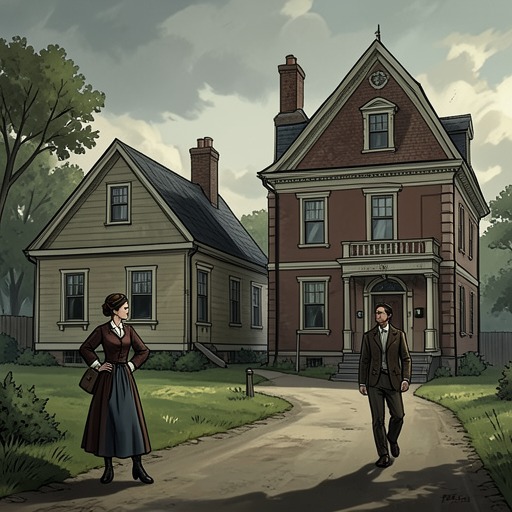
Bhuvan’s home at Hatipota was a vast mansion built on old wealth, with outer courtyards, inner chambers, worship rooms, reception rooms, guest apartments, offices, and many servants. Parvati had known that her husband was rich, but not the scale of the estate. Its abundance was matched by a striking lack of family members: the inner rooms seemed empty, and apart from an old aunt who welcomed her, the household initially presented itself to the new bride chiefly through its staff. Parvati was immediately declared its lady of the house.
Her new position became concrete when a handsome young man of about twenty approached and touched her feet, identifying himself as her eldest son. He repeated his request for her blessing, and Parvati raised her veil to her brow and invited him nearer. The young man, Mahendra, explained that the family had lost its mother two years earlier and that the intervening period had been difficult. His appeal was not merely a formal welcome: he hoped Parvati’s arrival would restore happiness to the household. Parvati answered without hesitation, asking after the rest of her children. The rapid shift from young bride to maternal authority shows how marriage places her inside an already established family, with obligations extending beyond her husband.
Mahendra told her that his younger sister, Yashoda, was at her husband’s home and had not come despite his earlier letter. Parvati later asked Mahendra to fetch her. When he hesitated, knowing Yashoda would refuse, Parvati persisted in bringing her eldest daughter home. Mahendra went alone and returned four days later with Yashoda, whose prepared accusations and anger fell away when she saw Parvati adorned in the jewels Bhuvan had recently obtained from Calcutta.
Parvati took Yashoda by the hand into her room, sat her down, and fanned her while asking whether she was angry with her daughter. Then she began removing her own ornaments one by one and placing them on Yashoda. This intimate welcome turns the marriage’s visible wealth into a means of creating kinship: Parvati does not merely occupy the title of stepmother but reaches toward the daughter who has reason to resent her arrival.
Separation and Significance
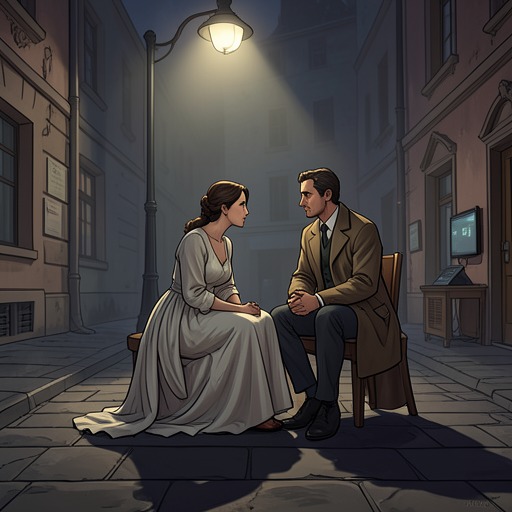
Parvati’s departure also marks a decisive change for Devdas. On the night she left, he spent the night on a bench in Eden Gardens. The narration describes his dawning realization through the image of a limb that has become paralyzed and no longer answers its owner’s call. He comes to understand that Parvati is no longer his to summon, and that neither anger nor protest can restore the former claim. The juxtaposition is sharp: Parvati crosses the threshold into a crowded network of new family duties, while Devdas confronts his loss alone in a public garden.
The marriage is therefore more than a romantic obstacle. The match is shaped by the custom of bride-price, the expected transfer of money, and the authority of families to arrange a daughter’s future. Yet the account also distinguishes economic pressure from a simple sale: Nilkantha disavows the practice of selling Parvati even as her family accepts a match whose expected payment helps silence its doubts. Once married, Parvati’s response is neither presented as a return to the unrealized childhood match nor reduced to passive entry into Bhuvan’s estate. She assumes responsibility for the household and makes a deliberate effort to welcome Yashoda. The event closes one possible future with Devdas and begins another, in which Parvati’s place is defined by the care and authority she builds within her husband’s family.