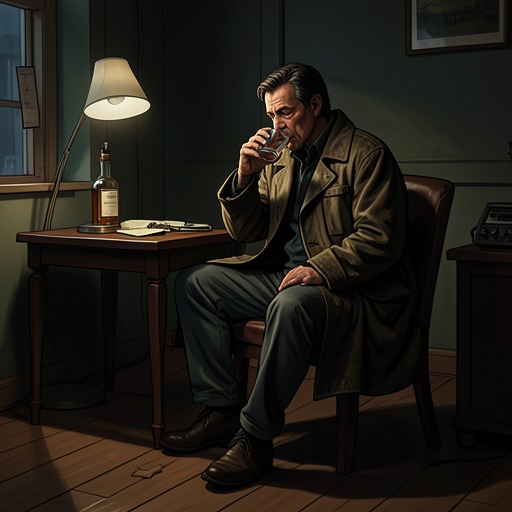
Devdas begins drinking heavily
DevdasDevdas Mukherjee’s descent into heavy drinking turns misery into a routine he insists he cannot surrender. In Chandramukhi’s room, the bottle offers him a reason to stay while also helping him avoid confronting what keeps him there; later, Dharmadas describes the bodily, financial, and social damage that has become impossible to conceal.
Background and Emerging Pattern
The evidence presents Devdas’s drinking as recent, but already consequential. Chandramukhi warns that he has taken to drink only lately and may not be able to bear it. Her concern makes the speed of the change plain: this is not described as an old habit whose effects have gradually become familiar, but as a new dependency whose danger is apparent to someone watching him closely.
The scene begins with Chunilal having held the ladder for Devdas’s descent into murky depths before quietly moving away. Devdas is then alone in Chandramukhi’s room, while she sits apart and watches him wretchedly. The movement from Chunilal’s assistance to Chandramukhi’s solitary, worried vigil gives the drinking episode a marked transition: the immediate company has withdrawn, but the consequences of Devdas’s descent remain present in the room.
Drinking as Refuge and Entrapment
When Chandramukhi urges him to stop, Devdas puts down his glass, frowns, and asks why. He does not claim that alcohol helps him endure suffering. Instead, he explains that he drinks because he is there. The distinction makes the bottle less a remedy than part of a larger refusal or inability to leave: his presence in the room, his drinking, and his misery have become bound together.
That dependence is expressed not as calm resolve but as incapacity. Devdas says he lacks the strength to get up and go, and describes himself as senseless enough to look at Chandramukhi and talk to her. Yet he also insists that some sense remains, and that he cannot touch her because he feels repulsed. The statement makes his condition sharply divided: he presents himself as too impaired to leave, while still claiming enough awareness to enforce a boundary. His words do not make that boundary a simple rejection of Chandramukhi; they show how drinking lets him remain near her while voicing hostility and distance.
Chandramukhi’s Concern and Devdas’s Contradiction
Chandramukhi answers that many visitors to her room never touch alcohol. Devdas reacts with sudden anger, widening his eyes, sitting up, and flailing his arms as he imagines shooting them if he had a gun. He calls those abstaining visitors worse sinners than himself. The outburst turns her practical comparison into an accusation against others, as though their restraint exposes his own drinking rather than excusing it.
He then imagines a future in which he gives up drinking, immediately qualifies the possibility by saying he never will, and claims that sobriety would mean he would never return to her room. He says he may yet be saved, but asks what would become of the others. In the same breath, he names misery as the reason he began drinking and calls drink a friend in times of trouble, before insisting that he can never let Chandramukhi go. His account therefore links the habit to emotional suffering and to his attachment to the room, but also uses that attachment to rationalize continuing. The possibility of recovery is raised only to be shut down, while his concern for other drinkers sits uneasily beside his declaration that he will not stop.
When Chandramukhi comes close and holds up his face, Devdas tells her not to touch him, again claiming that he has not entirely lost his senses. He says he hates her kind but will keep coming, sitting, and talking because he has no choice. He contrasts people who sin under cover of darkness with his own use of the room to drown his sorrows in drink, presenting the setting as especially suited to his self-destructive purpose. His contempt for Chandramukhi’s world thus coexists with dependence on her company: he declares disgust, refuses intimacy, and nevertheless says he will return.
Consequences and Disclosure
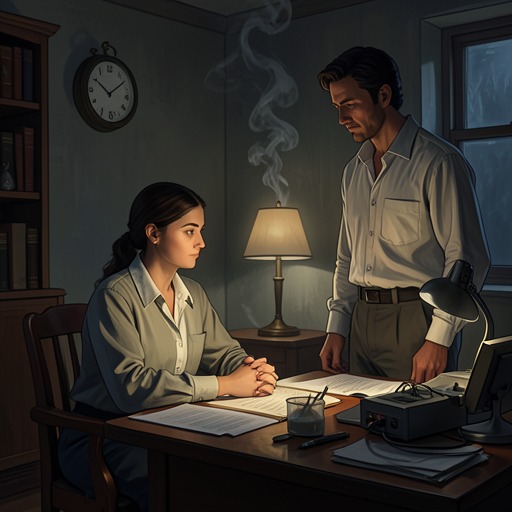
The later report to Parvati Chakravarty gives the private scene a wider measure of damage. Dharmadas says that Devdas takes no food, gets no sleep, lives for the bottle, and stays away for days at a time. He has also heard that Devdas has given Chandramukhi jewellery worth many thousands of rupees. These details extend the harm beyond an anguished conversation: drinking now accompanies physical neglect, prolonged absences, and the loss of substantial money through gifts.
Dharmadas fears that Devdas’s health is so poor that his days are numbered, and says he has no one to whom he can safely speak about the matter—not Devdas’s parents or his brother. His despair makes the drinking a crisis concealed within family life as well as a visible habit in Chandramukhi’s room. Parvati has already heard rumours through Manorama’s letters, but had not believed them. After Dharmadas confirms the situation, she resolves to speak to Devdas. The episode’s significance lies in that contrast: Devdas describes drinking as a refuge he will not relinquish, while those around him see an accelerating collapse and begin looking for a way to intervene.