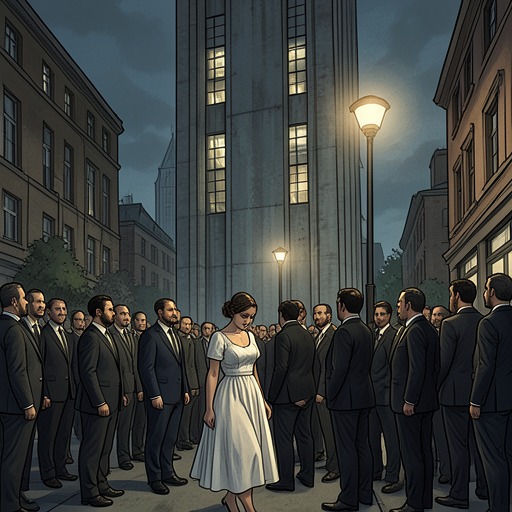
Parvati travels to find Devdas and bring him home
DevdasParvati Chakravarty’s journey to Talshonapur is an attempt to turn enduring attachment into practical care: she goes not merely to see Devdas Mukherjee, but to bring him home. The effort fails because he has left for Calcutta before she arrives, making the journey a missed encounter. Yet her candid explanation to Manorama gives it a force beyond its immediate outcome. Parvati treats Devdas’s abandonment and decline as reasons to act, not reasons to withdraw, and rejects the idea that social distance makes her concern improper.
News of Devdas’s Decline
The journey follows a letter that has reached Parvati from Manorama. Its account describes Devdas’s increasingly precarious life: his mother has moved to Varanasi, while he lives in Calcutta and returns to Talshonapur to quarrel with his brother and obtain money. According to the letter, he stays only as long as it takes to secure funds, then leaves again. His visits have become recurrent, but they offer no sign that he is settling into a stable home or accepting help.
The letter also gives Parvati grounds to understand the danger as more than a passing crisis. Two and a half years have passed since his father’s death, and Devdas has already spent half his inheritance. His brother, Dwijodas, has been careful with the estate; without that restraint, Manorama believes the money might have been squandered. She reports that Devdas is drinking heavily and that his health and appearance have deteriorated. Her account is not simply an update about where he is: it presents a pattern of repeated returns for money, renewed departure, and worsening condition. Parvati receives this news and responds by arranging to go after him.
Parvati’s Decision and Preparations
The day after the letter arrives, Parvati calls for two palanquins and thirty-two bearers and says she wants to leave for Talshonapur at once. Her eldest son, Mahendra, asks why she requires two palanquins. Parvati answers by explaining that he must accompany her: if she dies during the journey, she will need her eldest son to perform her last rites. The statement makes the expedition’s urgency plain while also showing that she has considered its physical risks. She does not present the trip as a casual visit or wait for others to decide whether it is suitable.
Mahendra does not challenge her further. The palanquins are brought, and mother and son set out. When Bhuvan Babu learns of their departure, he questions the household’s maids and servants, but none can explain the reason. He sends five additional guards and servants after them. One asks whether they should turn the party back if they catch up with it; Bhuvan Babu says they should not interfere, but should accompany the travelers and ensure they arrive safely. The response allows Parvati to continue while adding protection to the journey, without pretending that her purpose has been explained or approved by the household.
The Missed Encounter
The palanquins reach Talshonapur shortly after dusk. Devdas is not there: he left for Calcutta at noon that same day. Parvati strikes her brow in distress and blames her fate, but the practical result is unmistakable. She has crossed the distance to find him only to learn that he has already gone in the opposite direction. The timing reduces the attempted reunion to a near miss, with no meeting between them to alter his course or bring him home.
Parvati does meet Manorama, who asks whether she has come to see Devdas. Parvati clarifies that seeing him is not her object: she has come to take him home because no one there is caring for him. Manorama responds by raising the question of shame, pointing out that Parvati and Devdas are not related. Parvati rejects that objection and describes taking him back as reclaiming what is rightfully hers. Her reply does not erase the social fact Manorama names; it shows that Parvati refuses to let that fact define the limits of her responsibility. The scene makes her purpose explicit just as Devdas’s absence makes it impossible to carry out.
Significance and Aftermath
The journey reverses the familiar direction of helpless waiting. In the past, Devdas’s rejection and delayed recognition helped leave Parvati’s marriage arranged elsewhere; now Parvati takes the initiative, summons the means of travel, and goes to retrieve him. Her actions fit the novel’s larger contrast between her decisiveness and Devdas’s repeated departures and inaction. The letter supplies the immediate cause, but her own explanation supplies the deeper claim: she sees a person without care and acts, even though their relationship gives her no accepted social standing from which to do so.
The attempt nevertheless cannot repair their separation. Devdas has left before Parvati arrives, and the encounter with Manorama cannot substitute for finding him. Later, the novel brings Devdas to the vicinity of Parvati’s household in a far worse condition: he is found at dawn beneath a tree, unable to speak, while those gathered there recognize that he is dying. That later arrival gives the failed journey a painful reversal. When Parvati goes to Talshonapur, she reaches the place too late to meet him; when Devdas eventually reaches her household, he cannot call out to her. The journey therefore stands as an act of care whose intention is unmistakable but whose timing cannot overcome the pattern of missed meetings that shapes their relationship.