Chandramukhi returns to Calcutta to search for Devdas
DevdasChandramukhi returns to Calcutta to search for Devdas Mukherjee after six months without news of him. The journey pulls her away from a village where she has become a provider and a figure of refuge, and into a lonely vigil in the city. Her search finally succeeds by chance: she recognizes Devdas by his voice when she finds him lying drunk in the street. The reunion does not resolve their past, but brings her into the role of nursing him through a dangerous illness.
The Search Begins in the Village
By the time Chandramukhi decides to look for Devdas Mukherjee, her concern has become prolonged uncertainty. Her letters have gone unanswered, and registered letters have been returned undelivered. She has no reliable news of where he is, only the absence itself. Meanwhile, she has built a life in the village: she helped a milkman’s family establish a home near her hut, paid their son’s dowry, and bought farm implements for them. The family depends on her, and their loyalty is evident when she asks the milkman, Bhairav, how far Talshonapur is and whether the landlord’s family lives there.
Bhairav explains that the estate lies beyond two meadows and that the old landlord died three years earlier, leaving his two rich sons to run it. Chandramukhi asks Bhairav to take her there, then insists on setting out that very day. The visit is brief: she returns home that night. The next morning she announces a more consequential departure, telling Bhairav that she is going to Calcutta and will take his son, Kebla, with her because Bhairav cannot accompany her. She calls the journey urgent but does not explain its purpose in detail.
Leaving the People Who Need Her
Bhairav protests that if she does not return, the villagers will die. Chandramukhi answers that she has been among them for only two years and that they lived before she arrived. Yet she recognizes some truth in his plea. The villagers have gathered around her not merely as a benefactor but as someone whose presence has become part of their daily security. Earlier, they had knelt and asked her to pray for good rain; when crops disappointed or taxes pressed them, they came back, and she gave what she could.
As she loads her possessions onto the cart, the villagers assemble to see her off and weep bitterly. Chandramukhi also cries. The scene makes the cost of the search concrete: she is leaving a community that has given her affection and purpose, not escaping an unwanted life. The thought that, without Devdas, she would never have abandoned so much love gives the departure its force. She arrives in Calcutta the following day, accompanied by Kebla; the village’s dependence on her is now set against her determination to seek one absent man.
Rebuilding a Base for the Vigil
Chandramukhi finds that other people occupy her former home in Calcutta. Her old neighbour, Khetramani, is surprised to see her, and Chandramukhi conceals the truth of her absence by saying she has been in Allahabad. She then approaches Dayal with a practical request: in return for a few days’ work, he is to rent a suitable place nearby. She specifies a furnished room with a good bed and clean sheets, lights, paintings, two chairs, and a desk. The precise arrangements matter because she is not passing through the city; she is setting up a place from which she can search and wait.
Once settled, she sits by the window and watches the street, as she had done years before. Newcomers push at the door, but Kebla turns them away with the same refusal each time. Chandramukhi welcomes old acquaintances, speaks with them, and asks whether they know Devdas; when they have no news, she ends the visits. In the afternoons she goes to see former friends and describes the man she is seeking: fair, with a head of curls, a mark on his left brow, and great wealth. No one recognizes that description. Each failed inquiry sends her home disappointed, but she continues to stay awake late and watch from the window, even as a month passes and Kebla grows restless.
Her search extends beyond formal visits. At night she walks from house to house, listening for news, but never hears the name she wants. A covered-faced stranger sometimes reaches for her, and she has to move away quickly. These encounters underscore the exposure of her search in the city: she is looking for Devdas amid streets and people she cannot control, while repeatedly refusing the advances that approach her. She keeps to the same purpose, praying fervently and taking each day as it comes, despite beginning to wonder whether Devdas is in Calcutta at all.
Recognition and Care
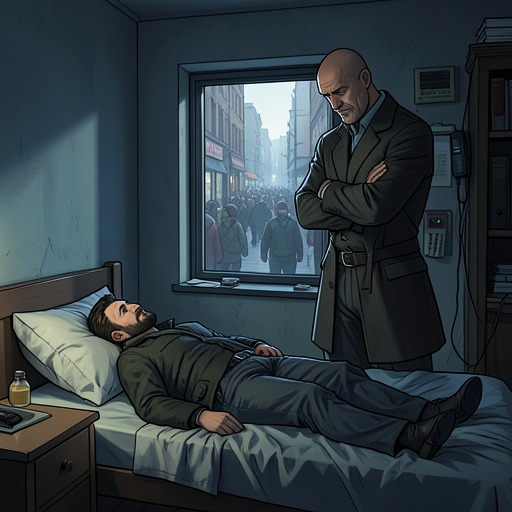
Nearly a month and a half after reaching Calcutta, Chandramukhi is returning home disconsolately at about eleven at night when she notices a man sitting by the roadside in front of a house, muttering to himself. He is lying face down and dead drunk. The darkness obscures him, but not his voice: Chandramukhi recognizes it, approaches, and shakes him lightly. When she calls Devdas by name, he answers without moving. Recognition comes through sound before she can properly see him, a moment that turns the long, fruitless search into an immediate obligation.
Chandramukhi asks whether he will go home and takes him back in a buggy, with Devdas leaning against her throughout the journey. At the door, he searches his pocket and warns her that he has no money, mistaking her help for a transaction. She quietly takes him by the hands, leads him into the bedroom, and puts him on the bed. Her response is direct and practical: she tells him to sleep rather than argue with his drunken suspicions.
The encounter leads quickly to medical alarm. When Chandramukhi fears that drink has ruined him and asks whether his liver is infected, Devdas accepts that it may be. A doctor examines him at length, prescribes medicine, and warns that without the utmost care his condition could become fatal. Word is sent home, Dharmadas arrives, and money is drawn from the bank for treatment. After two days that pass smoothly, Devdas develops a fever. He tells Chandramukhi that she has arrived at the right moment, since otherwise she might never have seen him again. She wipes away her tears and tends to him earnestly, praying that he will recover. He remains bedridden for nearly a month before slowly improving and the illness is contained. The search thus ends not with a declaration or a settled future, but with Chandramukhi present at the point when Devdas’s life is in immediate danger.